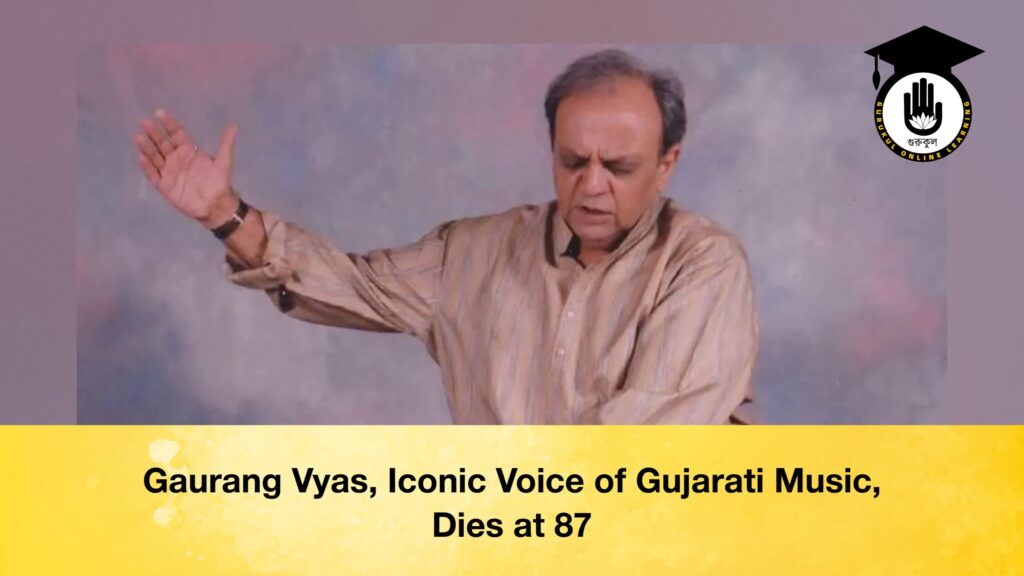
Renowned Gujarati composer, singer and music arranger Gaurang Vyas has died at the age of 87. Vyas passed away in Ahmedabad on the night of 2 September, leaving behind a career spanning several decades and a substantial body of work across Gujarati cinema, folk music, devotional music and traditional musical forms.
His death has prompted tributes from across the cultural sphere, including Indian Prime Minister Narendra Modi, who remembered the veteran musician’s contribution to Gujarati music and expressed condolences to his family and admirers.
Vyas was the son of the celebrated composer and Padma Shri recipient Avinash Vyas, one of the most influential figures in Gujarati music. Although he was born into a prominent musical family, Gaurang Vyas established an identity of his own through his compositions, performances and long association with Gujarati cinema and regional musical traditions.
His relationship with music began at a remarkably young age. At just five, he learnt to play ‘Vaishnav Jan’ on the harmonium, marking the beginning of a musical journey that would eventually span many decades.
Music was not, however, his first profession. Vyas initially worked in engineering and was employed by an established organisation. His growing attachment to music eventually led him to leave his job and devote himself entirely to the field. That decision marked a decisive turning point in his career.
Vyas entered Gujarati cinema professionally as an assistant to his father on the film Jesal Toral. He later emerged as an independent music director with Lakho Phulani. The film also gave him the opportunity to work with legendary playback singer Kishore Kumar on Gujarati songs.
Over the course of his career, Vyas was associated with more than 100 films. His work extended beyond cinema, covering folk and devotional music as well as traditional Gujarati forms. He was associated with the music of several notable films, including Ketan Mehta’s Bhavni Bhavai. Among his other recognised works were Maniyaro, Nasibni Balihari, Parki Thapan, Liludi Dharti and Maiyar Ma Mandu Nathi Lagtu.
His career also brought him into collaboration with some of the most respected voices in Indian music. Vyas worked with singers including Lata Mangeshkar, Asha Bhosle, Kishore Kumar, Manna Dey, Mahendra Kapoor, Suman Kalyanpur, Bhupinder Singh and Praful Dave.
Several of his compositions became particularly associated with Gujarati musical culture. Among the songs linked to his work are ‘Maniyaro Te Halu Halu Thai Re Viyo’ and ‘Hu Tu Tu Tu, Jami Ramatni Rutu’.
Vyas’ contribution was not confined to the silver screen. He also released a number of albums rooted in devotional and folk traditions. His notable releases included Jalaramni Jhopdi, Bhajan Anmol, Ganga Satina Bhajno, Kahat Kabir, Jalaram Bapanu Halaradu, Prachin Prabhatiyan and Non-Stop Dandiya-Raas. His work earned him around 11 state-level awards for best music direction during his career.
Recognition continued in his later years. In 2022, Gujarat Chief Minister Bhupendra Patel presented Vyas with a lifetime achievement honour in recognition of his contribution to music. In 2024, the Gujarat State Sangeet Akademi and the Gujarat Tourism Department also honoured his contribution.
Following Vyas’ death, Prime Minister Narendra Modi paid tribute to the veteran musician on social media, sharing a photograph with him. Modi recalled how Vyas had carried forward the rich musical legacy of his father, Avinash Vyas, while creating a distinct identity of his own within Gujarati music.
The Prime Minister also described his passing as a loss for Gujarat’s cultural and musical landscape and offered condolences to Vyas’ family and his many admirers.
For generations of Gujarati listeners, Gaurang Vyas’ work represented a connection between cinema and the region’s enduring musical traditions. His compositions reached audiences through films, devotional recordings and folk-based works, while his collaborations with leading Indian singers helped give his music a wider presence.
With his death, Gujarati music has lost a veteran whose career reflected both the strength of regional musical traditions and their ability to evolve through cinema and contemporary recordings. His extensive body of work will remain an important part of the musical legacy associated with Gujarat.