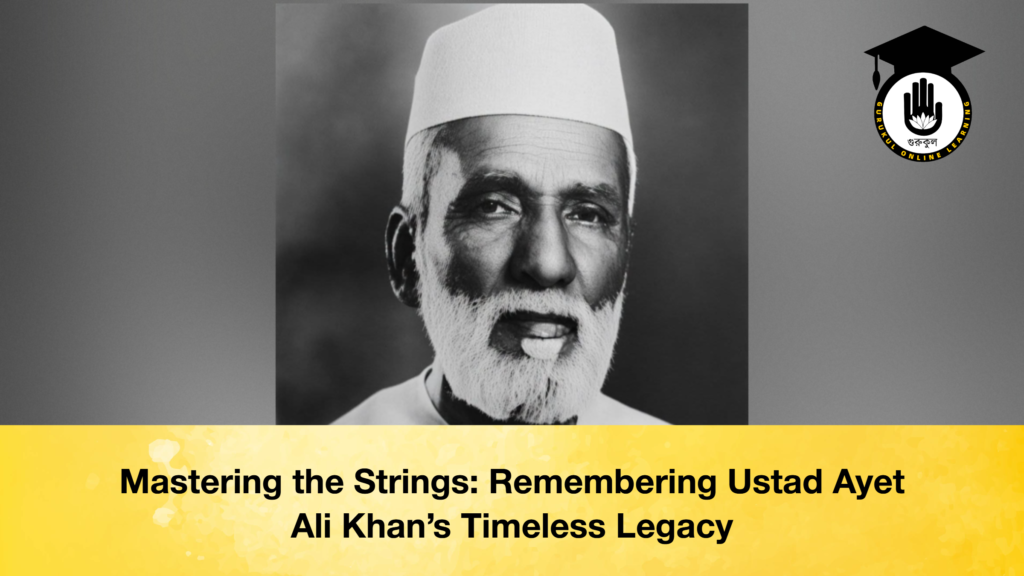
Within the grand tapestry of subcontinental classical music, certain figures transcend time, leaving behind a sonic heritage that echoes across generations. Ustad Ayet Ali Khan stands as a monumental luminary in this tradition, renowned not only as a dedicated master of classical music but also as a peerless exponent of the sitar and surbahar. Born on 26 April 1884 in the historic village of Shibpur under the Nabinagar upazila of Brahmanbaria, he emerged from a deeply artistic lineage. His father, Sabdar Hossain Khan, and mother, Sundari Begum, nurtured a household steeped in melody. He was the younger brother of the legendary maestro and ‘Surasamrat’ Ustad Alauddin Khan. Music was their birthright, yet Ayet Ali elevated this inheritance through relentless practice, intellectual rigor, and profound creativity.
His mastery spanned both vocal and instrumental domains, though his virtuosity on the sitar and surbahar earned him international renown. His performances balanced strict adherence to classical grammar with an emotional depth and stylistic innovation that captivated audiences. He refused to remain merely a traditional interpreter, choosing instead to pioneer new paths. He invented two distinct musical instruments—the ‘Monohara’ and the ‘Mantranad’—and composed several new ragas, including ‘Chandrasarang’. His artistic journey bridged royal patronage and public engagement. He served as the court musician for the princely states of Maihar and Rampur. Later, upon the invitation of Nobel laureate Rabindranath Tagore, he spent time teaching in the music department at Santiniketan, deeply enriching the cultural dialogue between Bengal and broader Indian classical traditions.
From 1951 to 1965, his regular surbahar broadcasts on Radio Pakistan carried his transcendental melodies directly into households across the region, shifting classical music from elite courts to the wider public sphere. Family life remained central to his world; he raised eleven children—Ambhiya Khanum, Ustad Abed Hossain Khan, Bahadur Hossain Khan, Mubarak Hossain Khan, Mamata Khanum, Sheikh Sadi Khan, Tansen Khan, Yasmin Khanum, Beethoven Khan, Kohinoor Khanum, and Rizia Begum—many of whom sustained the family’s musical legacy.