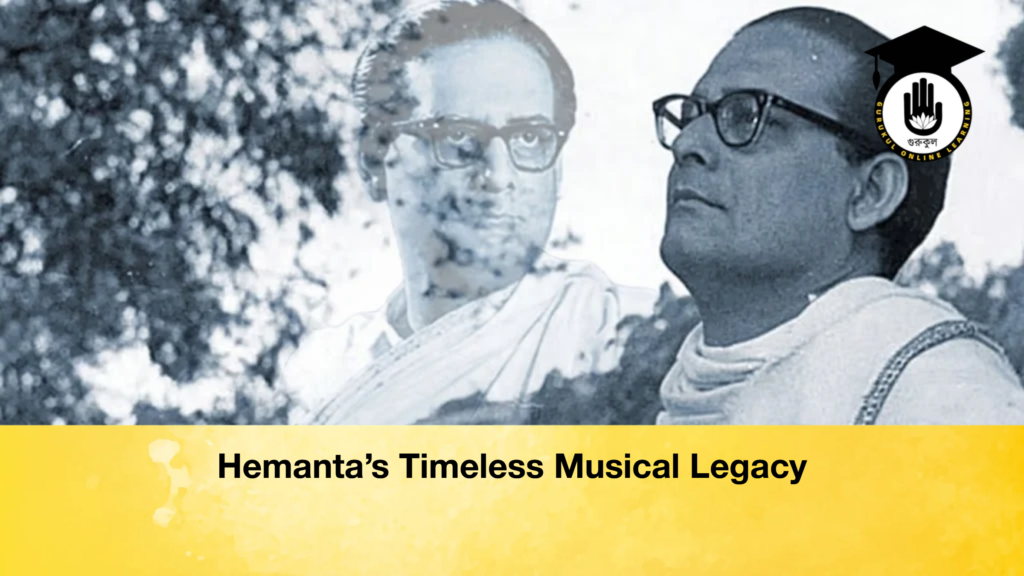
The songs “Tumi Ele, Onek Diner Pore,” “Neer Chhoto Kshati Nei,” “Ei Raat Tomar Amar,” “Ei Poth Jodi Na Shesh Hoy,” and “Muche Jawa Dinguli” remain deeply embedded in the collective memory of Bengali music listeners. Across generations, these compositions have not faded; rather, they have continued to resonate, transitioning seamlessly from gramophones and radio to cassettes, compact discs, and now digital streaming platforms. At the centre of this enduring musical journey stands Hemanta Mukhopadhyay—a figure whose voice has become inseparable from the emotional fabric of Bengali life.
His songs have long articulated unspoken emotions—romantic longing, quiet heartbreak, middle-class nostalgia, and solitude. In Bangladesh and across Bengal, his presence is still perceptible in everyday cultural settings: from university campuses and theatre rehearsal rooms to neighbourhood functions and quiet monsoon afternoons. Whether played in a small roadside shop or performed at a community gathering, his music continues to find relevance in diverse social spaces.
Table of Contents
Enduring Appeal Across Generations
Despite sweeping technological changes in music consumption, Hemanta Mukhopadhyay’s appeal has remained remarkably constant. His strength lay not in vocal ornamentation or technical complexity, but in a distinctive sincerity. Each performance conveyed an intimate emotional depth, allowing listeners to connect personally with his songs. This quality ensured that his music did not remain confined to a specific era but evolved into a timeless cultural asset.
On 16 June, his birth anniversary was observed, marking not merely the birth of an artist but, arguably, the emergence of a significant cultural epoch in Bengali music. Even more than a century after his birth, his legacy continues to be actively revisited. Social media platforms were recently filled with tributes, shared songs, and personal recollections. Streaming services and video platforms witnessed renewed engagement, demonstrating that his work continues to attract new audiences without reliance on formal commemorations.
Early Life and Formative Years
Hemanta Mukhopadhyay was born on 16 June 1920 in Benares (now Varanasi), before relocating with his family to Calcutta (now Kolkata). During his studies at Mitra Institution in Bhawanipur, he developed friendships with future literary figures such as Subhash Mukhopadhyay and Santosh Kumar Ghosh. At that time, however, music was not seen as his primary path. Like his peers, he initially aspired to become a writer and even had short stories published in the literary magazine Desh.
His inclination towards music developed informally. Without structured training, he learned by listening to gramophone records and practising independently. Instruments available at friends’ homes, particularly the harmonium, became his earliest tools of musical exploration. This self-directed learning played a crucial role in shaping his distinctive style.
A Defining School Incident
During his school years, an incident highlighted both his early passion for music and the resilience that would later define his career. He was reportedly expelled for singing in class, prompting protests from fellow students. His father, despite limited financial means, appealed to the authorities, leading to the revocation of the decision.
This episode had a lasting impact. Rather than fostering resentment, it instilled in him values of patience, humility, and perseverance. These traits became evident throughout his professional life, as he navigated challenges and setbacks without public complaint, focusing instead on consistent artistic output.
Key Milestones at a Glance
| Aspect | Details |
|---|---|
| Full Name | Hemanta Mukhopadhyay |
| Birth Date | 16 June 1920 |
| Birthplace | Benares (Varanasi), India |
| Primary Occupation | Playback singer, composer |
| Early Aspiration | Writer |
| Musical Training | Largely self-taught |
| Cultural Influence | Bengali and Indian music |
Legacy
Hemanta Mukhopadhyay’s journey from a middle-class upbringing in Benares to becoming one of the most influential voices in Bengali and Indian music reflects a career built on discipline and authenticity. His work continues to transcend generational boundaries, ensuring his place not merely as a historical figure but as a living presence in contemporary cultural life.