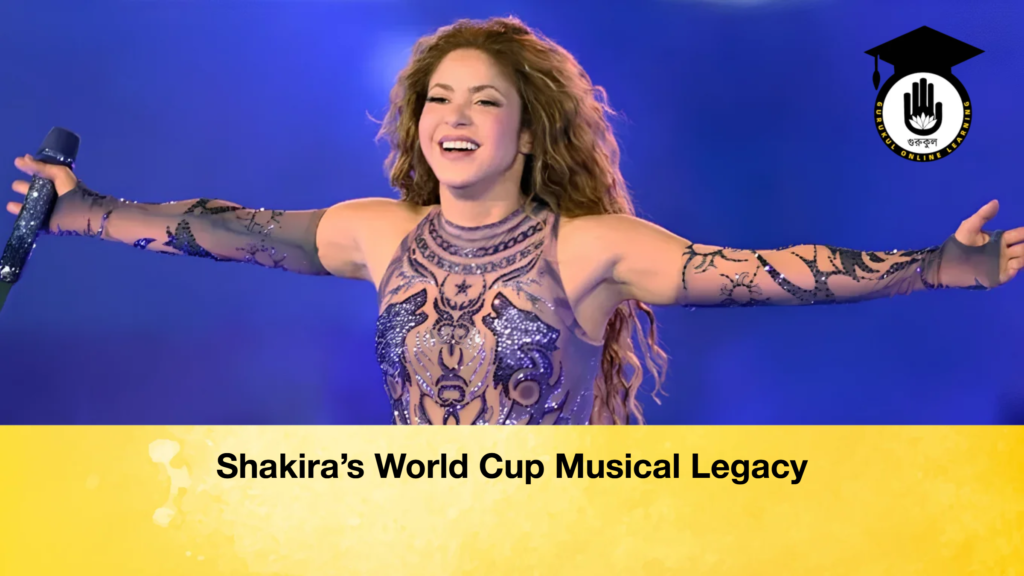
Colombian singer, songwriter and dancer Shakira is widely regarded as one of the most influential figures in global music. Over a career spanning more than three decades, she has played a central role in bringing Latin music to an international audience. Among the defining aspects of her career is her enduring association with the FIFA World Cup, particularly through a series of memorable performances and official songs.
Shakira’s connection with the World Cup became firmly established during the 2010 FIFA World Cup. The tournament’s official song, “Waka Waka (This Time for Africa)”, performed in collaboration with the South African band Freshlyground, achieved global recognition. The song was not only adopted as the tournament’s anthem but also became one of the most commercially successful sports songs in history. Its widespread popularity was reflected in strong global chart performance and millions of copies sold worldwide. Shakira’s performances at both the opening and closing ceremonies further reinforced her prominence on the World Cup stage.
Her involvement with the tournament, however, extends beyond a single edition. She has appeared across multiple World Cups in varying roles, including live performances and official recordings.
Shakira’s World Cup Involvement
| Year | Host Country | Role | Official Song |
|---|---|---|---|
| 2006 | Germany | Performed at final ceremony | Not official |
| 2010 | South Africa | Performer; official artist | “Waka Waka (This Time for Africa)” |
| 2014 | Brazil | Official artist | “La La La” |
| 2018 | Russia | Promotional/ceremonial involvement | Not official |
In the 2006 FIFA World Cup, Shakira performed during the final ceremony, marking her first significant presence at the tournament. By the 2014 FIFA World Cup, she returned with another official song, “La La La”, further consolidating her association with football’s most prominent global event. Although she did not perform an official song at the 2018 FIFA World Cup, she remained involved through promotional and ceremonial activities.
Across these appearances, Shakira contributed to at least three World Cups in major roles (2006, 2010, 2014), with two official tournament songs credited to her. Her work is often characterised by a blend of African and Latin musical influences, alongside themes of unity and sporting celebration. “Waka Waka” in particular remains one of the most viewed and commercially successful songs associated with the World Cup.
Shakira was born in 1977 in Barranquilla, Colombia, under the full name Shakira Isabel Mebarak Ripoll. She developed an early interest in poetry and songwriting, although her initial albums did not achieve major commercial success. Her breakthrough came with the 1995 album Pies Descalzos, which established her as a leading figure in Latin America. She later gained global recognition with “Whenever, Wherever” (2001), followed by one of her most successful international releases, “Hips Don’t Lie” (2006). These works contributed significantly to the integration of Latin music into mainstream global pop.
In recent developments, Shakira has again been linked with the 2026 FIFA World Cup. Reports indicate that she has released a new song titled “Dai Dai” in collaboration with Nigerian artist Burna Boy, presented as the tournament’s official theme. The track combines Afrobeat elements with Latin pop, reflecting a continued emphasis on global musical fusion and the theme of unity associated with the World Cup.
Through sustained involvement across multiple tournaments, Shakira has maintained a distinct position at the intersection of music and global sport, contributing to the cultural identity of the World Cup through widely recognised performances and recordings.