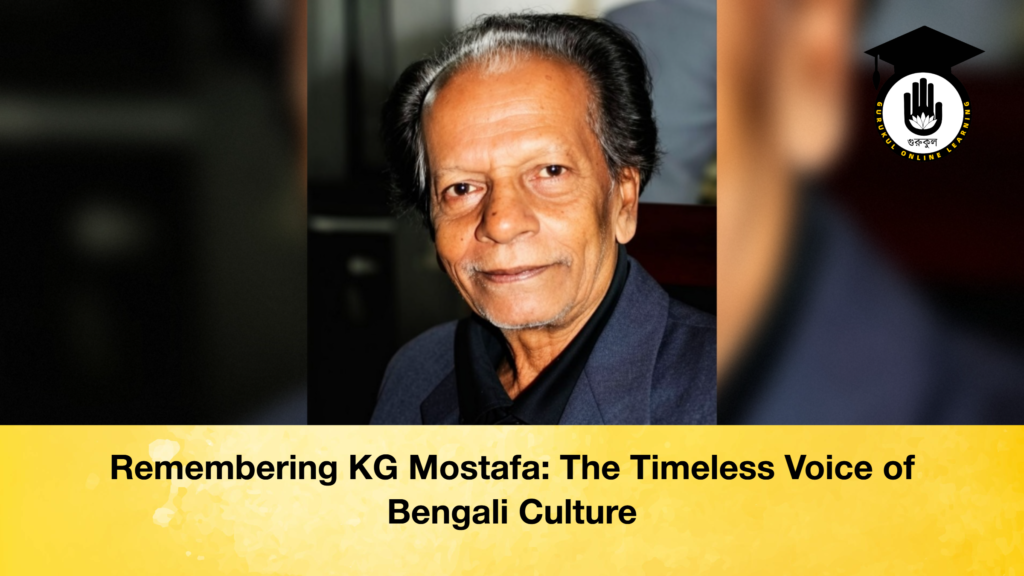
The landscape of Bengali music and journalism remains deeply indebted to the multifaceted genius of KG Mostafa. As a legendary lyricist, poet, veteran journalist, and cultural activist, Mostafa crafted a permanent sanctuary in the hearts of millions across generations. His passing on 8 May 2022 marked the end of a golden era, yet his extensive repertoire of over a thousand songs ensures his voice resonates eternally.
Table of Contents
Early Life and Literary Foundations
Born on 1 July 1937 in Begumganj within the Noakhali district, Mostafa displayed an early affinity for the written word. He pursued his academic passion at the University of Dhaka, obtaining a Master of Arts degree in Bengali Language and Literature in 1960. His university years served as a fertile ground for his poetic inclinations, with his verses regularly gracing national newspapers and literary periodicals.
A Career Forged in Journalism
Mostafa initiated his journalistic journey in 1958 as an apprentice at the Dainik Ittehad. Showing immediate promise, he transitioned to Dainik Mazlum as an assistant editor later that year, remaining dedicated to the publication until its eventual closure. His sharp editorial acumen led him to the weekly Janata in 1968. By 1970, his growing reputation caught the attention of the political sphere, resulting in his appointment as the Press Secretary to the veteran politician Kafiluddin Chowdhury.
During this pre-independence era, the Pakistan Public Service Commission selected Mostafa for a coveted first-class position within the government radio service. However, as the drumbeats of the Liberation War grew louder, he chose patriotism over professional security, declining the role to stand with his nation during the 1971 struggle for independence.
Following the liberation of Bangladesh, Mostafa returned to the newsroom with renewed vigour. He assumed pivotal editorial and journalistic roles at prominent dailies including Dainik Ganakantha, Dainik Swadesh, and Dainik Janapad. He also championed lifestyle and arts journalism, serving as the editor for Nupur, a popular monthly entertainment magazine.
Civil Service and Public Sector Leadership
In 1976, the government introduced a special rehabilitation initiative for journalists affected by the closure of various newspapers. Through this arrangement, Mostafa joined the Bangladesh Civil Service (Information) cadre. He commenced his public service career as an assistant editor at the Department of Films and Publications (DFP). Over the decades, his institutional dedication earned him successive promotions to the ranks of Editor and Senior Editor, culminating in his retirement in 1996.
His tenure in public service left an indelible mark on state-backed publishing. Mostafa lent his editorial expertise to a diverse array of publications, serving as the editor for the children’s magazine Nabarun, the literary monthly Purbachal, the weekly Bangladesh Sangbad, and the flagship publication Sachitra Bangladesh. Additionally, he managed editorial responsibilities for Agradoot, the official journal of the Bangladesh Scouts.
Musical Masterpieces and Cinematic Endeavours
While his journalistic career was illustrious, it was Mostafa’s lyrical prowess that cemented his status as a cultural icon. From 1960 onwards, he composed timeless tracks for cinema, radio, and television. His lyrics blended love, nature, and human vulnerability into profound yet accessible poetry.
Masterpieces such as “Tomare Legechhe Eto Je Bhalo, Chand Budhi Ta Jane” (You have seemed so beautiful to me, perhaps the moon knows it too) and “Ami Nei Bhabtei Byathay Mon Bhore Jay” (My heart fills with pain just thinking that I will cease to exist) remain cornerstones of the romantic Bengali canon. His compositions attracted the finest vocal talents of the subcontinent, most notably the legendary singer Talat Mahmood, alongside virtually every major contemporary Bangladeshi vocalist.
Beyond song-writing, Mostafa actively explored the cinematic arts, working as an assistant director on notable feature films including Mayar Sangsar, Adhikar, and Goli Theke Rajpath. His extensive literary footprint spanned collections of poetry, children’s rhymes, and analytical essays. His life and creative philosophy were later chronicled in the biographical volume titled Ekjon KG Mostafa.
A permanent member of the National Press Club, he co-edited Kobitapotro and Sahitya Bangladesh. Intriguingly, alongside his demanding creative pursuits, he maintained a lifelong practice in homeopathic medicine, offering care to his community. Recipient of numerous national accolades for his lifelong devotion to arts and letters, KG Mostafa remains an irreplaceable pillar of the Bengali cultural consciousness.