
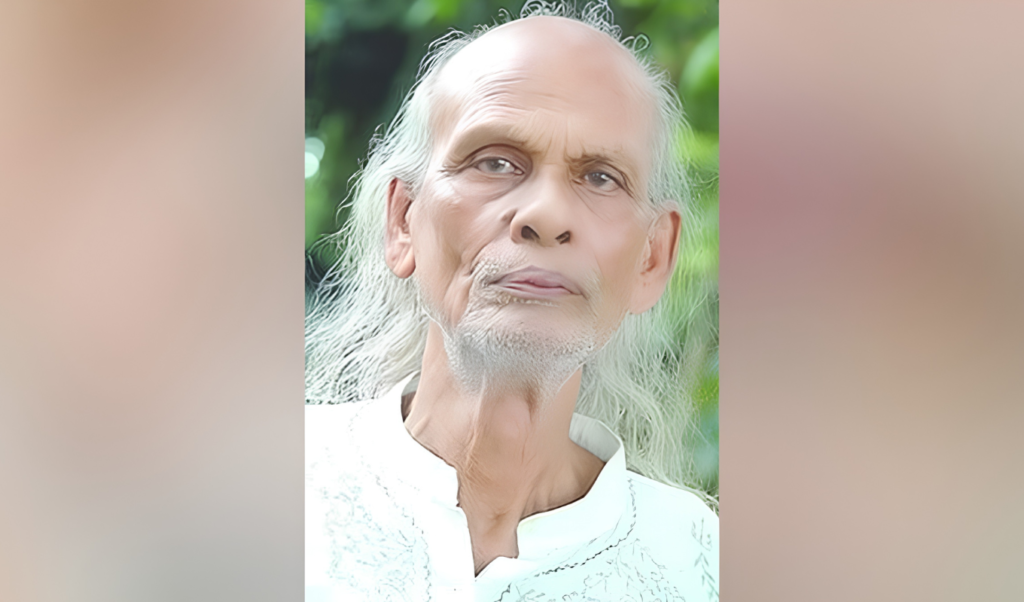
Nestled along the banks of the Kalni River in Sunamganj lies Ujandhol, a small village surrounded by vast wetland marshes. In the monsoon, the landscape transforms into an endless expanse of water, whilst dry winters reveal sprawling paddy fields. From this rugged natural environment emerged Shah Abdul Karim, the revered emperor of Baul music, whose soul-stirring compositions captured the joys, heartbreaks, struggles, and resilient human spirit of the low-lying bati region.
Today, 12 September, marks the 17th death anniversary of the legendary folk maestro, who passed away in Sylhet in 2009 at the age of 93. To commemorate his enduring legacy, the Shah Abdul Karim Parishad has organised a prayer session and a cultural gathering at his ancestral residence in Ujandhol. As with every passing year, musicians, devotees, and admirers from across Bangladesh have gathered at his residence to pay homage to a philosopher-poet whose music transcends generational boundaries.
Born on 15 February 1916 in Dhalashram village in Derai upazila, Karim grew up in severe poverty within a farming family. Institutional education remained largely out of reach, limited to a brief stint at a local night school when he was 12 years old. Instead, his formative years were spent tending cattle, working in grocery shops, and observing the daily struggles of rural workers. Equipped with an ektara, he traversed villages, transforming the lives, testimonies, and oral traditions of ordinary people into timeless folk ballads.
Karim’s repertoire extended far beyond traditional Baul devotional philosophy. He was fundamentally a voice of the masses. His music gave expression to social injustice, hunger, and popular movements, most notably during the 1954 United Front election campaign, where his political songs resonated widely at public rallies. Classics such as Age Ki Sundor Din Kataitam, Bonde Maya Lagaise, Gari Chole Na, Keno Piriti Barailay Re Bondhu, and Bosonto Batase have long become woven into the cultural fabric of Bengal.
Humanism stood at the core of Karim’s philosophy. Rejecting religious bigotry, his poetry celebrated communal harmony and shared humanity, building deep bonds with fellow spiritual practitioners like Ranesh Thakur. His musical gatherings served as inclusive spaces where social divides dissolved.
Today, Ujandhol has evolved into a cultural pilgrimage site. However, the artist’s family believes greater official recognition is overdue. Shah Noor Jalal, the maestro’s only son, appealed for the government to observe his father’s birth and death anniversaries nationally. In response, Motiur Rahman Khan, Additional Deputy Commissioner (General) of Sunamganj, noted that while the death anniversary is not part of the national official calendar, local authorities actively support and contribute grants towards the events organised by the Shah Abdul Karim Parishad.