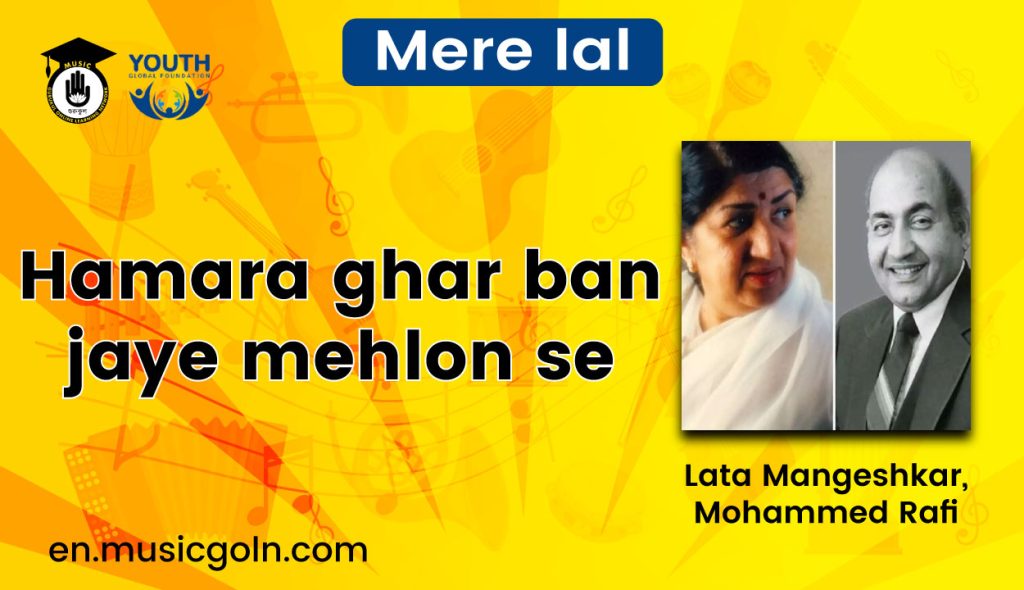
Hamara ghar ban jaye mehlon se lyrics | Lata Mangeshkar , Mohammed Rafi | Mere lal | 1948

Hamara ghar ban jaye mehlon se lyrics | Lata Mangeshkar , Mohammed Rafi | Mere lal | 1948

Singer: Lata Mangeshkar, Mohammed Rafi, Mohantara Talpade, Purushottam
Lyricist: Mahipal
Music Director: Purushottam


Mohammed Rafi (24 December 1924 – 31 July 1980) was an Indian playback singer and musician. He is considered to have been one of the greatest and most influential singers of the Indian subcontinent.Rafi was notable for his versatility and range of voice; his songs varied from fast peppy numbers to patriotic songs, sad numbers to highly romantic songs, qawwalis to ghazals and bhajans to classical songs.He was known for his ability to mould his voice to the persona and style of the actor lip-syncing the song on screen in the movie. He received six Filmfare Awards and one National Film Award. In 1967, he was honored with the Padma Shri award by the Government of India. In 2001, Rafi was honoured with the “Best Singer of the Millennium” title by Hero Honda and Stardust magazine. In 2013, Rafi was voted for the Greatest Voice in Hindi Cinema in the CNN-IBN’s poll.


He recorded songs for over a thousand Hindi films and in many Indian languages as well as some foreign languages, though primarily in Urdu and Punjabi, over which he had a strong command. He recorded as many as 7,000 songs throughout his career, spanning several languages and dialects such as Konkani, Assamese, Bhojpuri, Odia, Bengali, Marathi, Sindhi, Kannada, Gujarati, Tamil, Telugu, Magahi, Maithili, etc. Apart from Indian languages, he also sang in some foreign languages, including English, Farsi, Arabic, Sinhala, Mauritian Creole, and Dutch

Hamara ghar ban jaye mehlon se lyrics | Lata Mangeshkar , Mohammed Rafi | Mere lal | 1948


Hamara ghar ban jaye mehlon se lyrics : 

hamara ghar hamara ghar
ban jaye ban jaye
mahlo se pyara sundar
hamara ghar hamara ghar
ban jaye ban jaye
mahlo se pyara sundar

dil ko lubhane wala ho
sone ke sanche me dhala ho
salona sajila suhana shohar
hamara ghar hamara ghar
ban jaye ban jaye
mahlo se pyara sundar

unche gharo se jhake, gharo se jhake
gharo se jhake
chup chup has has hilmil
haye aakash pe haye badal pe
haye aakash pe apni najar
na sitaro ki odhe chunar
hamara ghar hamara ghar
ban jaye ban jaye
mahlo se pyara sundar

bake hindole dole dolenge dolenge
pran me mehfil ke
sara jag ujiyala ho
cham cham chamaacham wala ho
ujiyala ho chamaacham wala ho
nachenge kirno ki pariya utar
hamara ghar hamara ghar
ban jaye ban jaye
mahlo se pyara sundar
 

Lata Mangeshkar  was an Indian playback singer and occasional music composer. She is widely considered to have been one of the greatest and most influential singers in India. Her contribution to the Indian music industry in a career spanning eight decades gained her honorific titles such as the “Queen of Melody”, “Nightingale of India”, and “Voice of the Millennium”.

Lata recorded songs in over thirty-six Indian languages and a few foreign languages, though primarily in Marathi, Hindi, and Bengali. Her foreign languages included English, Russian, Dutch, Nepali, and Swahili.She received several accolades and honors throughout her career. In 1989, the Dadasaheb Phalke Award was bestowed on her by the Government of India. In 2001, in recognition of her contributions to the nation, she was awarded the Bharat Ratna, India’s highest civilian honour; she is only the second female singer, after M. S. Subbulakshmi, to receive this honour.France conferred on her its highest civilian award, Officer of the National Order of the Legion of Honour, in 2007.

She was the recipient of three National Film Awards, 15 Bengal Film Journalists’ Association Awards, four Filmfare Best Female Playback Awards, two Filmfare Special Awards, the Filmfare Lifetime Achievement Award and many more. In 1974, she was one of the first Indian playback singers to perform at the Royal Albert Hall in London, UK. Her last recorded song was “Saugandh Mujhe Is Mitti ki” released on 30 March 2019 as a tribute to the Indian Army and the Nation.

At one point, she appeared in the Guinness World Records, which listed her as the most recorded artist in history between 1948 and 1987

She moved to Mumbai in 1945 when Master Vinayak’s company moved its headquarters there. She started taking lessons in Hindustani classical music from Ustad Aman Ali Khan of Bhindibazaar Gharana. She sang “Paa Lagoon Kar Jori” for Vasant Joglekar’s Hindi-language movie Aap Ki Seva Mein (1946),which was composed by Datta Davjekar.The dance in the film was performed by Rohini Bhate, who later became a famous classical dancer. Lata and her sister Asha played minor roles in Vinayak’s first Hindi-language movie, Badi Maa (1945).

In that movie, Lata also sang a bhajan, “Maata Tere Charnon Mein.” She was introduced to music director Vasant Desai during the recording of Vinayak’s second Hindi-language movie, Subhadra (1946).

After Vinayak’s death in 1948, music director Ghulam Haider mentored her as a singer. He introduced her to producer Sashadhar Mukherjee, who was then working on the movie Shaheed (1948), but Mukherjee dismissed her voice as “too thin”. An annoyed Haider responded that in coming years producers and directors would “fall at Lata’s feet” and “beg her” to sing in their movies. Haider gave her her first major break with the song “Dil Mera Toda, Mujhe Kahin Ka Na Chhora”—lyrics by Nazim Panipati—in the movie Majboor (1948),

Leave a Comment