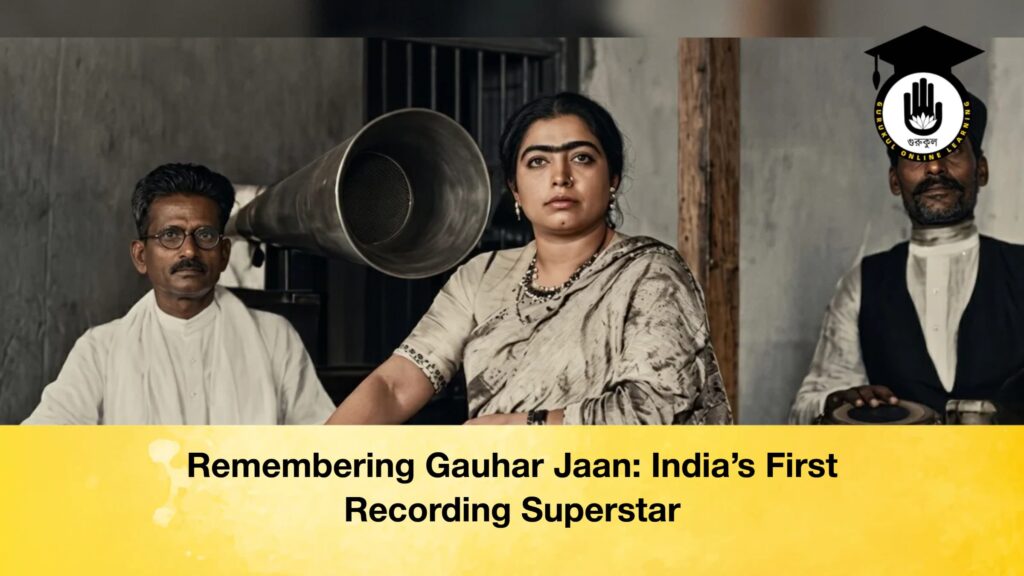
Today marks the birth anniversary of Gauhar Jaan, a legendary figure in Indian classical music who pioneered the transition of traditional arts into the modern recording era. Born on 26 June 1873, she was an extraordinary artist whose voice, exceptional showmanship, and forward-thinking approach secured her an immortal place in the cultural history of the subcontinent.
A Technological Pioneer
Gauhar Jaan holds the unique distinction of being one of India’s very first gramophone recording artists. In November 1902, she entered a makeshift studio in Calcutta to record a khayal in Raag Jogiya for the Gramophone and Typewriter Company, under the supervision of recording engineer Frederick William Gaisberg. This moment was a watershed event for Indian music.
Adapting to the new technology required immense skill. The early shellac discs could only capture roughly three minutes of audio. For a classical musician accustomed to performing single ragas for hours in royal courts, condensing an entire performance into three minutes was a formidable challenge. Gauhar Jaan mastered this constraint with absolute brilliance, structuring her renditions to include the slow exposition, faster improvisations, and a grand finale all within the strict time limit. At the end of her recordings, she would state in high-pitched English, “My name is Gauhar Jaan”—a technical necessity used by engineers in Hanover, Germany, to identify the matrix, which later became her iconic trademark.
Versatility and Cultural Legacy
Her mastery spanned across a vast repertoire of musical genres. She was equally adept at performing khayal, thumri, dadra, tappa, and bhajans, making her immensely popular across diverse audiences. Beyond her vocal prowess, she was a trailblazer who democratised Indian classical music. By embracing the gramophone, she helped liberate the art form from the exclusive confines of princely courts, making it accessible to the general public.
Over her career, she reportedly recorded hundreds of songs in multiple languages, including Bengali, Hindustani, Gujarati, and even French. Her immense success made her one of the subcontinent’s wealthiest independent women of the era, famous for her flamboyant lifestyle, her love for fine arts, and her charitable contributions.
An Enduring Influence
As music lovers, researchers, and cultural historians commemorate her birth anniversary, her legacy remains remarkably relevant. While technology and listening habits have evolved dramatically from shellac discs to digital streaming, Gauhar Jaan’s contributions endure. The tracks she left behind are far more than historical curiosities; they serve as priceless archives of Indian heritage and musical evolution. Her artistry, resilience, and groundbreaking spirit continue to inspire generations of musicians navigating the intersection of tradition and technology.