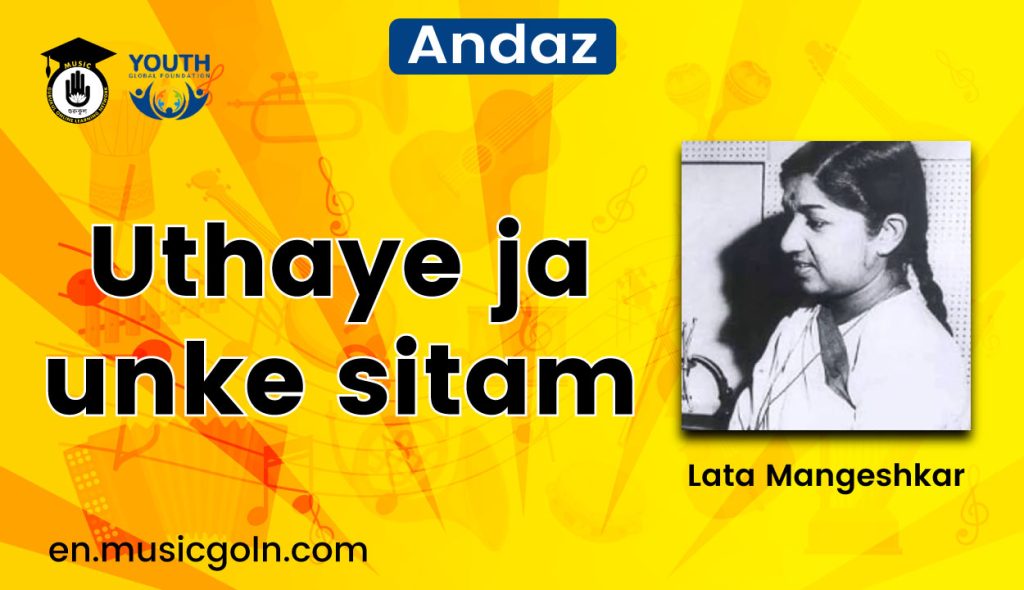
Uthaye ja unke sitam lyrics | Lata Mangeshkar | Andaz | 1949

Uthaye ja unke sitam lyrics | Lata Mangeshkar | Andaz | 1949

Song: Uthaye Ja Unke Sitam
Movie: Andaz
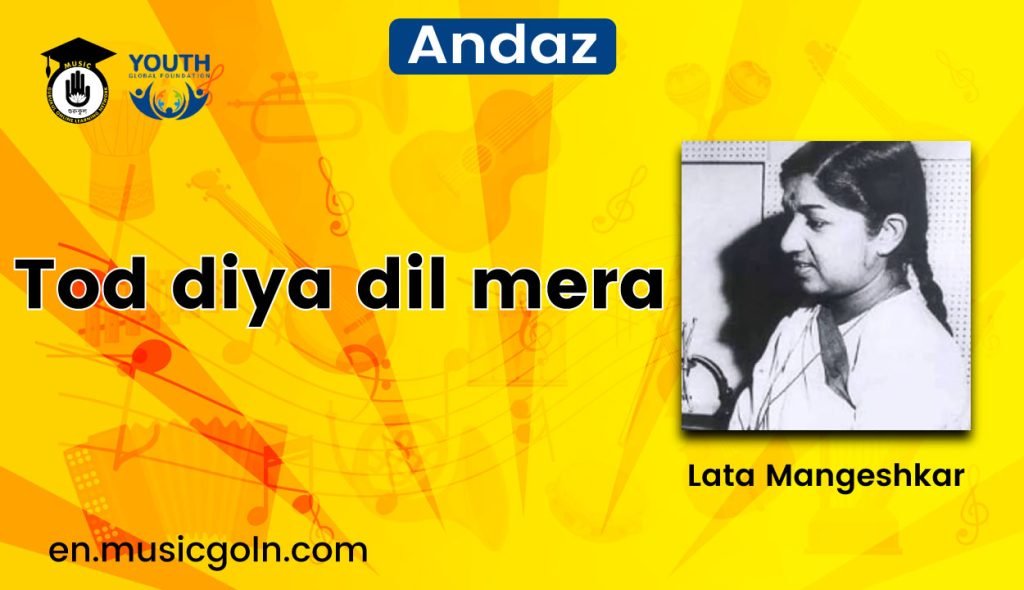
Singer: Lata Mangeshkar
Music: Naushad Ali


Lata Mangeshkar (born as Hema Mangeshkar; 28 September 1929 – 6 February 2022) was an Indian playback singer and occasional music composer. She is widely considered to have been one of the greatest and most influential singers in India. Her contribution to the Indian music industry in a career spanning eight decades gained her honorific titles such as the “Queen of Melody”, “Nightingale of India”, and “Voice of the Millennium”.

Lata recorded songs in over thirty-six Indian languages and a few foreign languages, though primarily in Marathi, Hindi, and Bengali. Her foreign languages included English, Russian, Dutch, Nepali, and Swahili.She received several accolades and honors throughout her career. In 1989, the Dadasaheb Phalke Award was bestowed on her by the Government of India. In 2001, in recognition of her contributions to the nation, she was awarded the Bharat Ratna,

India’s highest civilian honour; she is only the second female singer, after M. S. Subbulakshmi, to receive this honour. France conferred on her its highest civilian award, Officer of the National Order of the Legion of Honour, in 2007.

She was the recipient of three National Film Awards, 15 Bengal Film Journalists’ Association Awards, four Filmfare Best Female Playback Awards, two Filmfare Special Awards, the Filmfare Lifetime Achievement Award and many more. In 1974, she was one of the first Indian playback singers to perform at the Royal Albert Hall in London, UK. Her last recorded song was “Saugandh Mujhe Is Mitti ki” released on 30 March 2019 as a tribute to the Indian Army and the Nation.

he sang many raga-based songs for Naushad in movies such as Deedar (1951), Baiju Bawra (1952), Amar (1954), Uran Khatola (1955) and Mother India (1957). Ae Chorre Ki Jaat Badi Bewafa, a duet with G. M. Durrani, was her first song for the composer Naushad. The duo, Shankar–Jaikishan, chose Lata for Barsaat (1949), Aah (1953), Shree 420 (1955) and Chori Chori (1956). Before 1957,


composer S. D. Burman chose her as the leading female singer for his musical scores in Sazaa (1951), House No. 44 (1955), and Devdas (1955). However a rift developed between her and Burman in 1957, and she did not sing his compositions again until 1962.

She won a Filmfare Award for Best Female Playback Singer for Salil Chowdhury’s composition “Aaja Re Pardesi” from Madhumati (1958). Her association with C. Ramchandra produced songs in movies such as Albela (1951), Shin Shinkai Bublaa Boo (1952), Anarkali (1953), Pehli Jhhalak (1954), Azad (1955), Aasha (1957), and Amardeep (1958). For Madan Mohan, she performed for films like Baagi (1953), Railway Platform (1955), Pocketmaar (1956), Mr. Lambu (1956), Dekh Kabira Roya (1957), Adalat (1958), Jailor (1958), Mohar (1959), and Chacha Zindabad (1959).

Her song Aye Maalik Tere Bande Hum which was the original composition of Vasant Desai and used in the film Do Aankhen Barah Haath on 1957, was adapted by a Pakistani school as the school anthem.

Mangeshkar’s song “Pyar Kiya To Darna Kya” from Mughal-e-Azam (1960), composed by Naushad and lip-synced by Madhubala, still remains famous.The Hawaiian-themed number “Ajeeb Dastaan Hai Yeh”, from Dil Apna Aur Preet Parai (1960), was composed by Shankar–Jaikishan and lip-synced by Meena Kumari.

In 1961, she recorded two popular bhajans, “Allah Tero Naam” and “Prabhu Tero Naam”, for Burman’s assistant, Jaidev. In 1962, she was awarded her second Filmfare Award for the song “Kahin Deep Jale Kahin Dil” from Bees Saal Baad, composed by Hemant Kumar.

On 27 January 1963, against the backdrop of the Sino-Indian War, she sang the patriotic song “Aye Mere Watan Ke Logo” (literally, “Oh, People of My Country”) in the presence of Jawaharlal Nehru, then the Prime Minister of India. The song, composed by C. Ramchandra and written by Kavi Pradeep, is said to have brought the Prime Minister to tears.

In 1963, she returned to collaborate with S. D. Burman.She had sung in R. D. Burman’s first film, Chhote Nawab (1961), and later in his films such as Bhoot Bungla (1965), Pati Patni (1966), Baharon ke Sapne (1967), and Abhilasha (1969). She also recorded several popular songs for S. D. Burman, including “Aaj Phir Jeene Ki Tamanna Hai”, “Gata Rahe Mera Dil” (duet with Kishore Kumar) and “Piya Tose” from Guide (1965), “Hothon Pe Aisi Baat” from Jewel Thief (1967), and “Kitni Akeli Kitni Tanhaa” from Talash

Uthaye ja unke sitam lyrics | Lata Mangeshkar | Andaz | 1949

Uthaye ja unke sitam lyrics :

Uthaye ja unake sitam, aur jiye ja
Yuhi muskuraye ja, aansu piye ja
Uthaye ja unake sitam, aur jiye ja
Yuhi muskuraye ja, aansu piye ja
Uthaye ja unake sitam
Yahi hai mohabbat kaa
Dastoor ai dil, dastoor aye dil
Woh gham de tujhe
Tu duwaye diye ja
Uthaye ja unake sitam

Kabhi woh nazar
Jo samayi thi dil mein
Samayi thi dil mein
Usi ek nazar kaa sahara liye ja
Uthaye ja unake sitam

Sataye zamana ho
Sitam dhaye dooniya
Sitam dhaye dooniya
Magar too kisi kee tamanna kiye ja
Uthaye ja unake sitam aur jiye ja
Yuhi muskuraye ja, aansu piye ja
Uthaye ja unake sitam.
Leave a Comment