
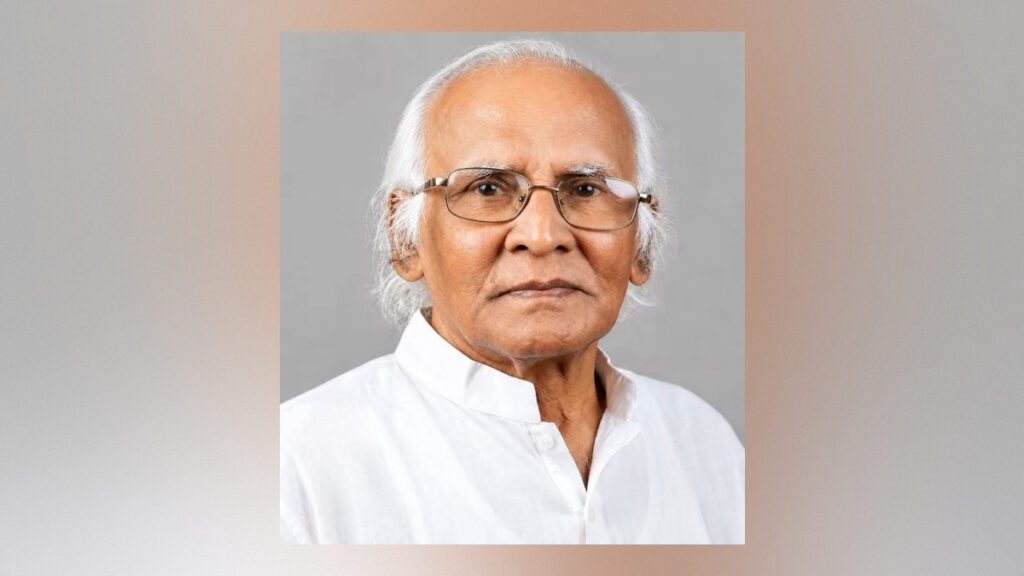
There was a time when Nayeem Gohar’s voice carried the urgency of a nation in turmoil. During the Liberation War of 1971, his songs became expressions of courage, patriotism and resistance, inspiring people at a time when words and music were themselves powerful weapons. Yet the man behind those songs gradually receded from public view, leaving behind a remarkable body of work that has not always received the recognition it deserves.
Nayeem Gohar was a freedom fighter and a remarkably versatile creative figure. He was a lyricist, poet, novelist, singer, actor, playwright, BBC Bengali broadcaster and newsreader. His career crossed literature, music, broadcasting, television and theatre, while his personal life remained notably private and unassuming.
Born on 15 August 1936 into a distinguished family in the Bikrampur pargana, Gohar demonstrated considerable academic ability from an early age. He secured first place in his graduation examination at the University of Dhaka. His literary interests emerged during his youth, when he began writing poetry in English. His work was published in the Observer, a prominent English-language newspaper of the time.
He later published the poetry collections Shob O Swagotokti and Nishiddho Bichhana, as well as the short-story collection Rahugras. A considerable number of his poems and stories also appeared in newspapers and periodicals. Yet Gohar was not particularly careful about preserving his own writings. As a result, many of his works remain scattered, leaving gaps in the documented record of a remarkably productive creative life.
For the wider public, however, his most enduring identity was that of a lyricist.
During the turbulent days of 1971, Gohar wrote songs that captured the spirit of a people fighting for freedom. Among them were Nongor Tolo Tolo, Shomoy Je Holo Holo, Sagor Parite Jhor Jage Jodi Jagte Dao, Puber Oi Akashe Surjo Uthchhe Aloke Alokmoy, Joy Joy Joy Joy Bangla and Jonmo Amar Dhonno Holo Mago.
These were more than musical compositions. Their words reflected the determination, sacrifice and patriotic fervour of the period. For a generation caught up in the struggle for independence, such songs became expressions of hope and defiance.
Gohar’s contribution to music was not limited to patriotic compositions. He also wrote modern and classical songs, producing around 200 songs during his career. His lyrics explored love, nature, patriotism and a wide range of human emotions, demonstrating the breadth of his artistic interests.
His talents extended to television and drama as well. His first play in independent Bangladesh, Pakhi Amar Joyonto, was broadcast on Bangladesh Television. The name ‘Joyonto’ was taken from that of his son.
Together with Fazle Lohani, Gohar was also associated with the innovative television programme Jodi Kichhu Mone Na Korেন. The programme became known for its distinctive style and sharp observations. Among the memorable lines associated with his writing were:
“Those who deliberately make mistakes,
Those who pretend not to know despite knowing,
I will make them understand a few of their mistakes.”
Gohar also possessed considerable acting ability. Renowned film director Ehtesham repeatedly encouraged him to take on a leading role in cinema. The contemporary film magazine Rupchhaya published his photograph and described him as a promising new face. Yet his eventual legacy was shaped less by acting than by his writing, music, broadcasting and involvement in the national struggle.
His role during the Liberation War was particularly significant. On the night of 25 March 1971, at enormous personal risk, Gohar secretly carried an urgent message from Bangabandhu Sheikh Mujibur Rahman to M. R. Siddiqui in Chattogram. Decades later, his contribution to the Liberation War was formally recognised when he received the Independence Award, the country’s highest civilian honour, in 2012.
Despite his many achievements, Gohar became increasingly withdrawn during the later years of his life. He moved away from the public spotlight and gradually distanced himself from the creative world that had once occupied such a central place in his life. The reasons for that withdrawal remain unclear.
What is certain is that the vibrant voice associated with some of the defining cultural expressions of 1971 eventually fell silent.
Nayeem Gohar died on 7 October 2015. His daughters, singer Tajreen Gohar and theatre and film actress Elora Gohar, have continued their own creative journeys, carrying forward part of the artistic legacy of their father.
Gohar may no longer be physically present, but his words and songs remain part of Bangladesh’s cultural memory. His contribution is preserved not only in the songs that once stirred a nation but also in his literary works, television programmes and courageous role during the Liberation War.
Some people leave behind monuments. Others leave behind words and melodies that continue to live in the memory of generations.
Nayeem Gohar belongs to the latter group. His life may have passed into the shadows, but the voice behind those unforgettable songs still carries the call of a defining chapter in Bangladesh’s history:
Raise the anchor, raise it high—
the time has come.