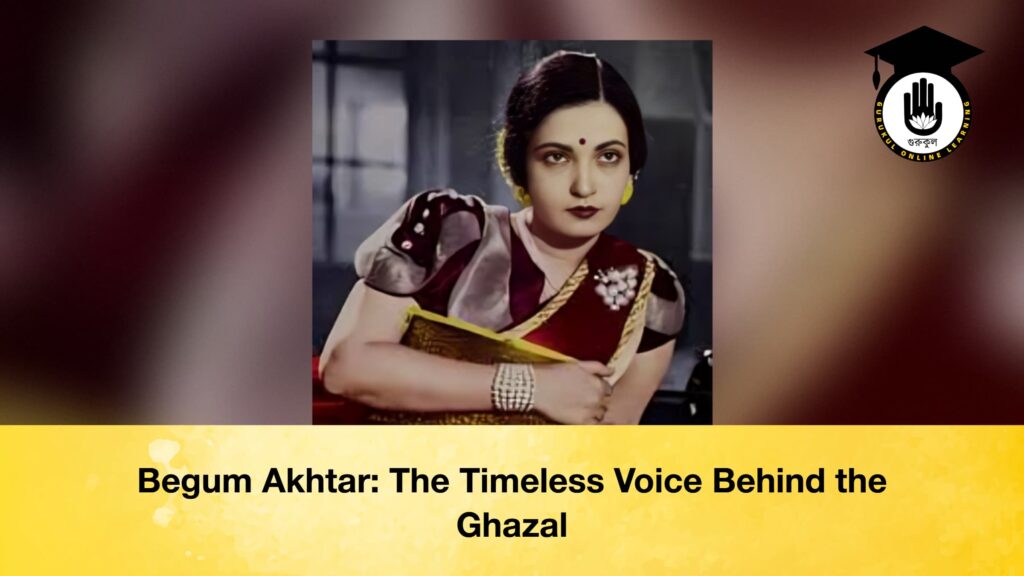
Ghazal became more than music in Begum Akhtar’s voice. It became an intimate language of the heart, carrying love, longing, sorrow and quiet resentment with an emotional intensity that few singers have matched. Decades after her death, her recordings continue to resonate with listeners across the Indian subcontinent.
Known as the ‘Malika-e-Ghazal’, or Queen of Ghazal, Begum Akhtar was one of the most influential voices in Hindustani music. Her mastery of ghazal, dadra and thumri established her as an artist whose appeal extended well beyond the boundaries of classical music.
Born Akhtari Bai Faizabadi on 7 October 1914 in Faizabad, Uttar Pradesh, she developed an interest in music at a very young age. She made her stage debut when she was just seven. Her early promise was followed by years of rigorous musical training under distinguished masters, including Ustad Ata Mohammad Khan of the Patiala tradition and Ustad Abdul Waheed Khan of the Kirana tradition.
That training gave her a strong classical foundation, but Begum Akhtar’s artistry was never confined to technical excellence. She possessed an extraordinary ability to communicate emotion. Her voice could convey heartbreak without becoming theatrical and express romantic longing without losing restraint. In thumri and dadra, she brought together elements of the Purab and Punjab traditions, gradually developing a distinctive style that became recognisably her own.
It was, however, the ghazal that secured her lasting place in musical history.
She had an exceptional gift for interpreting poetry. The works of celebrated poets, including Mirza Ghalib, gained renewed emotional force through her singing. Love, separation, loneliness, waiting and wounded pride were recurring themes, yet she presented them with such sincerity that listeners often felt the verses were describing their own experiences.
Begum Akhtar was also a performer in the early Indian film industry. During the 1930s and 1940s, she appeared in several films, including Mumtaz Begum, Nasib Ka Chakkar, Roti, Panna Dai and Dana Pani. Although she demonstrated considerable ability as an actress, music remained her deepest artistic calling.
In 1944, she married Lucknow-based barrister Ishtiaq Ahmed Abbasi. After her marriage, she withdrew from public singing for a period. Yet her relationship with music endured. Around 1948–49, she returned to the public sphere through All India Radio, bringing her voice back to audiences across the region.
Radio played an important role in extending her reach at a time when broadcasting was becoming a major means of bringing music into homes. Her return also marked a new chapter in her career, allowing her distinctive interpretations to reach listeners who might never have attended one of her live performances.
Her connection with Bengali-speaking audiences was particularly memorable. Songs such as Koelia Gaan Thama Ebar and Jochhona Korechhe Ari became closely associated with her voice and gave her a special place in the memories of Bengali music lovers. For them, Begum Akhtar was not simply a renowned ghazal singer from North India; she became a familiar and deeply nostalgic presence.
Her contribution was recognised through several major honours. The Government of India awarded her the Padma Shri in 1968. She received the Sangeet Natak Akademi Award in 1972, acknowledging her contribution to Indian music. Following her death, she was awarded the Padma Bhushan posthumously in 1975.
Even towards the end of her life, Begum Akhtar remained devoted to performing. In October 1974, during one of her final musical appearances, she reportedly became dissatisfied with her performance and continued singing with greater intensity. She subsequently fell ill and was taken to hospital.
Accounts of her final performance contain some differences over the precise circumstances, including the date and venue. It is, however, widely recorded that she became seriously ill after a final performance in Ahmedabad in late October 1974. She died there on 30 October 1974, aged 60.
Her death silenced a remarkable voice, but it did not end her musical journey.
Begum Akhtar’s importance lies not only in the honours she received or the songs she recorded. She helped establish the ghazal as a form capable of combining poetic sophistication with emotional immediacy. Her performances demonstrated that classical discipline and personal expression could coexist naturally.
Her greatest strength was perhaps her ability to make listeners feel included in the music. She did not sing of heartbreak as an abstract idea. She made it sound personal. A phrase about separation could feel like a memory; a line about love could sound like a confession.
That quality has allowed her music to survive changing tastes and generations.
Even today, when a listener hears Koelia Gaan Thama Ebar, the voice can seem to emerge from another era—from an old musical gathering filled with quiet lights, attentive listeners and the lingering emotion of poetry set to melody.
Begum Akhtar died in 1974, but her artistic presence has never disappeared. Her songs continue to be heard, remembered and revisited by new generations of listeners and musicians.
The Queen of Ghazal may have left the world, but the voice that gave longing a melody remains alive.
Her songs continue to carry love, sorrow, solitude and hope across generations. And in that enduring resonance lies the true measure of Begum Akhtar’s legacy: the singer is gone, but the emotion in her voice has never fallen silent.