Sikh music represents a profound and multifaceted tradition that lies at the heart of Sikh religious and cultural expression. Inherently devotional and transcendent, it revolves around the melodic rendition and recitation of sacred hymns drawn from the Guru Granth Sahib, the eternal scripture of Sikhism. Known collectively as Gurbani Kirtan (or Gurmat Sangeet), this form of music weaves together poetic depth, melodic nuance, and rhythmic precision to forge an intimate spiritual bond with the Divine. Far from mere entertainment, it serves as a conduit for communal worship, personal introspection, and the dissemination of Sikh philosophy—emphasising equality, devotion, and unity. In an era dominated by globalised sounds, Sikh music endures as a timeless reminder of the faith’s commitment to naam simran (remembrance of the Divine Name), where melody becomes a vehicle for enlightenment.

Table of Contents
Origins and Historical Context
The origins of Sikh music can be traced back to the 15th century, with the visionary Guru Nanak Dev Ji, the founder of Sikhism. Travelling across the Indian subcontinent and beyond, Guru Nanak composed and sang hymns (shabads) that addressed universal themes of devotion, social justice, and the oneness of creation. These were often accompanied by the rabab, a plucked string instrument masterfully played by his Muslim companion, Bhai Mardana. This interfaith collaboration—exemplified in their joint performances at sacred sites like Kartarpur—set the inclusive tone for Sikh music, transcending religious boundaries and embracing folk, Sufi, and classical influences. Guru Nanak’s compositions, such as those in Raag Asa or Raag Dhanasri, were not mere songs but profound meditations designed to evoke spiritual awakening, often performed in the open air amid diverse gatherings.
Successive Gurus built upon this foundation, transforming Sikh music into a structured and expansive art form. Guru Angad Dev Ji and Guru Amar Das Ji emphasised its role in langar (community kitchens), fostering equality through shared singing. The pivotal contribution came from Guru Arjan Dev Ji, the fifth Guru, who in 1604 compiled the Adi Granth—the precursor to the Guru Granth Sahib. He meticulously assigned 31 primary raags (melodic modes) and numerous sub-raags to the hymns, drawing from Hindustani classical traditions while infusing them with Sikh ethos. This systematisation ensured that each shabad evoked specific emotions aligned with its spiritual message—Raag Bhairav for dawn’s solemnity, for instance, or Raag Suhi for evening’s introspection. Guru Arjan’s innovation preserved the oral tradition while making it accessible for congregational performance. Later, Guru Hargobind Sahib introduced the taus, a peacock-shaped bowed instrument symbolising divine beauty, further enriching the repertoire. By the time of Guru Gobind Singh Ji, the tenth Guru, in the early 18th century, Sikh music had evolved into a resilient force, sustaining the community through persecution and exile, as kirtan sessions became acts of defiance and solace.
Structure and Elements of Sikh Music
Sikh music’s structure is meticulously rooted in the Guru Granth Sahib, where over 1,430 shabads are organised by raag, taal, and thematic content. This precision ensures that the music is not arbitrary but a deliberate pathway to spiritual immersion.
Raag The raag forms the melodic backbone, dictating the scale, ascending-descending patterns (arohana and avarohana), and emotional timbre. With 31 principal raags prescribed—such as Asa (for contemplation), Bhairav (for devotion at dawn), Todi (for pathos), Sarang (for joy), and Kalyan (for serenity)—each evokes a specific rasa (mood) to amplify the hymn’s message. For example, Raag Gauri conveys maternal love and compassion, mirroring Sikh teachings on universal kinship. The Gurus’ stipulation of raags prevents dilution, ensuring performances remain authentic and evocative, though modern interpretations sometimes blend them for accessibility.
Taal Rhythmic cycles (taals) provide the temporal framework, with traditional Hindustani patterns like Teentaal (16 beats) or Jhaptaal (10 beats) adapted for devotional flow. In kirtan, taals are understated to avoid overshadowing the lyrics, often using ektaal (12 beats) for its meditative pulse. Percussion maintains a steady heartbeat, symbolising the eternal rhythm of creation.
Shabad The shabad—a poetic hymn of 4–16 lines—is the lyrical core, encapsulating Sikh tenets like ek ongkar (one universal creator). Sung with clarity and humility, it prioritises textual meaning over vocal acrobatics, encouraging singers to embody the Guru’s wisdom. In performance, shabads unfold in var (ballad) or pauri (stanza) forms, building to a crescendo of collective resonance.
Instruments in Sikh Music
Sikh music’s instrumental palette draws from classical and folk traditions, emphasising stringed instruments as per the Gurus’ preference for their emotive timbre, which mimics the human voice and evokes introspection. Key instruments include:
- Rabab: The foundational plucked lute, played by Bhai Mardana, symbolising Guru Nanak’s itinerant ministry. Its resonant strings capture the raw, nomadic spirit of early Sikhism.
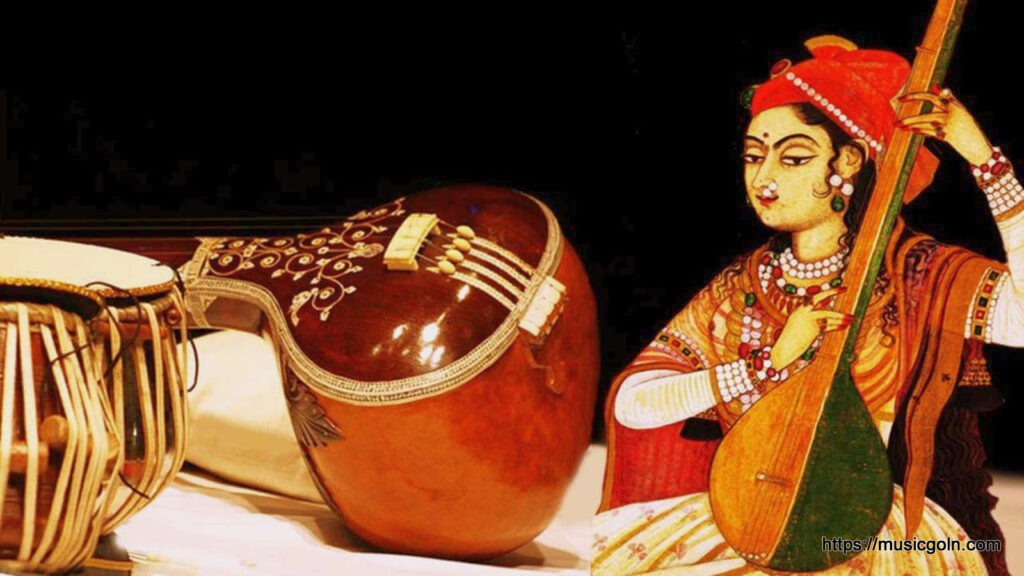
- Taus: Invented by Guru Hargobind, this peacock-shaped bowed instrument (resembling a sitar) produces a haunting, vocal-like tone, often used in Raag Yaman for its lyrical depth.
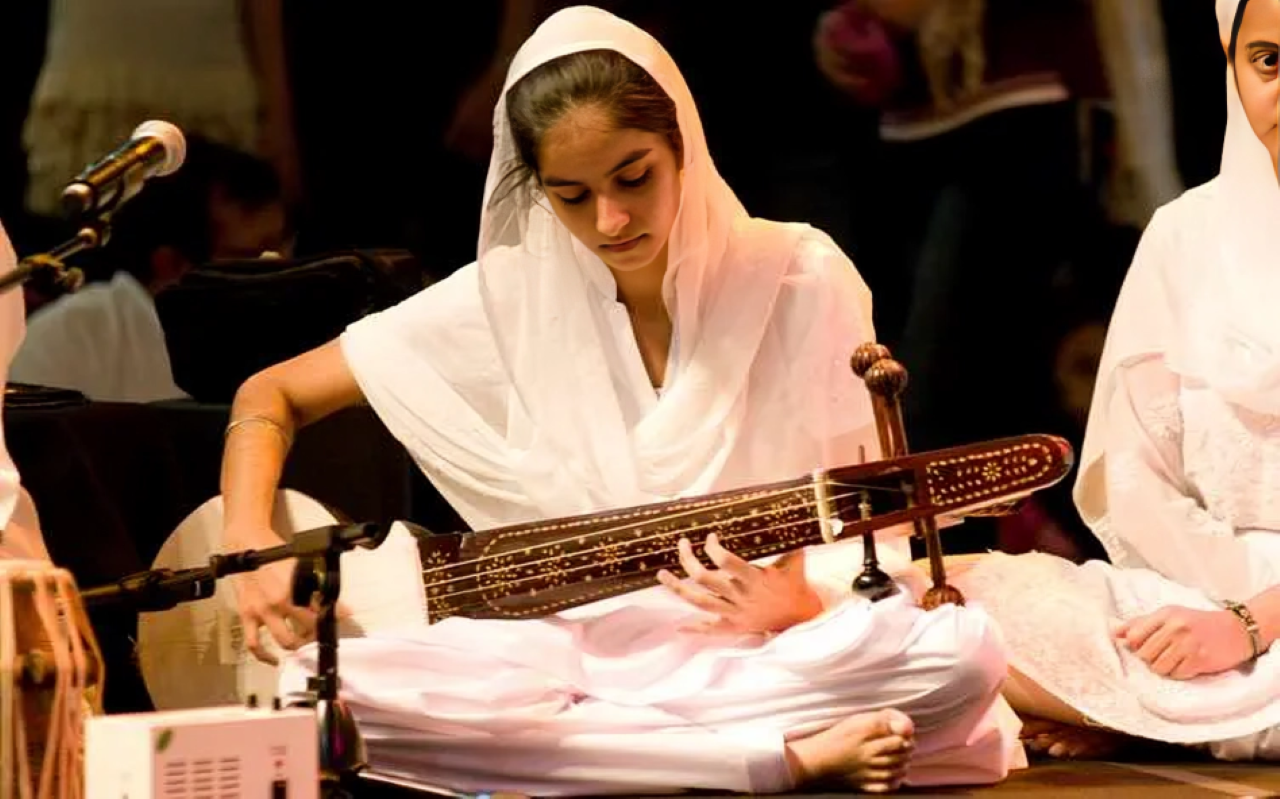
- Dilruba and Sarangi: Bowed fiddles providing melodic support; the dilruba (heart-ravishing) adds warmth, while the sarangi (with a hundred colours) offers expressive slides.
- Jori and Mridang: Paired hand drums (jori as the “Sikh tabla”) and barrel drums (mridang) for rhythm, evoking the heartbeat of devotion.
- Modern Additions: The harmonium (introduced in the 19th century) and tabla dominate contemporary kirtan, though purists advocate reviving tanti saaj (string ensembles) like the esraj or sitar to honour the Gurus’ vision.
These instruments, once nearly extinct by the 1980s due to colonial disruptions, are now experiencing a resurgence, blending tradition with subtle innovations like electronic amplification for global audiences.
Kirtan in the Gurdwara
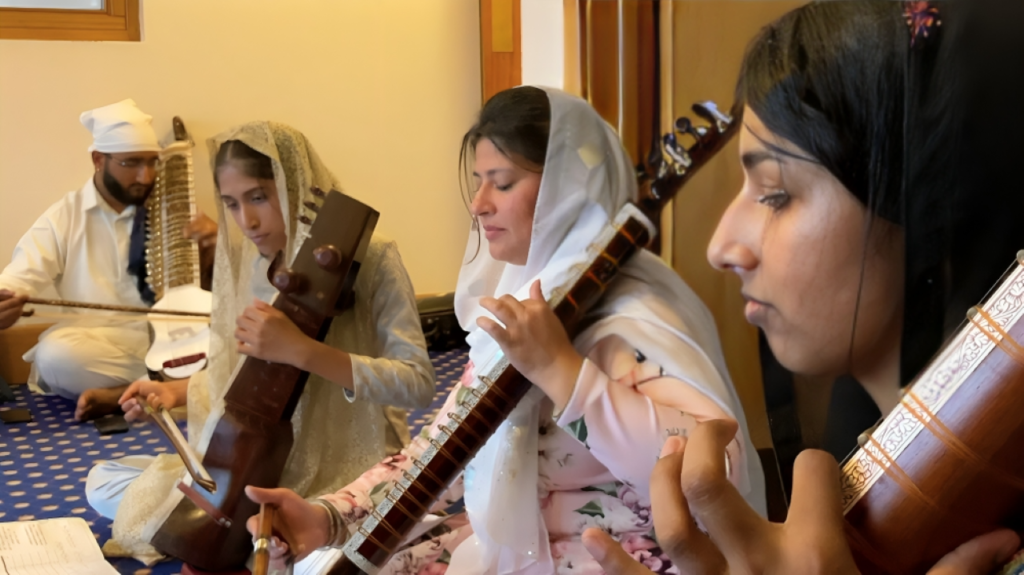
The Gurdwara—Sikhism’s abode of the Guru—serves as the sacred stage for kirtan, where raagis (professional musicians) lead congregational singing. Sessions, known as divan, span dawn (Asa di Var) to dusk (Sohila), with continuous recitals at the Golden Temple (Harmandir Sahib). The call-and-response format (sangat echoing the raagis) fosters sadh sangat (holy congregation), transforming worship into a participatory symphony of souls. Evening aarti—with lamps and rhythmic claps—culminates in profound unity, as described in Sikh texts as a “highway to bliss”. Annual rain sabai (all-night vigils) at major shrines amplify this, blending dhrupad-style austerity with folk vitality.
Styles and Traditions
Sikh music’s styles reflect its syncretic heritage, evolving from Guru Nanak’s folk-infused kirtan to classical sophistication:
- Dhrupad Style: An austere, meditative form rooted in Guru Arjan’s era, emphasising textual purity and slow elaboration; favoured in historical kirtan for its trance-like depth.
- Khayal Style: More fluid and ornamental, allowing improvisational alap (unmetered exploration); adopted in 19th-century ragi jathas for emotional expressiveness.
- Namdhari Style: Preserved by the Namdhari sect, it adheres strictly to puratan raags (ancient modes) and instruments like the taus, rejecting harmonium for authenticity.
- Punjab Gharana and Folk Variants: Blends classical with semi-classical bhajan or dakhani (southern folk), incorporating var ballads for narrative flair. Modern gharanas like those in Ludhiana integrate digital tools while honouring taal-bound structures.
These styles, once oral, are now documented in notations like those by the Punjabi University of Patiala, preserving over 500 shabad executions.
Preservation and Revival
Colonial rule and post-Partition migrations diluted Sikh music, introducing Western instruments and simplifying raags for accessibility. Yet, since the 1970s, a renaissance has unfolded. The Shiromani Gurdwara Parbandhak Committee (SGPC) and institutions like the Punjabi University promote Gurbani Sangeet courses, analysing raags from ragi lineages. Ludhiana’s annual Adutti Gurmat Sangeet Samellan revives puratan practices, while digital archives (e.g., SikhNet’s recordings) safeguard rare taus renditions. Women raagis like Bhai Baldeep Singh’s disciples challenge gender norms, and fusion projects blend kirtan with global genres, ensuring relevance without dilution.

Influence and Global Reach
Sikh music’s diaspora—spanning Punjab’s villages to Toronto’s Gurdwaras and London’s festivals—has globalised it. In Canada and the UK, nagar kirtan processions merge shabads with urban soundscapes, while artists like Dya Singh fuse Gurbani with world music, performing at Glastonbury or WOMAD. Contemporary figures—Bhai Baldeep Singh (revivalist dhrupad), Ragini Rainu (women’s kirtan), and Manika Kaur (youth fusion)—bridge generations. Digital platforms amplify this: Spotify playlists of Raag Asa reach millions, fostering intercultural dialogue amid globalisation’s cacophony.
Sikh music transcends artifice—it is a spiritual discipline, a cultural bulwark, and the Gurus’ living legacy. Rooted in raag‘s precision, animated by divine love and truth, and sustained by communal harmony, Gurbani Kirtan inspires devotion, reflection, and oneness. In our fractured world, its melodic wisdom endures: when sung with pure intent, music becomes a bridge to the Eternal.