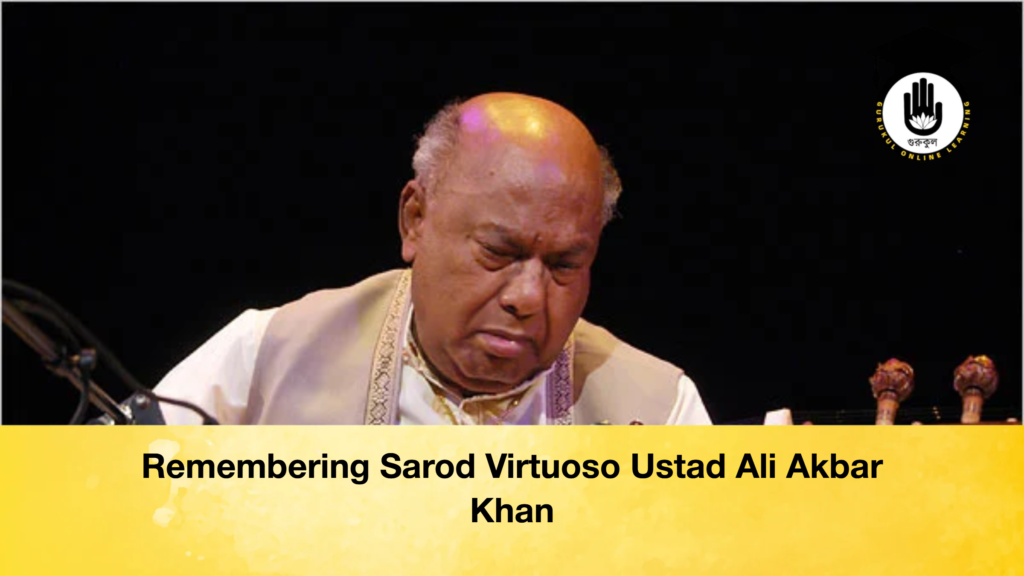
Ustad Ali Akbar Khan, widely regarded as one of the greatest sarod virtuosos of the 20th century and a global ambassador of Indian classical music, was born on 14 April 1922 in Shibpur village, located in the Nabinagar upazila of Brahmanbaria district (in present-day Bangladesh). He was the son of the legendary musician court-musician Sur Samrat Ustad Allauddin Khan and Madina Begum. Spending his childhood and adolescence in the princely state of Maihar where his father served as the court musician, Ali Akbar Khan began his formal musical training at the tender age of three, initially focusing on vocal music. Given his father’s mastery over numerous instruments, the young musician received rigorous, comprehensive instruction in various musical traditions from an early age.
At the age of nine, his father introduced him to the sarod. Shortly thereafter, in 1933, his uncle Ustad Ayet Ali Khan gifted him a custom, hand-crafted sarod. This instrument became his lifelong companion in a relentless pursuit of musical excellence. Known for his profound discipline, he routinely underwent rigorous daily practice sessions (riyaz) lasting up to eighteen hours.
Ali Akbar Khan gave his debut public performance at a music conference in Allahabad at the age of thirteen. By the 1940s, his performances at major music conferences across India brought him widespread acclaim. In 1938, he joined All India Radio (AIR) Lucknow as a music director, and in 1943, he was appointed the court musician for the Maharaja of Jodhpur, a position he held for six years. Moving to Mumbai (then Bombay) in 1948, he established himself as a distinguished film composer, scoring highly acclaimed soundtracks for films such as Kshudhita Pashan (Hungry Stones) and Jhinder Bandi.
In 1955, at the invitation of violinist Yehudi Menuhin, Ali Akbar Khan embarked on his first international tour, visiting the United Kingdom and the United States. He was a pioneer in introducing Eastern classical music to Western television audiences. During this period, he recorded the first LP album of Indian classical music in the United States, released by Angel Records. His dedication to education led him to found the Ali Akbar College of Music in Calcutta in 1956, and later in Berkeley, California, in 1965 (which subsequently relocated to San Rafael in 1968).
During the 1971 Bangladesh Liberation War, he played a crucial role in raising international awareness and funds for refugees. Alongside Pandit Ravi Shankar and Ustad Alla Rakha, he performed at the historic Concert for Bangladesh, organised by George Harrison at Madison Square Garden, New York, where their performance of Bangla Dhun achieved legendary status.
Key Milestones and Awards
| Year / Period | Recognition / Event |
| 14 April 1922 | Born in Shibpur, Brahmanbaria (present-day Bangladesh). |
| 1933 | Gifted a hand-crafted sarod by his uncle, Ustad Ayet Ali Khan. |
| 1938 | Appointed Music Director at All India Radio, Lucknow. |
| 1943–1949 | Served as the official court musician for the State of Jodhpur. |
| 1955 | Toured the UK and US; recorded the first Western LP of Indian classical music. |
| 1956 | Founded the Ali Akbar College of Music in Calcutta, India. |
| 1961 | Performed at the inaugural events for US President John F. Kennedy. |
| 1965 | Founded the Ali Akbar College of Music in California, United States. |
| 1967 | Awarded the Padma Bhushan by the Government of India. |
| 1971 | Performed at the historic Concert for Bangladesh in New York. |
| 1974 | Received an Honorary Doctorate from the University of Dhaka. |
| 1989 | Awarded the Padma Vibhushan, India’s second-highest civilian honour. |
| 1991 | Named a Genius Fellow by the MacArthur Foundation. |
| 1970–1998 | Nominated five times for the prestigious Grammy Awards. |
| 18 June 2009 | Passed away in San Francisco, California, United States. |
Ustad Ali Akbar Khan passed away on 18 June 2009 in San Francisco, California. Throughout his lifetime, his extraordinary contributions were recognised globally; he received the Padma Bhushan in 1967 and the Padma Vibhushan in 1989 from the Government of India, alongside two President of India Awards. He also received honorary doctorates from the University of Dhaka and Rabindra भारती (Rabindra Bharati) University, and remained a towering figure whose musical lineage continues to influence generations globally.