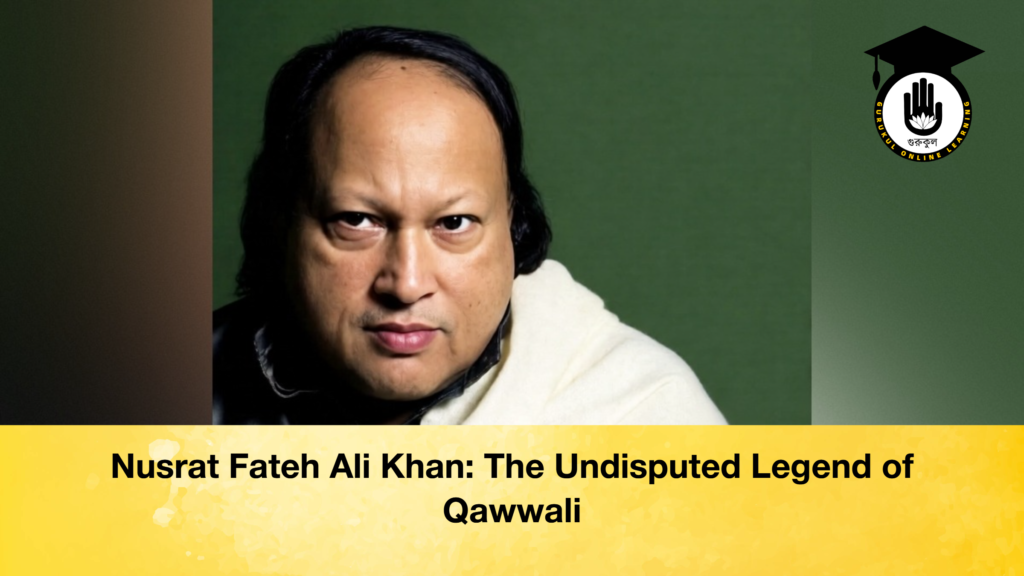
There was an earnest prayer in his voice and a profound yearning of the soul within his melodies. Listening to Nusrat Fateh Ali Khan perform qawwali often felt like witnessing music slowly transcend the boundaries of the physical world, drawing listeners deep into a profound spiritual realm. With his formidable vocal range, extraordinary breath control, acute improvisational brilliance, and an unmatched capacity for emotionally charged delivery, he did more than simply captivate traditional audiences. He carved out a permanent, revered place for himself across the vast landscape of global music.
He was Ustad Nusrat Fateh Ali Khan—the undisputed legend of qawwali, one of the greatest exponents of Sufi music, and a visionary artist who successfully carried the rich musical heritage of South Asia onto the international stage. Nearly three decades after his passing, the resonance of his voice, the power of his performances, and the magnitude of his creative output continue to shape and inspire newer generations of musicians.
Table of Contents
Heir to a Six-Century Musical Tradition
Born on 13 October 1948 in Lyallpur—now known as Faisalabad in Pakistan—Nusrat belonged to a family whose dedicated practice of qawwali had endured for roughly six centuries. His father, Ustad Fateh Ali Khan, was a distinguished classical vocalist and qawwal who served as his primary teacher during his formative years.
Growing up immersed in this rich environment, Nusrat was initially steered toward a career in medicine by his father, who hoped to spare him the arduous path of a professional musician. Yet, the young boy’s pull toward music proved irresistible, ultimately drawing him back into the family lineage. Following his father’s death in 1964, a teenage Nusrat became deeply integrated into the family ensemble. Under the guidance of his uncles and other senior practitioners, he began cultivating his distinct artistic voice, eventually assuming leadership of the ensemble around 1971.
Forging a New Language Within Tradition
Qawwali is fundamentally a devotional art form tethered to Sufi philosophy. Through poetry, melody, rhythmic handclapping, chorus harmonies, and a steadily escalating emotional momentum, performances gradually transport listeners into an elevated state of consciousness.
Nusrat honoured this deeply rooted tradition while simultaneously expanding its stylistic boundaries. His command over alap, taan, sargam, intricate rhythmic phrasing, and the sheer endurance of his vocal stamina was astonishing. A performance under his direction typically began with measured restraint, progressively intensifying in velocity and power until it culminated in an overwhelming emotional experience.
This distinctive delivery allowed him to communicate across linguistic divides. Whether conveying profound devotion to the divine, the yearning of Sufi poetry, or raw human emotion, his voice resonated with global audiences who did not require an understanding of Urdu or Punjabi to feel the depth of his expression.
Taking Qawwali to the Global Stage
One of Nusrat’s most enduring contributions was introducing qawwali to Western and international audiences. His landmark performance at the World of Music, Arts and Dance (WOMAD) festival in the United Kingdom in 1985 marked a major turning point, rapidly elevating his profile across Europe and North America.
Collaborations with British musician Peter Gabriel further widened his international reach. While working with artists from diverse musical backgrounds, Nusrat maintained the core integrity of traditional qawwali while eagerly engaging in creative experimentation. Gabriel later lauded Nusrat’s exceptional intuition, profound sense of timing, and innate structural understanding of music. Throughout the 1980s and 1990s, his touring schedule spanned Europe, Asia, and North America. He performed in Japan in 1987, generating profound appreciation for traditional South Asian aesthetics in East Asia.
Recognition and Accolades
In recognition of his immense service to the arts, the Government of Pakistan conferred upon him the prestigious Pride of Performance award in 1987. UNESCO honoured him with its Music Prize in 1995. In 1996, he received the Grand Prize of the Americas at the Montreal World Film Festival, alongside the prestigious Arts and Culture Prize of the Fukuoka Asian Culture Prizes.
Beyond traditional concerts, his contributions extended into cinematic sound-tracks and cross-cultural collaborations, cementing his status as a bridge between traditional heritage and contemporary global culture.
Cultural Legacy Beyond Popularity
Timeless compositions such as Afreen Afreen, Tumhe Dillagi, Allahu, Yeh Jo Halka Halka Suroor Hai, and Akhiyan Uddik Diyan remain beloved by listeners worldwide. His stylistic phrasing and improvisational techniques profoundly influenced contemporary artists across various genres, ranging from Western rock musicians like Jeff Buckley to modern South Asian vocalists.
His prolific recording output during his lifetime earned him official recognition in world records for releasing the highest number of qawwali albums by a solo artist.
A Life Cut Short at Forty-Eight
Ustad Nusrat Fateh Ali Khan passed away on 16 August 1997 at the age of forty-eight while undergoing medical treatment in London. His sudden demise left an irremediable void in the global music community.
Yet, time has only amplified his legacy. Today marks his twenty-ninth death anniversary, and his voice remains as vibrant and relevant as ever. Through his nephew, Rahat Fateh Ali Khan, and countless other artists influenced by his path, the tradition continues to thrive. Nusrat Fateh Ali Khan was never merely a qawwal; he was a custodian of centuries of heritage who transformed localized devotional gatherings into a universal language of the human spirit.