Table of Contents
Historical Background and the Contribution of Mian Tansen
The origins of the Kanada tradition are ancient. Historically, the musical framework of the Karnat or Kanada lineage was integrated into the North Indian system from the Karnataka region of South India. Subsequently, during the sixteenth century, Mian Tansen—the legendary court musician to the Mughal Emperor Akbar—refashioned this ancient framework by imbuing it with a profoundly majestic character.
Classical Framework and Profile
According to musical treatises, Raga Darbari Kanada belongs to the Asavari thaat. Its structural composition is complex, relying heavily on subtle microtonal nuances for its full expression.
| Theoretical Attribute | Description |
| Thaat | Asavari |
| Jati (Class) | Sampurna–Shadav (Septatonic in ascent; Hexatonic in descent) |
| Vadi (Primary Note) | Rishabh (R) |
| Samvadi (Secondary Note) | Pancham (P) |
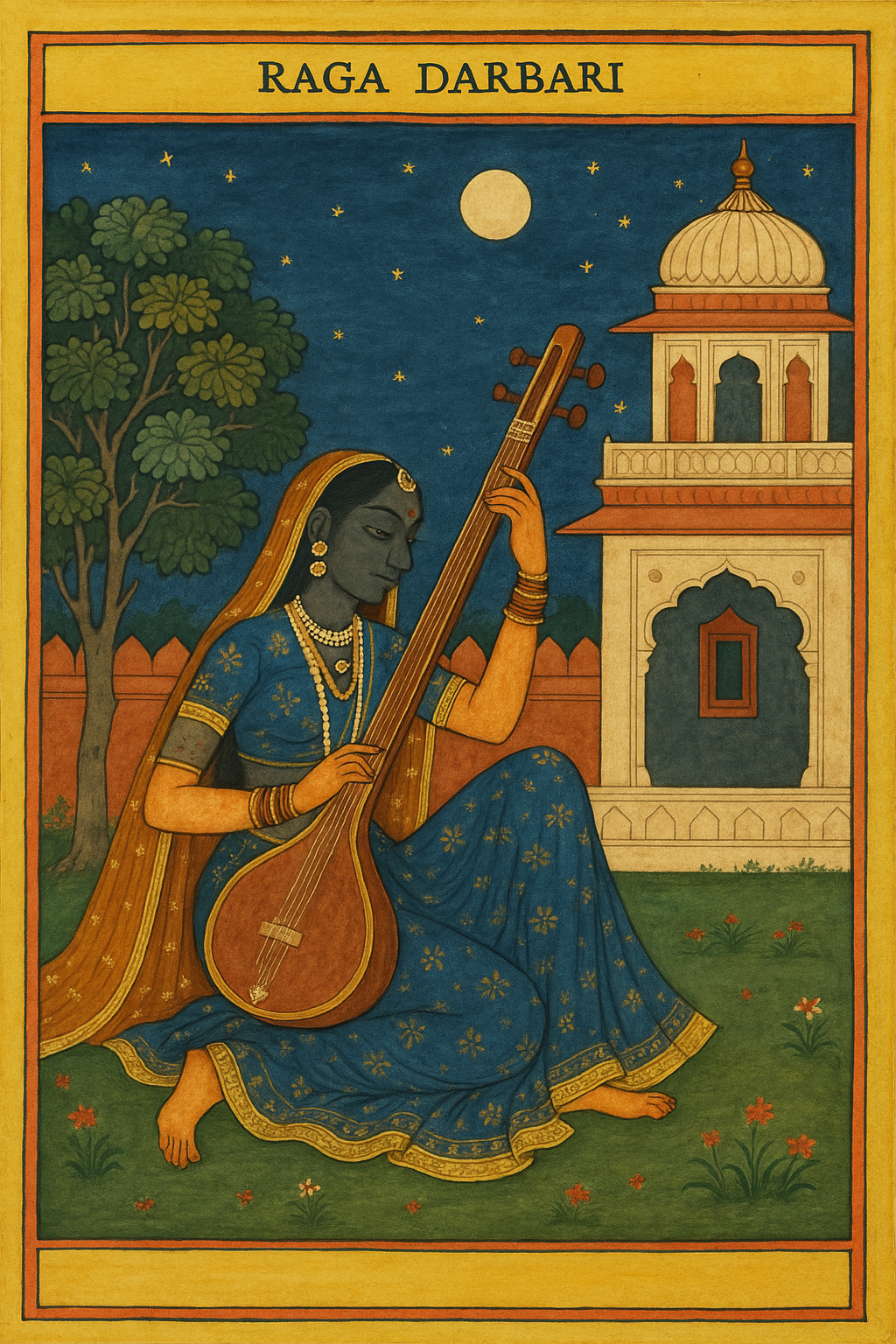
| Nature / Mood | Deeply solemn, serene, contemplative, and majestic |
| Performance Time | Second quarter of the night (9:00 PM – 12:00 AM) |
| Dominant Anga | Poorvanga-pradhan (Lower tetrachord) and Kanada Anga |
| Notes (Swaras) | Rishabh and Pancham are natural (Shuddha); Gandhar, Dhaivat, and Nishad are flat (Komal) |
Ascent, Descent, and Catch Phrase (Pakad)
- Arohana (Ascent): ṇ S, R g, R S, M P, d, n Ś
- Avrohana (Descent): Ś, d, n, P, M P, g, R S
- Pakad (Key Phrase): g, R R, S; ḍ, ṇ S, R S; M P g, R S(Note: Lowercase letters denote flat/Komal notes; sub-dots represent the lower octave / Mandra Saptak).
Microtonal Nuances: Andolan, Meend, and the Expression of Shruti
The Slow Oscillation (Andolan) on Komal Gandhar (g) and Komal Dhaivat (d)
The most intricate aspect of Darbari Kanada lies in the deliberate oscillation (andolan) applied to Komal Gandhar and Komal Dhaivat. Unlike ragas where these flat notes are struck cleanly, in Darbari, direct articulation is strictly avoided.
Heavy Glides (Meend) across Flat Notes
Dominance of the Lower and Middle Octaves
Darbari Kanada is a Poorvanga-pradhan raga, expanding predominantly within the lower (Mandra) and middle (Madhya) octaves. Its movement in the higher octave (Tara Saptak) is comparatively understated. When the artist explores the deep registers of the lower octave, the resulting resonance evokes a profound sense of peace and reverence.
Aesthetic Rasas, Emotional Tone, and Psychological Impact
- Imperial Majesty: The deliberate tempo and heavy movements instil a sense of noble grandeur in the listener.
- Meditative Solitude: The slow oscillations and subtle microtones reflect an inner journey, capturing themes of yearning, deep reflection, and spiritual devotion.
Comparative Distinction from Allied Ragas
Darbari Kanada versus Adana
- Adana is Uttaranga-pradhan (focused on the upper register), fast-paced, and energetic. It dispenses with the slow oscillation on Komal Gandhar and frequently introduces a natural Dhaivat in descent.
- Darbari Kanada is Poorvanga-pradhan, contemplative, and deeply dignified, relying strictly on sustained oscillations and heavy glides.
Darbari Kanada versus Nayaki and Shahana Kanada
In Nayaki Kanada, the phrase M P g M R S is rendered with lighter agility in the middle register. Shahana Kanada, meanwhile, exhibits a softer, romantic (Shringar) disposition. Neither possesses the sombre gravity, lower-register dominance, or ascetic detachment characteristic of Darbari.
Performance Styles: Dhrupad, Khayal, and Structural Expansion
- Dhrupad Style: Historically, within the Mughal courts, the raga flourished in the Dhrupad and Dhamar genres. The unhurried Alap, majestic Nom-Tom expansion, and solemn rhythmic improvisations highlighting its core spirit.
- Khayal Style: In modern classical concerts, Darbari is most frequently rendered in the slow (Vilambit) Khayal. Set to unhurried rhythmic cycles (such as Ektal or Jhumra), the gradual unfolding of notes across the lower register creates an unforgettable aura.
- Passages (Tans): Light, rapid scale runs are avoided. Instead, artists employ Gamak Tans (oscillated, heavy vocal passages) and Meend-yukt Tans to preserve the raga’s gravity.
Applications in Modern and Film Music
- Hindi Cinema: Composed by Naushad and sung by Mohammad Rafi, the iconic track “O Duniya Ke Rakhwale” from the film Baiju Bawra (1952) remains one of the finest cinematic adaptations of Darbari Kanada. Similarly, the song “Tu Pyaar Ka Sagar Hai” (rendered by Manna Dey in Seema) highlights the raga’s serene, devotional dimension.
- Bengali Music: The influence of Darbari Kanada is equally prominent in Bengali modern music and Nazrul Sangeet, where Kazi Nazrul Islam drew upon its contemplative character to compose several of his most profound classical melodies.