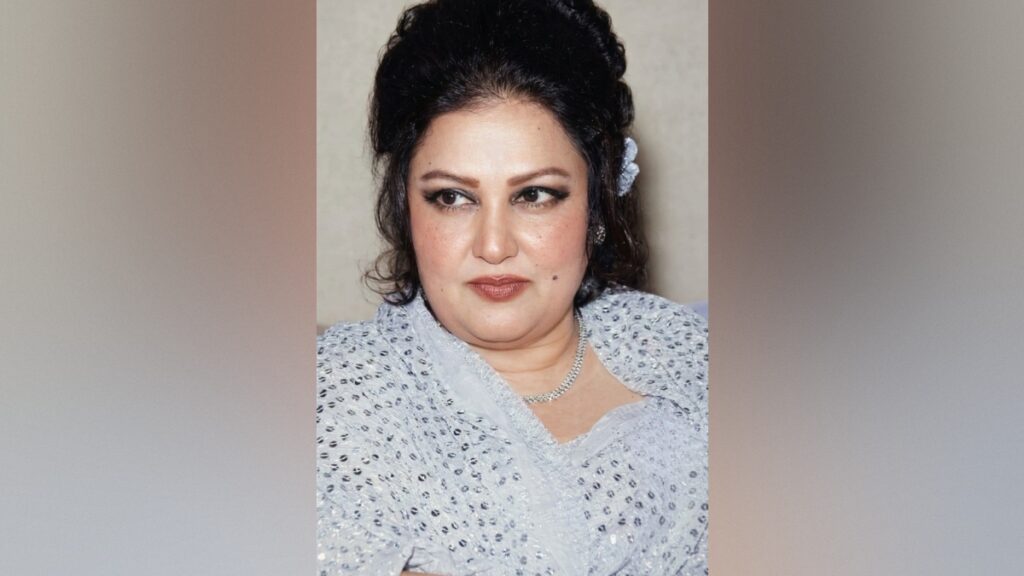
“Jo bhikh liya tera, wohi mujhe qubool hai…” — the haunting words carry the unmistakable emotional force of a voice that captivated generations across the Indian subcontinent. That voice belonged to Malika-e-Tarannum Noor Jehan, one of the most influential singers and performers in South Asian musical history.
Born Allah Rakhi Wasai on 21 September 1925 in Kasur, Punjab, then part of British India, Noor Jehan grew up in a large family of 11 siblings. Her parents, Imdad Ali and Fateh Bibi, were closely connected with music, and the artistic environment of her childhood played a significant role in shaping her future. From an early age, her exceptional voice and natural musical ability set her apart.
Noor Jehan entered the entertainment world as both a singer and an actress. Her career began during the era of British India and continued after the creation of Pakistan in 1947. Over more than six decades, she established herself not merely as a popular playback singer but as an artist whose distinctive voice and expressive style left a lasting mark on the region’s cultural landscape.
Her repertoire crossed musical and linguistic boundaries. She performed ghazals, film songs, folk compositions and patriotic music, while elements of Hindustani classical music could also be heard in her vocal style. She recorded songs in several languages, including Urdu, Punjabi, Sindhi, Pashto and Persian. Although different sources have cited varying figures for the total number of songs she recorded, the sheer scale of her recorded work remains a defining feature of her extraordinary career.
Her contribution to cinema was equally significant. Noor Jehan combined acting with singing and became an important figure in the development of Pakistani cinema. She is also remembered as one of the country’s pioneering female film directors. Her work demonstrated that her artistic abilities extended well beyond singing.
Her collaborations with other prominent performers also became part of Pakistan’s musical heritage. Her duets with singer Ahmed Rushdi, in particular, gained considerable popularity and remain associated with the golden era of Pakistani film music.
Noor Jehan’s contribution received recognition at the highest levels of the Pakistani state. In 1965, she received the Pride of Performance for her contribution to acting and music. During the 1965 India-Pakistan war, her patriotic songs became particularly prominent and helped strengthen her public image as a major cultural voice of the period. She later received other state honours, including the Tamgha-e-Imtiaz and Sitara-e-Imtiaz. She was also honoured with lifetime achievement recognitions during and after her lifetime.
Away from the spotlight, her personal life went through several major changes. In 1942, she married Shaukat Hussain Rizvi, with whom she had three children. Their daughter, Zile Huma, later followed her mother’s path and became a singer. Noor Jehan and Rizvi divorced in 1953.
She married film personality Ejaz Durrani in 1959, and they had three children. That marriage also ended in divorce in 1970. Despite the personal challenges she experienced over the years, her professional career continued to flourish and her artistic identity remained remarkably strong.
Perhaps the most enduring quality of Noor Jehan’s singing was her ability to communicate emotion. Her voice could convey longing, heartbreak, romance, joy and sorrow with remarkable intensity. She did not simply deliver lyrics; she gave them emotional character. That quality helped her songs remain relevant long after their original release.
Noor Jehan died on 23 December 2000, bringing to an end the life of one of the most celebrated voices of the subcontinent. Yet her death did little to diminish her presence in South Asian music.
Her songs continue to circulate through recordings, radio archives, films and the memories of music lovers. Generations who were born long after her greatest performances can still encounter the distinctive power of her voice. Her influence can also be traced through singers who inherited an artistic tradition in which emotional expression and vocal individuality were central.
Noor Jehan was much more than a celebrated singer. She was an actress, filmmaker and cultural figure whose career spanned major political and social transformations in South Asia. From the final decades of British India to the development of Pakistan’s post-independence film and music industries, her artistic journey became closely intertwined with the region’s modern cultural history.
Her voice has fallen silent, but the music remains. Every time one of her songs is played, a part of that extraordinary era returns — carrying with it the emotion, artistry and unmistakable presence of the woman remembered as the Queen of Melody.
For generations of listeners, Noor Jehan remains not simply a name from the past, but a defining voice of South Asian music — an artist whose songs continue to live through memory, recordings and the enduring affection of her audience.