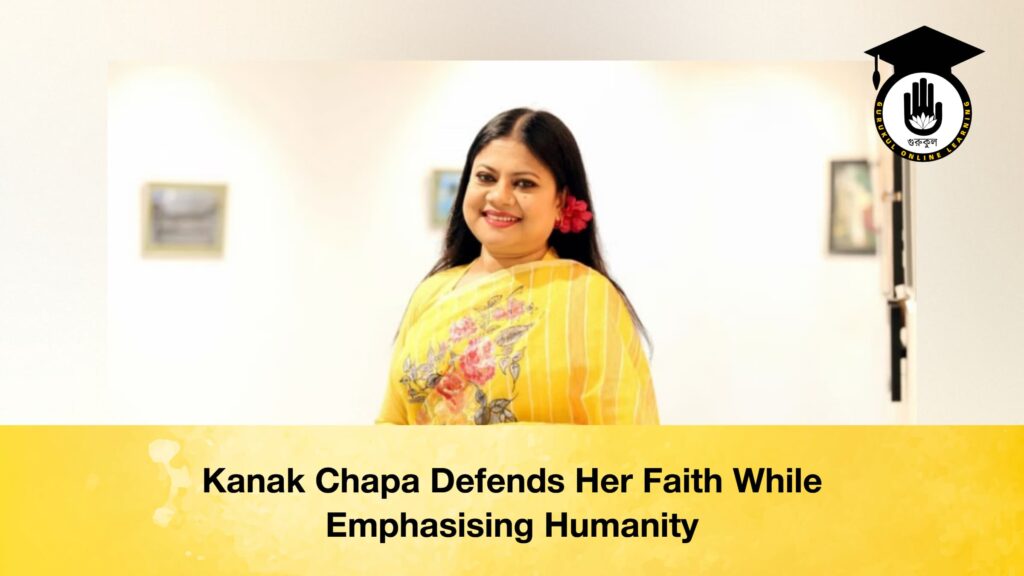
Popular Bangladeshi singer Rumana Morshed Kanak Chapa has shared a strongly worded message about her religious beliefs, Islamic values and the relationship between faith and humanity, addressing what she described as prevailing attitudes within civil society.
In a lengthy Facebook post published on Sunday night, the singer spoke openly about her identity as a Muslim, her love for Islam and her commitment to religious principles. She also challenged the notion that working for humanity requires people to distance themselves from religious beliefs or practices.
Introducing herself, Kanak Chapa described herself as a Bangladeshi citizen and a proud Muslim. She also acknowledged the affection and support of her fans, whom she portrayed as a reflection of the love she has for others. The singer said she respected her admirers deeply and valued the relationship she had built with them through music.
Kanak Chapa also shared details of her family background and educational interests. She said her father, Azizul Haque Morshed, had served as a deputy director at the Bangladesh Water Development Board and was a man of varied interests. Her mother, Momena Jahan, was an Islamic thinker and social worker. Although her parents came from Kazipur in Sirajganj, she was born and raised in Dhaka.
Her husband, Mainul Islam Khan, is a composer and music director. The singer added that she remained keenly interested in education and continued to read and learn about different subjects, describing herself as a dedicated student even now.
Table of Contents
Faith at the centre of her identity
Explaining her religious convictions, Kanak Chapa said she respected all religions but felt the deepest love for Islam, Allah and Prophet Muhammad (peace be upon him). She stressed that she had no hesitation or embarrassment about expressing those beliefs publicly.
She also spoke about remembering Allah regularly and reflecting on death as an inevitable part of human existence. Her post expressed a firm belief in the Day of Judgement, the gathering on the Plain of Resurrection, divine accountability and the prospect of eternal peace in paradise.
The singer said her hopes for the afterlife did not diminish her affection for the world or its living creatures. Rather, her belief in paradise gave her additional hope. She made it clear that she felt no shame in discussing such religious convictions.
Criticism of religious mockery
Kanak Chapa also addressed the mockery of Prophet Muhammad and criticism directed at Islamic etiquette and practices. She expressed the view that those who ridicule the Prophet might reconsider their actions if they understood the significance of what they were doing.
She maintained that such behaviour did not diminish the standing of Islam or the Prophet in the eyes of believers. She also indicated that she did not attach importance to those who made disparaging remarks about Islamic customs.
Her comments reflected her determination to defend her religious beliefs without feeling compelled to apologise for expressing them.
Reading the Quran and understanding its meaning
The singer said her interest in learning extended beyond formal education and textbooks. She regularly read books on a range of subjects, but described the Holy Quran as a particularly remarkable source of knowledge and reflection.
She explained that she read the Quran in Arabic and spent even more time reading its Bengali translation to understand its underlying meaning. Her remarks highlighted the importance she placed on engaging with religious scripture rather than relying solely on inherited beliefs or established practices.
Humanity and religious observance
One of the central themes of Kanak Chapa’s post was the relationship between humanitarian work and religious commitment.
Responding to the idea that humanity is the greatest religion, she acknowledged that compassion and other humane qualities were essential. However, she argued that people could serve humanity while remaining devout and observing the requirements of their faith.
She said she saw no contradiction between religious commitment and helping others. In her view, using humanitarian work as a justification for avoiding religious obligations amounted to an excuse rather than a genuine reconciliation between the two.
Kanak Chapa also observed that peace was a central teaching of religions. However, she rejected the suggestion that someone had to adopt the practices, clothing or celebrations of another faith to promote peace or demonstrate humanity.
She took particular issue with the idea that becoming part of civil society or working for humanitarian causes required a person to deny their religious identity. She said that way of thinking prompted a mixture of compassion and amusement in her.
Family values and personal conviction
Towards the end of her post, Kanak Chapa reflected on the role of family values in shaping personal choices. She acknowledged that other families might be wealthier or enjoy greater social status, but said she continued to regard the rules and guidance established by her own family and guardians as important.
She concluded by emphasising that her commitment to Islam was not simply a consequence of being born into a Muslim family. Rather, she said, it stemmed from her own firm conviction and deep affection for the religion.
Ending her message with the Islamic expression “Alhamdulillah”, she prayed for the well-being of her readers and asked them to pray for her and her family.
The post offered a personal account of how Kanak Chapa understands faith, religious observance and social responsibility. By speaking candidly about her beliefs, the singer underlined her view that religious devotion and concern for humanity can coexist, and that people should not have to conceal their convictions to demonstrate compassion or contribute to society.