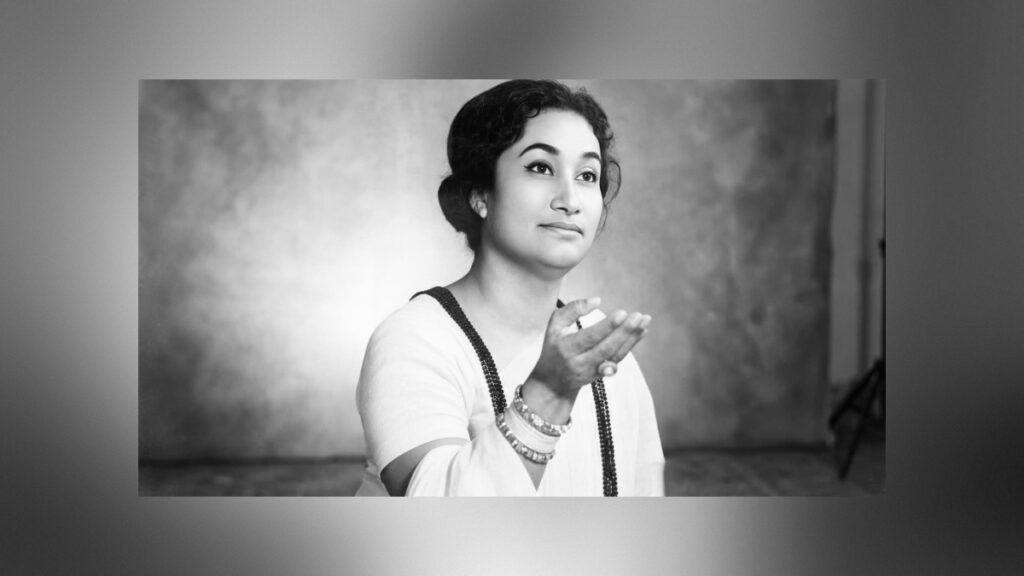
Some voices do more than sing. They preserve the emotions of an era and become inseparable from a nation’s cultural memory. Firoza Begum was one such artist. Through her distinctive voice, the songs of Kazi Nazrul Islam found an enduring place in the hearts of generations, carrying themes of love, longing, devotion, rebellion and humanity.
Firoza Begum was born on 28 July 1930 in the village of Ratail Ghonapara in Gopalganj. Her father was Khan Bahadur Mohammad Ismail and her mother was Begum Kowkabunnesa. Her fascination with music emerged at an early age, eventually leading her to one of the most significant musical relationships of her life — her association with Nazrul.
At just 10 years old, she came into contact with Kazi Nazrul Islam and had the opportunity to receive training in his songs directly from the poet. That early association played a formative role in shaping her musical career and her lifelong commitment to Nazrul Sangeet.
Her talent was evident from childhood. While still in Class VI, she performed on All India Radio. In 1942, at the age of only 12, a 78 rpm record featuring her Islamic songs was released by the renowned His Master’s Voice (HMV) record company. Her early entry into professional music established her as a promising young voice at a remarkably young age.
Her musical journey was later enriched by her association with composer, singer and lyricist Kamal Dasgupta. The two married in 1955. After living in Kolkata from 1954, Firoza Begum returned to Dhaka in 1967.
Yet her most enduring identity was established through Nazrul Sangeet.
Her first record featuring Nazrul’s songs was released in 1949. From then on, her voice became closely associated with the poet’s musical creations. Following Nazrul’s illness, Firoza Begum also played an important role in preserving and presenting his songs with attention to their established melodies and musical notation.
In her rendition, Nazrul’s songs could take on very different shades of emotion. Songs of love conveyed intimacy and tenderness, while songs of separation carried a profound sense of longing. Devotional compositions reflected surrender and spiritual feeling, while Nazrul’s songs of rebellion resonated with resistance to injustice and oppression.
Her interpretations helped bring Nazrul’s music to successive generations of listeners. For many audiences, her voice became one of the defining sounds through which the songs of Nazrul were experienced.
Firoza Begum’s repertoire, however, extended beyond Nazrul Sangeet. She performed modern Bengali songs, ghazals, qawwalis, bhajans, hamd and naat. She also performed extensively outside Bangladesh, taking part in more than 380 solo musical programmes in different countries. Her vocal quality and distinctive style earned her recognition well beyond the country’s borders and established her as a prominent figure in the wider musical landscape of the Indian subcontinent.
Over a career spanning several decades, countless songs in her voice were recorded and released in different formats, including LPs, EPs, audio cassettes and CDs. Whether on stage, radio or recorded media, she maintained a distinctive artistic identity.
One notable moment came in 1972, when she performed alongside Kamal Dasgupta at the Banga Sanskriti Sammelan in Kolkata. Their appearance as both musical collaborators and husband and wife became another memorable chapter in their long association with music.
Firoza Begum received numerous honours in recognition of her contribution to music. In 1979, she was awarded the Independence Award, Bangladesh’s highest civilian honour. She also received the Ekushey Padak, Netaji Subhas Chandra Award, Satyajit Ray Award, Nasiruddin Gold Medal, Bangladesh Shilpakala Academy Gold Medal, Nazrul Academy Award and Churulia Gold Medal, among other distinctions.
Burdwan University awarded her an honorary D.Litt degree. In 2011, she received the Meril-Prothom Alo Lifetime Achievement Award, followed by the West Bengal government’s Banga Bhushan honour in 2012.
For all the recognition she received, however, Firoza Begum’s greatest legacy lies in the body of music she left behind. Her recordings helped preserve an important tradition of Nazrul Sangeet and ensured that the poet’s compositions continued to reach listeners through her highly recognisable interpretation.
Firoza Begum died on 9 September 2014. With her death, Bangladesh lost one of its most celebrated voices in Nazrul Sangeet. Yet her passing could not silence the music that had defined her career.
Her voice continues to be heard in songs of love and separation, devotion and rebellion. Her recordings remain part of the musical heritage of Bangladesh, while her interpretation of Nazrul’s compositions continues to hold a special place in the country’s cultural memory.
Firoza Begum’s contribution cannot be measured simply by the number of awards she received or recordings she made. Her enduring achievement was her ability to give Nazrul’s words and melodies a powerful vocal identity that resonated across generations.
On her death anniversary, she is remembered not only as a legendary singer but also as one of the artists who helped preserve and popularise the musical legacy of Kazi Nazrul Islam.
Firoza Begum may have fallen silent, but the voice that carried Nazrul’s songs remains alive through her recordings and in the memories of countless listeners.
Her musical legacy continues to shine as a lasting chapter in the history of Bengali music.
A respectful remembrance of the legendary Firoza Begum.