
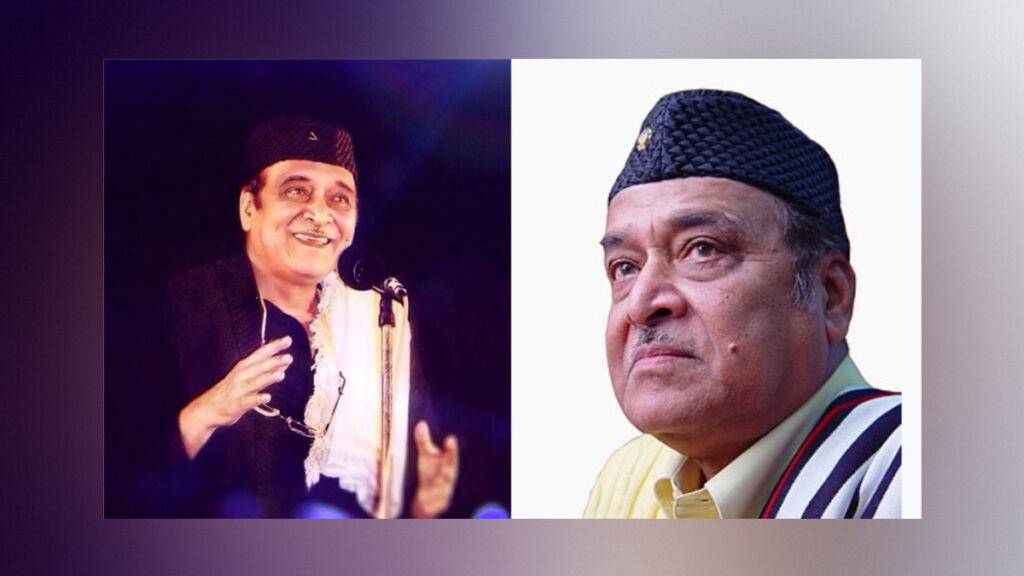
Bhupen Hazarika remains one of the most influential figures in the musical heritage of the Indian subcontinent. Renowned for his remarkably deep voice, powerful lyrics and distinctive musical compositions, he won the affection of generations of listeners. While bringing Assamese music to a wider international audience, he also made significant contributions to Bengali and Hindi music. His songs were far more than entertainment; they became expressions of humanity, equality, social consciousness and resistance against injustice. Years after his death, his music continues to touch hearts and inspire audiences across linguistic and geographical boundaries.
Born on 8 September 1926 in Sadiya, Assam, Hazarika developed an interest in music at an early age. The lullabies sung by his mother and the traditional folk music of Assam played an important role in shaping his musical sensibilities. His talent became apparent during childhood. At just 10, he attracted attention with his singing at a public event. In 1939, aged only 12, he made his debut in the film music industry by lending his voice to the Assamese film Indramalati. This early opportunity marked the beginning of an extraordinary musical journey.
Alongside his artistic pursuits, Hazarika maintained a strong commitment to education. He studied at Cotton College in Guwahati before attending Banaras Hindu University. He later travelled to the United States for higher studies, earning a doctorate in Mass Communication from Columbia University.
His years in the United States proved particularly influential. During this period, he became acquainted with American singer and civil rights activist Paul Robeson. Robeson’s music, political awareness and commitment to social justice left a lasting impression on Hazarika. The experience helped shape his understanding of music as a medium for communicating social concerns and addressing human rights. In the years that followed, inequality, discrimination, human dignity and social justice became recurring themes in his compositions.
After returning to India, Hazarika became associated with the Indian People’s Theatre Association (IPTA), a cultural movement that used music, theatre and other art forms to highlight social and political issues. His involvement strengthened his belief that music could give a voice to ordinary people and reflect the realities of their lives.
He gradually established himself as a distinctive singer, songwriter and composer in Assamese music. One of his most celebrated compositions, Manuhe Manuhar Babe, remains a powerful musical expression of humanity, compassion and mutual responsibility. Its message transcended linguistic boundaries, particularly through its Bengali version, Manush Manusher Jonyo, which became immensely popular in Bangladesh. The song continues to remind listeners of the importance of standing beside one another and recognising the shared responsibilities of human society.
Other notable compositions include Bistirno Dupare, Moi Eti Jajabor and Ganga Mor Maa. These songs reflect his ability to combine personal emotions with broader social realities. His lyrics frequently explored the lives of ordinary people, the struggles of marginalised communities and the relationship between human beings and nature.
Although Assamese music remained central to his artistic identity, Hazarika’s contribution to Bengali music was equally significant. His songs reached a wide audience in both India and Bangladesh, earning him a special place among Bengali-speaking listeners. His distinctive voice and emotionally rich compositions gave his music a lasting appeal. Bistirno Dupare, in particular, became widely recognised beyond Assam and was adapted into different languages, carrying its powerful message to audiences across the region.
Hazarika also established himself as an accomplished film music director. In 1975, he received the National Film Award for Best Music Direction for the Assamese film Chameli Memsaab. His work in Hindi cinema further demonstrated his versatility. Through his association with filmmaker Kalpana Lajmi, he composed music for films including Ek Pal, Rudaali and Daman. Among these, the song Dil Hoom Hoom Kare from Rudaali became one of the most memorable compositions of his career. Its haunting melody and emotional depth continue to resonate with film music enthusiasts.
Throughout his long career, Hazarika worked as a singer, lyricist, composer and music director, creating an extensive body of work. His compositions drew heavily on the folk traditions and cultural identity of Assam. Rivers, landscapes, rural communities, social struggles and human relationships featured prominently in his music.
The Brahmaputra held a particularly important place in his artistic imagination. The river was not simply a geographical feature; it represented the lives, hardships, hopes and emotions of the people living along its banks. Its influence can be heard in several of his compositions, which explore the relationship between nature and human existence. His deep connection with the river also earned him the affectionate description of the ‘Poet of the Brahmaputra’.
One of the defining characteristics of Hazarika’s music was his ability to transform regional experiences into universal expressions. Although rooted in Assamese culture, his compositions addressed emotions and concerns that people from different backgrounds could understand. This quality helped his music reach far beyond the boundaries of his home state.
His extraordinary contribution to music and culture earned him numerous national honours. He received the Padma Shri in 1977, followed by the Dadasaheb Phalke Award in 1992, one of India’s most prestigious recognitions for contributions to cinema. In 2001, he was awarded the Padma Bhushan, while the Sangeet Natak Akademi Fellowship followed in 2008.
Recognition continued even after his death. In 2012, he was posthumously awarded the Padma Vibhushan, India’s second-highest civilian honour. In 2019, he received the Bharat Ratna, the country’s highest civilian award, in recognition of his exceptional contribution to Indian music and culture.
His connection with Bangladesh also forms an important part of his legacy. In recognition of his contribution to the country’s Liberation War, he received the Friends of Liberation War Honour in 2011. His music, particularly his Bengali compositions, has long enjoyed a special place among Bangladeshi listeners, reflecting the cultural ties shared by the two neighbouring countries.
Bhupen Hazarika passed away in Mumbai on 5 November 2011, aged 85. His death marked the end of an extraordinary chapter in the musical history of the subcontinent. Yet his artistic journey did not end with his passing. His compositions continue to be performed, remembered and rediscovered by successive generations.
As musical tastes and styles evolve, the human values embedded in Hazarika’s work remain relevant. His songs speak of compassion in a divided society, dignity in the face of hardship and solidarity among people regardless of their differences. For listeners in Bangladesh and India, his music represents a shared cultural heritage that continues to bring people together.
More than a celebrated singer or composer, Bhupen Hazarika was an artist who used music to express the hopes, struggles and emotions of humanity. His powerful voice may have fallen silent, but the message carried through his songs remains alive. Through his timeless compositions, he continues to occupy a cherished place in the hearts of music lovers.