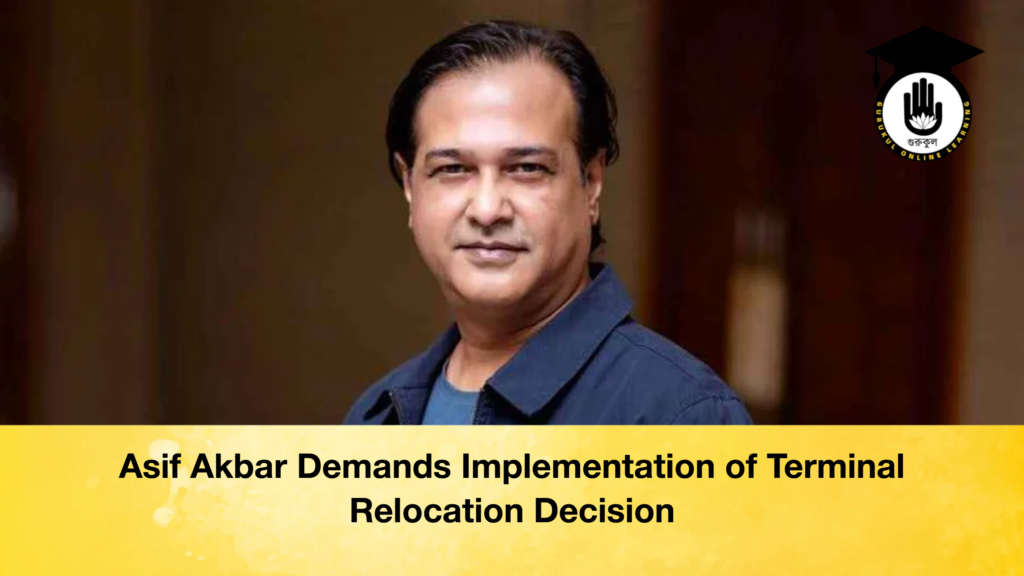
Prime Minister Tariq Rahman has ordered the relocation of the Sayedabad, Gulistan, and Mohakhali bus depots to restore discipline on the capital’s streets and resolve long-standing traffic congestion. Following this administrative directive, prominent vocalist Asif Akbar expressed his views on social media, urging that this critical decision regarding the three major terminals must not be shelved or delayed by bureaucratic inefficiencies, which he referred to as a “corrupt system”.
Table of Contents
Social Media Statement and Personal Observations
On Monday (15 June), the singer published a post on his verified Facebook account to address the relocation decision. In his statement, Akbar noted that the physical placement of these primary bus depots unnecessarily complicates straightforward roadways, causing significant disruption to traffic flow. Reflecting on his own experiences, he stated that he had been a direct witness to and sufferer of this persistent problem since his adolescence, and he demanded a permanent resolution to the issue. He explicitly stated that the primary demand of the public is to ensure that this public-interest initiative does not become buried in bureaucratic files due to systemic failures of the past.
Concerns Over Highway Chaos and Three-Wheelers
Beyond the relocation of the terminal depots, Akbar emphasised the urgent need for comprehensive measures to prevent disorder on national highways. He highlighted the issue of unregulated battery-operated auto-rickshaws—locally referred to as “Tesla”—which have proliferated from narrow alleys onto major highways.
According to his post, these vehicles are frequently operated by unskilled drivers, leading to frequent road accidents that cause injuries and fatalities. He noted that these operators lack valid driving licences and show no inclination to abide by established traffic regulations. Furthermore, he stated that when affected citizens protest against these violations, the drivers frequently group together to instigate altercations. Consequently, he appealed to the democratically elected government to enforce strict order across the road and highway networks.
The core issues highlighted by the artist, along with his specific demands, are structured in the analytical table below:
Summary of Relocation Directives and Public Concerns
| Focus Area | Identified Grievances and Context | Stated Demands and Expectations |
| Bus Terminal Depots | Sayedabad, Gulistan, and Mohakhali depots causing gridlock on main roads. | Immediate execution of the Prime Minister’s directive without bureaucratic delay. |
| Battery-Operated Rickshaws | Unregulated movement on highways, lack of licences, and unskilled driving causing accidents. | Rapid and effective administrative intervention to curb highway lawlessness. |
| Public Compliance | General reluctance among citizens to voluntarily adhere to traffic laws. | Introduction of systematic discipline for commuters and pedestrian networks. |
| Regulatory Enforcement | Initial signs of improved traffic management currently visible on Dhaka streets. | Implementation of strict financial penalties for traffic violators to ensure order. |
Civic Discipline and Penalties
In the concluding section of his social media statement, the vocalist stressed the importance of civic responsibility, observing that many citizens often resist complying with statutory laws. To rectify this behavioural trend, he suggested that enforcing strict financial penalties and fines on violators would be the most effective mechanism to establish order within the road traffic system.
He noted that certain positive changes and visible examples of disciplined enforcement have recently become apparent on the streets of Dhaka. Finally, Akbar expressed his appreciation to the Prime Minister for rendering a public-friendly decision, concluding his message with an expression of continuous support.