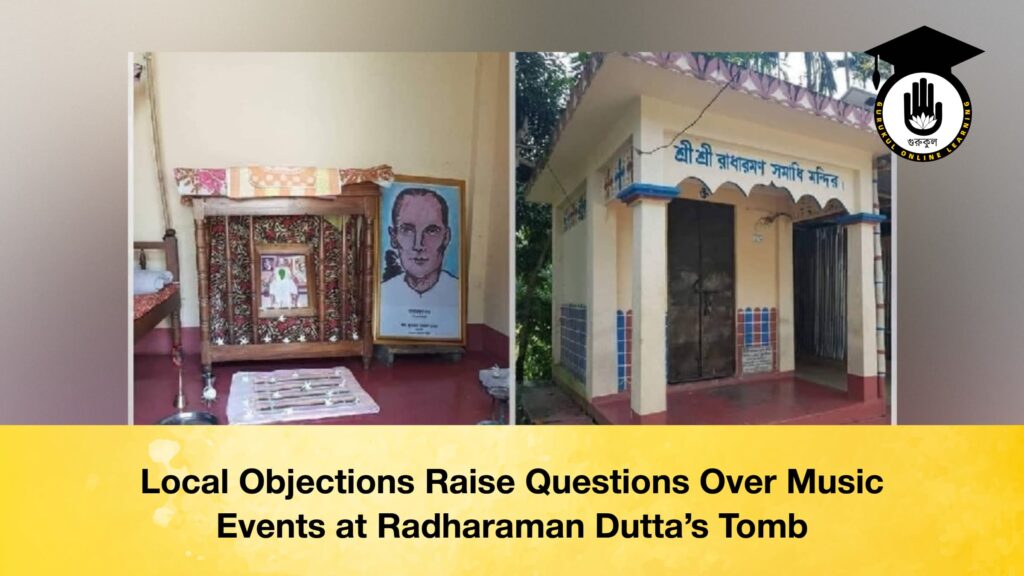
A fresh dispute over folk music gatherings has emerged in Sunamganj, where members of a local Islamic organisation have asked the authorities to prevent musical events and what they describe as un-Islamic activities near the cemetery beside the tomb of mystic poet Radharaman Dutta.
Members of the Keshabpur Islamic Organisation Committee submitted a written application to the Upazila Nirbahi Officer (UNO), the chief administrative official of the sub-district, on Monday, 26 October. The application expressed concern about plans to hold musical events near the cemetery in Keshabpur village, under Jagannathpur upazila.
The request comes days after objections from some local residents led to restrictions on a Baul music gathering in neighbouring Dirai upazila, bringing renewed attention to tensions surrounding traditional folk performances in the region.
Radharaman Dutta, a celebrated figure in Bengali folk culture, is particularly renowned for his contribution to Dhamail songs and dance. His compositions remain an important part of the region’s cultural heritage, and Baul music gatherings are held annually near his tomb in Keshabpur.
In their application, the committee members said they had learned that some people were planning to organise musical performances and other activities in the poet’s name near the cemetery. They expressed the view that such activities were inconsistent with Islamic principles and argued that holding them beside a burial ground could cause disagreement among local residents.
The signatories urged the administration to consider the matter seriously in the interests of public order and community harmony. They warned that musical events at the site could lead to disputes and potentially disrupt peace in the area. They also requested an investigation and appropriate measures to address their concerns.
Among those who signed the application were local residents Kadir Mia, Rafiq Mia, Md Toyemuch Ali, Ankar Mia, Khaled Mia, Sohel Mia, Md Rafiqul Mia, Jahangir Mia, Abu Mia, Rafiq Ali, Dila Mia, Wahid Mia, Ekhlak Mia, Abu Taher, Awlad Mia and Tarek Mia, along with others.
However, Jagannathpur UNO Md Islam Uddin clarified on Tuesday afternoon that the application should not be interpreted as a demand to stop music altogether.
He said the committee had asked that musical events not be organised beside the cemetery, rather than calling for a complete ban on music. The administration intends to discuss the matter with all concerned parties before deciding how the programme marking Radharaman Dutta’s legacy should be organised.
The UNO said the authorities would seek to protect the sanctity of the cemetery while working towards a more appropriate and larger-scale arrangement for the event. A decision would be taken after consultations with those involved.
The issue follows a separate controversy in Dirai, where a Baul music gathering at the home of Shaukat Ali, a British expatriate, in Hatia village was initially declared cancelled after objections to the participation of female performers.
Two local residents reportedly submitted an application to Dirai police on Wednesday, raising concerns that the proposed performances by women could lead to obscenity in the name of music. Police subsequently spoke to Shaukat Ali, who announced that the event would not go ahead.
Local residents said, however, that a smaller musical gathering eventually took place on Thursday night.
Hatia village is in Kulanj Union, while Ujandhal village, in neighbouring Taral Union, is known as the home of the late Baul maestro Shah Abdul Karim.
The developments have highlighted differing views over the organisation of traditional musical events in parts of Sunamganj. While Baul music and the works of figures such as Radharaman Dutta and Shah Abdul Karim hold a significant place in Bengali folk heritage, some residents have raised objections based on religious concerns and the location of performances.
The Jagannathpur administration’s proposed consultations are expected to determine how the Radharaman Dutta programme can proceed while addressing local concerns and preserving the cultural significance of the gathering.