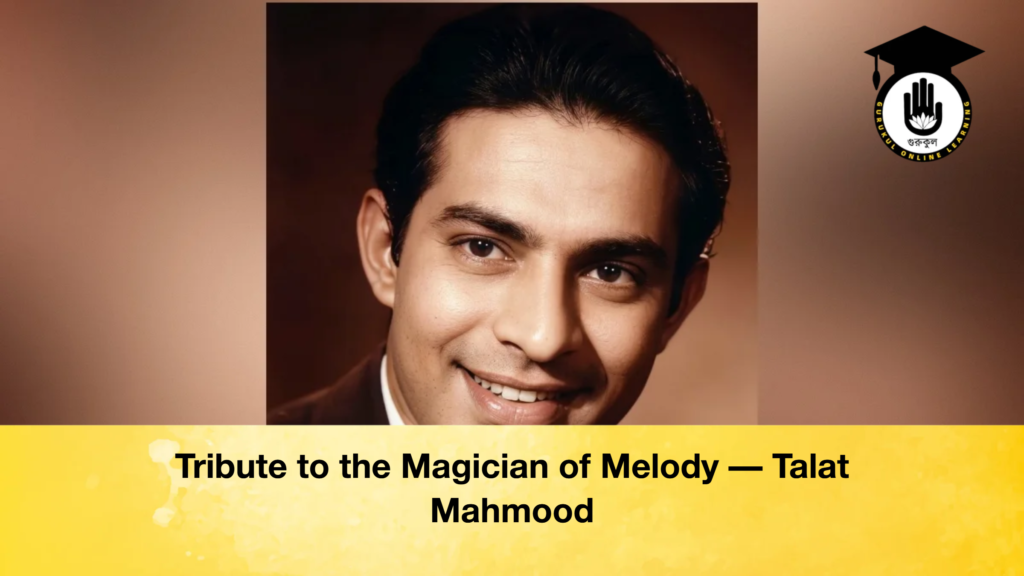
Talat Mahmood remains one of the most distinguished voices in the musical heritage of the Indian subcontinent, widely recognised for his distinctive vocal softness and emotive expression. His singing style, marked by smooth tonal quality and subtle emotional depth, established him as a leading figure in the genre of ghazal and light classical music.
Born on 24 February 1924 in Lucknow, India, into a respected but traditionally conservative family, Mahmood developed an early interest in music. Despite significant familial opposition to his pursuit of a musical career, he ultimately chose to follow his passion. This decision proved pivotal in shaping his future, and over time, his family accepted his professional path.
By the age of sixteen, he had already begun gaining attention as a ghazal singer, interpreting works by notable Urdu poets including Daagh, Jigar, and Mir. His early association with music was formalised through his participation in All India Radio, which provided an important platform for his emerging career.
His professional recording journey began when he signed with the His Master’s Voice (HMV) record label. In 1941, he recorded the ghazal “Sab Din Ek Samaan Nahin Tha”, which contributed significantly to his growing recognition. His popularity expanded further in 1944 following the release of “Tasveer Teri Dil Mera Behla Na Sakegi”, which established him as a widely admired vocalist across the Indian subcontinent.
Mahmood’s reputation as a ghazal singer earned him the honorary title of “Ghazal King”. However, his musical contributions were not limited to ghazals alone. He also made a substantial impact on Bengali modern songs, film music, Nazrul Geeti, and devotional compositions including Hamd and Naat. His versatility enabled him to reach diverse audiences across linguistic and cultural boundaries.
In 1960, he travelled to Dhaka, where he lent his voice to film music, further strengthening his presence in the Bengali music industry. His songs in Bengali cinema and modern music remain notable contributions to the cultural landscape of the region.
The key milestones of his life and career are summarised below:
| Year / Period | Event |
|---|---|
| 1924 | Born in Lucknow, India |
| Early life | Developed interest in music despite family opposition |
| Early 1940s | Began career through All India Radio |
| 1941 | Recorded “Sab Din Ek Samaan Nahin Tha” with HMV |
| 1944 | Gained wide recognition with “Tasveer Teri Dil Mera Behla Na Sakegi” |
| 1960 | Visited Dhaka and contributed to film music |
| 1998 (9 May) | Passed away |
Throughout his career, Talat Mahmood received several state honours from the Government of India in recognition of his contribution to music. His artistic output continues to be regarded as an important part of South Asian musical history.
He passed away on 9 May 1998, but his recordings remain preserved in the cultural memory of the region, maintaining their relevance among successive generations of listeners.