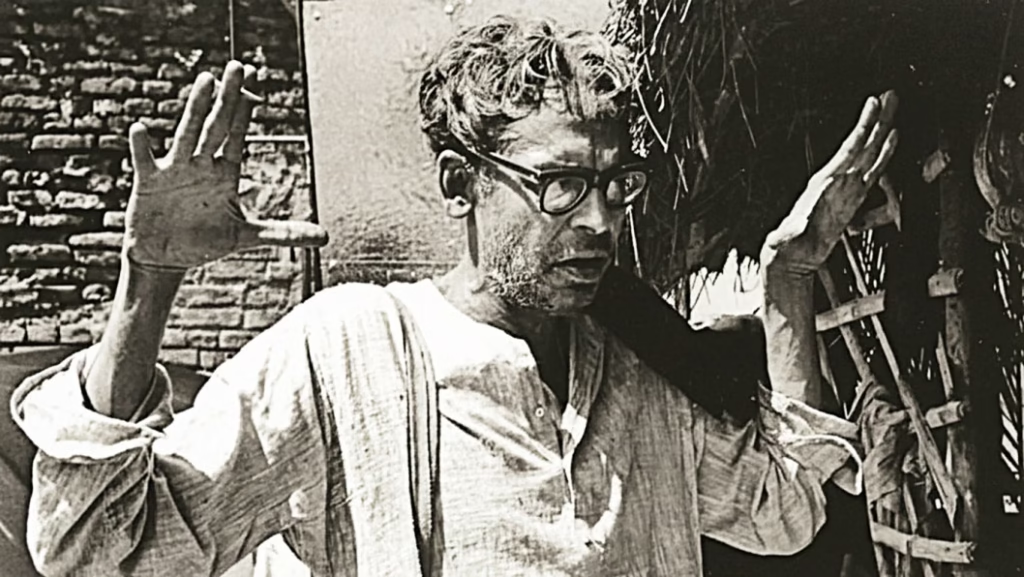
Ritwik Kumar Ghatak, the celebrated Bengali author, playwright, and film director, was born on November 4, 1925, in East Bengal (now Bangladesh). The son of Rai Bahadur Suresh Chandra Ghatak, a district magistrate, and Indubala Devi, Ghatak’s early life was marked by significant upheaval. His family moved from Dhaka to Berhampore and later Kolkata in the 1940s, amid the turmoil of the Second World War, the Bengal Famine, and most profoundly, the Partition of India in 1947.
The political and social upheavals of the era deeply influenced Ghatak’s work, which often focused on the trauma of displacement caused by Partition, the severing of Bengal into two parts, and the ongoing crisis of Bengali cultural identity. His films, plays, and writings are an archive of these struggles, particularly the mass migration of Hindu families from East Bengal to India and the violent fractures within Bengali society.
Although many of Ghatak’s works touch upon the Partition, it is his trilogy of films—Meghe Dhaka Tara (The Cloud-Capped Star, 1960), Komal Gandhar (E-Flat, 1961), and Subarnarekha (1962, released in 1965)—that provide the most profound cinematic exploration of the trauma and dislocation caused by the division. In his contemporaneous writings, film critic and filmmaker Satyajit Ray observed that Ghatak’s “lifelong obsession” with the tragedy of Partition set him apart, highlighting the depth of his emotional and cultural connection to the subject.
In Komal Gandhar, the film opens with the “Niriksha” theatre troupe staging a play that begins with an elderly man angrily asking, “Why should I leave?” His words echo the sentiment of millions who were forced to abandon their homeland. The scene, filled with haunting dialogue and powerful imagery, illustrates the pain of losing one’s birthplace and culture. The film juxtaposes this personal trauma with images of mass migration—human silhouettes moving across a barren landscape, evoking the vast refugee crises triggered by the Partition.
The film goes on to show Anasuya and Bhrigu, two displaced individuals from East Bengal, who arrive in the Indian border town of Lalgola, where they pause on the riverbank of the Padma to reflect on the land they left behind. Anasuya speaks of her ancestral home, now lost across the river in East Bengal, invoking memories of childhood and a sense of tranquillity that no longer exists. Bhrigu, too, shares a similar sentiment: his birthplace is now unreachable, and the once-connecting railway tracks now mark a painful division. For both, their homeland has become foreign—”bidesh”—forever out of reach.
This theme of dislocation and the anguish of the displaced runs through all three films of Ghatak’s Partition trilogy. In Meghe Dhaka Tara, Ghatak explores the social and economic consequences of Partition, focusing particularly on the lives of women in displaced families. Neeta, the protagonist, must take on the role of the family’s economic provider after the collapse of their once-stable life. Her work in various jobs, a symbol of the changing social landscape, also signifies the burdens imposed on women in a society reeling from the effects of war and displacement. Yet, despite her efforts, Neeta’s sacrifice takes a physical toll on her health, and she contracts tuberculosis. The disease symbolises both her personal entrapment within her family’s needs and a broader social decay, where compassion and selflessness often lead to exploitation and suffering.
In Subarnarekha, the final film in the trilogy, Ghatak revisits the traumatic effects of Partition through the character of Seeta, a young girl who, after losing her family, is forced to adapt to new lives in multiple refugee colonies. The film questions what constitutes “home” in a world divided by borders and communities torn apart by religious and ethnic divides. Seeta’s repeated displacements echo the emotional fragmentation that many refugees experience, a theme that is carried over into her own children, who continue to ask, “Is this my new home?” This generational trauma of homelessness and loss resonates throughout the film, reinforcing the enduring consequences of Partition.
In all three films, Ghatak’s work challenges the logic of Partition and its religious underpinnings, advocating for a syncretic Bengali culture. He famously interweaved songs from both Muslim and Hindu traditions in Komal Gandhar to express his longing for a reunited Bengal, free from the sectarian divisions caused by Partition. Ghatak’s personal desire for cultural unity is encapsulated in his remark, “I am not talking about a political union of the two Bengals … I am talking about a cultural reunion.”
Throughout these films, Ghatak explores the suffering of those displaced by Partition, particularly the marginalised, such as women and lower-caste individuals, who bear the brunt of societal and familial breakdowns. The anguish of these characters becomes a metaphor for the crumbling state of Bengal itself, as the region’s once-unified cultural and social fabric is torn apart.
The profound sense of grief and loss in Ghatak’s cinema is evident in numerous symbolic scenes, such as Neeta’s isolation in Meghe Dhaka Tara, where her tuberculosis—both a personal and social affliction—represents the larger decay of a society that no longer values or nurtures the selfless. As her health deteriorates, she becomes a metaphor for a Bengal that is slowly disintegrating, unable to heal from the wounds of Partition.
In Subarnarekha, the film culminates with the tragic fate of Seeta, whose dislocation and eventual suicide reflect the ultimate despair of a people who have been torn from their roots. The characters in Ghatak’s films are forever grappling with the impact of a violent and arbitrary division of their homeland—something that continues to resonate with viewers even decades after the films were made.
Ghatak’s reflection on the state of Bengal in the twentieth century is a testament to his unshakeable commitment to exploring the consequences of the Partition: “In our boyhood, we have seen a Bengal whole and glorious. … This was the world that was shattered by the War, the Famine, and when the Congress and the Muslim League brought disaster to the country and tore it into two to snatch for it a fragmented independence. Communal riots engulfed the country. … Our dreams faded away. We crashed on our faces clinging to a crumbling Bengal, divested of all its glory.”
Ritwik Ghatak passed away on February 6, 1976, but his cinematic legacy endures. Through his work, he continues to bear witness to the ravages of Partition, offering an unflinching portrayal of its human cost and the deep scars it left on the Bengali people.