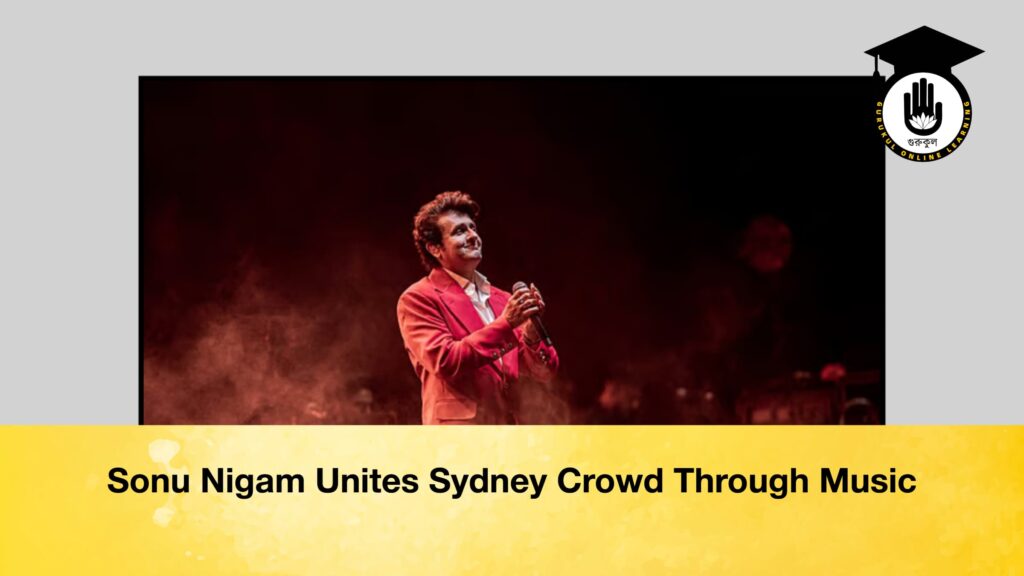
Severe hail and thunderstorms swept across Sydney on Saturday afternoon, creating difficult conditions for people travelling across the city. Visibility on the roads dropped sharply as the storm intensified. Yet despite the weather, thousands of music lovers made their way to the Tumbalong Park precinct in Darling Harbour for Indian singer Sonu Nigam’s ‘Revolution Tour’ concert.
Inside the venue, the atmosphere could not have been more different from the turbulent weather outside. Around 9,000 people packed the entertainment centre, leaving little room in the auditorium. Even designated areas for wheelchair users were occupied, reflecting the scale of the audience turnout.
Despite the large crowd, the event was reported to have been orderly. Audiences entered the venue in a controlled manner and left in much the same way after the performance. The Sydney leg of Sonu Nigam’s tour was organised by Cinestar Events.
Table of Contents
A concert that began on time
The concert was scheduled to begin at 7.30pm, and Nigam appeared on stage almost precisely at the announced time. There was no lengthy opening ceremony, a series of promotional speeches or prolonged introductions. The evening moved quickly into what the audience had come for — live music.
The performance continued until around 10.45pm, with Nigam moving between songs, dance sequences and conversations with the audience. He had arrived in Sydney after performing in Auckland, New Zealand, the previous day, but there was little visible sign of fatigue during the lengthy performance.
His Australian tour is also scheduled to take him to Melbourne, Brisbane, Adelaide and Perth after the Sydney show.
The concert also paid attention to younger members of the audience. Special hearing-protection devices were made available for children to help reduce the impact of high-volume sound. The lighting and stage production added another dimension to the performance, shifting between bright, energetic sequences and softer, darker arrangements that complemented the emotional character of individual songs.
From silence to celebration
The mood inside the auditorium changed dramatically when Nigam began ‘Sandese Aate Hain’. The lively crowd became noticeably quieter as the song evoked themes of distance, longing and memories of loved ones left behind.
The atmosphere changed again with ‘Yeh Dil Deewana’. Many spectators rose from their seats, dancing and singing along. Other popular numbers, including ‘Suraj Hua Maddham’, ‘Tanhai’ and ‘Panchhi Nadiyan Pawan Ke’, kept the audience engaged.
‘Abhi Mujh Mein Kahin’ brought another moment of intense concentration as Nigam moved through the song’s demanding vocal passages. Towards the end of the concert, he performed ‘Kal Ho Naa Ho’, prompting thousands of people to sing along.
The sight of thousands of mobile phone lights illuminating the auditorium turned the final part of the evening into a striking visual spectacle.
A major commercial-scale production
The concert also demonstrated the considerable commercial appeal of major South Asian musical acts among overseas audiences. Tickets were priced at A$109, A$209, A$309 and A$450. With the venue accommodating around 9,000 people and the audience filling the auditorium, ticket sales represented a substantial commercial component of the event.
However, the total revenue cannot be calculated accurately without knowing how many tickets were sold at each price level. What is clear is that the combination of a large venue, relatively high ticket prices and strong attendance reflected considerable demand for Nigam’s music among audiences in Australia.
The scale of the production was also evident in its sound, lighting and stage arrangements, which were designed to support both the energetic and emotional sections of the performance.
When music crosses language and borders
Perhaps the most striking aspect of the evening was the diversity of the audience. Indian spectators were joined by people from Bangladesh, Pakistan, Nepal, Bhutan, Sri Lanka, the Maldives and Australia.
For many South Asian expatriates, familiar songs can carry memories of home and earlier stages of life. That emotional connection was particularly visible during the more nostalgic performances.
An Australian member of the audience offered another perspective, saying that although he did not understand the language of the songs, the power and emotion in Nigam’s voice moved him deeply. His reaction highlighted the ability of music to communicate even when listeners do not understand every word.
A Bangladeshi spectator similarly pointed to the strong response among the Bangladeshi community whenever major South Asian performers visit Australia. Concerts by artists such as Shreya Ghoshal, A.R. Rahman and Sonu Nigam can bring together people who may otherwise have little reason to share the same space.
For expatriate communities, such events can become more than entertainment. They provide an opportunity to reconnect with familiar languages, melodies and memories while also creating a shared cultural space for people from different countries.
That was perhaps the defining image of Sonu Nigam’s Sydney performance. Indian, Bangladeshi, Pakistani, Nepali, Bhutanese, Sri Lankan, Maldivian and Australian spectators stood alongside one another, singing the same songs.
For several hours, their different nationalities and backgrounds mattered less than the music they shared. In a city known for its multicultural character, Sonu Nigam’s concert offered a vivid reminder that a song can travel far beyond the language in which it is written — and bring strangers together through a common emotion.