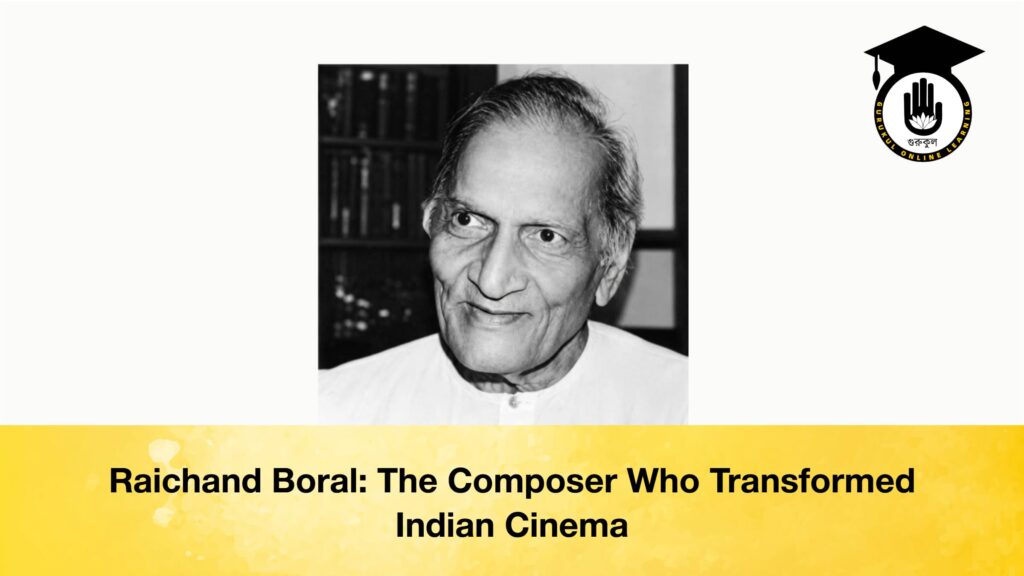
Born on 19 October 1903 in Kolkata into a family deeply rooted in music, Boral was exposed to classical traditions from an early age. His father, Lalchand Boral, was a distinguished practitioner of classical music. Growing up in such an environment, he developed a passion for music that eventually led him to study Hindustani classical traditions and master the tabla. His early training laid the foundation for a musical career that would leave a lasting mark on Indian cinema.
Boral began his professional journey with radio before entering the film industry. In 1931, he joined New Theatres, one of Kolkata’s most prominent film production companies, which played a major role in the development of Bengali and Hindi cinema. There, he worked alongside accomplished musicians, including Pankaj Mullick, contributing to a period of remarkable musical innovation.
One of Boral’s most significant contributions was his involvement in the development of playback singing. In the early years of Indian cinema, songs were often recorded live during filming, requiring actors to sing while performing in front of the camera. This approach imposed technical limitations on both acting and musical presentation.
The introduction of separately recorded songs, later synchronised with the filmed scenes, transformed the process. Boral and filmmaker Nitin Bose played important roles in advancing this technique, which was successfully employed in the 1935 film Dhoop Chhaon. Its adoption marked a major milestone in Indian cinema, opening new possibilities for singers, composers and filmmakers alike.
Boral’s musical style was distinguished by its sophisticated blend of classical depth, the melodic richness of ragas and the emotional demands of cinematic storytelling. He adapted traditional musical elements to suit the narrative and atmosphere of films, creating compositions that were both artistically rich and accessible to audiences. His contributions extended beyond songs to background scores and orchestration, helping establish music as an essential part of the cinematic experience.
Among his notable films as a composer were Chandidas (1934), Devdas (1935), Vidyapati (1937), Street Singer (1938), Sapurey (1939), Lagan (1941) and Saugandh (1942). The music of these productions captivated audiences and contributed to the growing popularity of film songs across the subcontinent.
He also played a significant role in the career of legendary vocalist K. L. Saigal, helping establish him as one of the defining voices of early Indian cinema. Boral’s compositions, performed by Saigal and celebrated singer Kanan Devi, became widely popular. His association with leading artists of the era helped shape the musical identity of Indian films during a formative period.
His outstanding contribution to cinema received national recognition in 1978, when he was awarded the Dadasaheb Phalke Award, India’s highest honour in the film industry. In the same year, he also received the Sangeet Natak Akademi Award, recognising his exceptional achievements in music.
Raichand Boral died in Kolkata on 25 November 1981. His passing marked the end of an extraordinary chapter in the history of Indian film music, but his artistic legacy continued to inspire generations of musicians and filmmakers.
Boral regarded music as far more than an element of entertainment. He understood its ability to convey emotion, deepen a narrative and give cinematic scenes a distinct character. His compositions and innovations helped establish a musical language that became central to Indian filmmaking.
Over the decades, film music has evolved through technological advances, new recording techniques and changing artistic preferences. Yet the foundations laid by pioneers such as Boral remain an important part of its history.
Some artists leave behind creations that transcend their own era. Raichand Boral was one of them. His melodies, musical innovations and dedication to his craft continue to be remembered with admiration, securing his place among the pioneers who shaped Indian cinema.