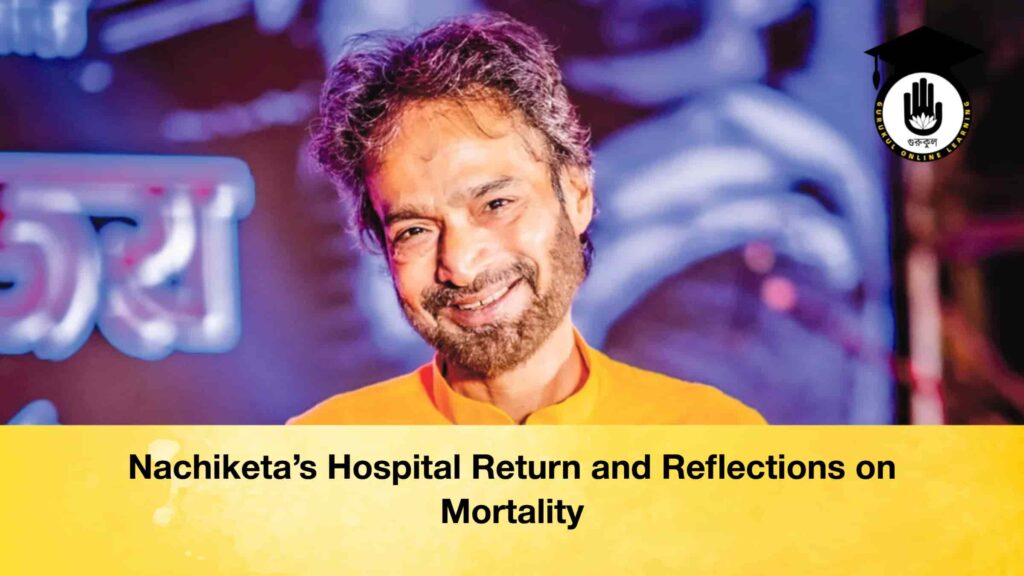
At the beginning of December, popular and influential West Bengal singer-songwriter Nachiketa Chakraborty was suddenly admitted to hospital after experiencing acute chest pain. What began as a moment of grave concern soon unfolded into a sobering medical reality: tests revealed a blockage in his heart. Under constant medical supervision, Nachiketa spent several days in close observation, confronting both physical vulnerability and deep emotional introspection. Gradually, his condition stabilised, and after six days of treatment, he returned home on 12 December. Yet the days spent confined to a hospital bed proved to be more than a medical episode; they became an intense encounter with life’s most inescapable truth—death itself.
During those long, solitary hours in hospital, Nachiketa turned to pen and paper, recording his thoughts and emotions with characteristic honesty. These reflections eventually evolved into a poignant monologue titled Mrityu Masto Phanki (“Death Is the Ultimate Deception”). He recently shared this piece on his Facebook page in video form, delivering the words in his own voice. The video reveals a deeply human Nachiketa—layered with emotion, lived experience, sharp wit, and a trace of wounded indignation.
In the monologue, the singer revisits several moments in his life when he found himself perilously close to death. “I don’t really mind coming back repeatedly from death’s doorstep,” he remarks with disarming calm. He recalls slipping into a coma after a motorbike accident in his youth, witnessing the death of a fellow activist during political unrest, nearly drowning in an abandoned underground railway tunnel, and even attempting suicide as a child. He also speaks of traumatic incidents witnessed at the tender age of six or seven, shaped by a climate of intense social and political turbulence. Another defining struggle came at the age of 47, when he survived a complex Whipple surgery in a Delhi hospital. Together, these memories testify to how often he has walked the fragile line between life and death.
Perhaps the most striking segment of the video, however, is Nachiketa’s candid expression of frustration with social media. Over the years, false reports of his death have circulated repeatedly online. Even during his recent hospitalisation, such rumours resurfaced. Addressing this with bitter humour, he observes, “Social media has killed me more times than my actual lifespan allows.” With mock apology, he adds that perhaps next time the internet declares him dead, he should comply—just to spare others the inconvenience.
The monologue concludes with two evocative lines from his iconic song Agunpakhi, affirming his enduring commitment to life:
“Death is the ultimate deception;
The sky fills my eyes, fire fuels my wings—
There is still so much left to fly.”
Through illness, rumours, and reflection, Nachiketa Chakraborty makes one thing abundantly clear: he is not finished yet. The songs—and the living—continue.