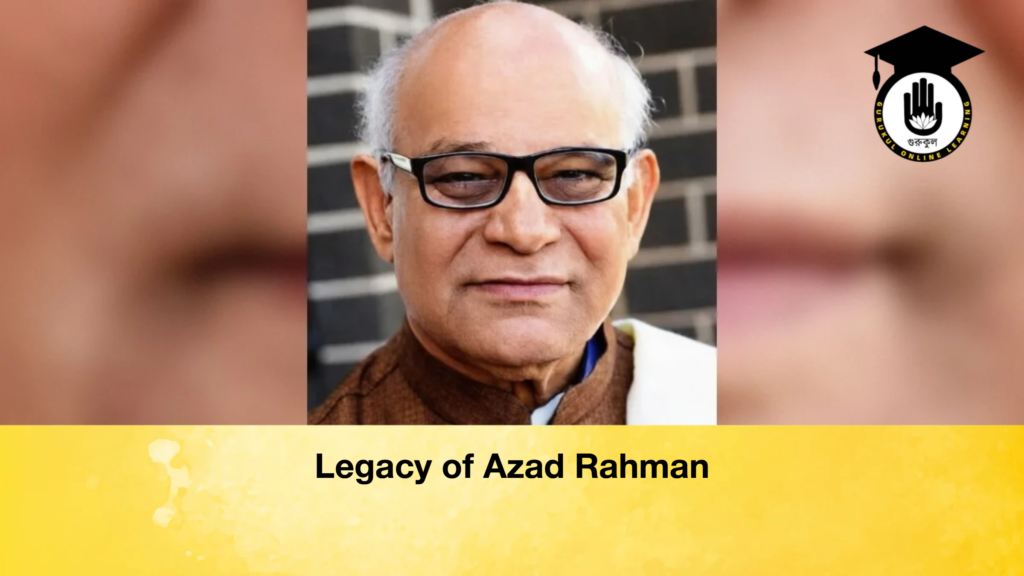
Azad Rahman was one of the most distinguished figures in Bengali music, celebrated for his multifaceted contributions as a vocalist, composer, lyricist and music director. His artistic vision and pioneering work enriched Bengali music with both classical depth and popular appeal, earning him a lasting place in its cultural history.
Born on 1 January 1944 in the Bardhaman district of West Bengal, India, Azad Rahman developed an early fascination with music. This passion led him to rigorous training in classical traditions, particularly Hindustani classical music. He later graduated in Khayal music from Rabindra Bharati University, an achievement that laid the foundation for his lifelong dedication to classical and semi-classical forms. Over time, he became widely regarded as one of the pioneers of Khayal-based music in Bangladesh, with many admirers even referring to him as a founding figure of the genre in the country.
Rahman’s entry into the film industry began in 1967 when he co-directed music for the Bengali film Miss Priyambada, alongside Subir Sen. His debut in Bangladeshi cinema came with the film Agantuk, directed by Babul Chowdhury, marking the beginning of a prolific career in film music direction.
Throughout the 1970s, his compositions and vocal performances gained immense popularity. His music captured emotional depth and lyrical beauty, resonating strongly with audiences across generations. Several of his songs became iconic in Bengali cinema and remain culturally significant to this day.
Selected works and contributions
| Category | Work | Notable Feature |
|---|---|---|
| Film song | Bhalobashar Mullo Koto | From Epar Opar, widely popular romantic track |
| Devotional song | Koro Mone Bhakti Maayer | From Dumurer Phool, devotional classic |
| Folk-inspired song | Doshyu Bonhur | Includes the famous line “Dorakata dag dekhe bagh chena jay” |
| Patriotic song | Jonmo Amar Dhonno Holo Ma Go | Iconic nationalist composition |
| Film music debut (Bangladesh) | Agantuk | First Bangladeshi film as music director |
Beyond cinema, Rahman made a profound contribution to patriotic and devotional music. His song Jonmo Amar Dhonno Holo Ma Go became an enduring symbol of national pride and emotional attachment for Bengali audiences, transcending generations and political eras.
His excellence was formally recognised through the National Film Awards of Bangladesh, where he received honours in both the Best Music Director and Best Male Vocalist categories, reflecting his rare versatility in the industry.
In his personal life, he was married to renowned singer Selina Azad. Their three daughters—Rumana Azad, Rozana Azad and Nafisa Azad—grew up in a deeply musical environment. Together, they formed the group “Azad Sisters”, continuing their father’s legacy through performances and digital music releases.
Rahman also contributed to literature, authoring scholarly works on music. His two-volume book Bangla Khayal, published by the Bangla Academy, remains an important reference for students and enthusiasts of classical Bengali music.
In addition, he demonstrated social awareness through creative projects. In 1976, he directed the awareness-oriented film Gopon Kotha, featuring Kabari and Sohel Rana, addressing sensitive social themes.
Azad Rahman passed away on 16 May 2020, leaving behind a rich musical legacy. His compositions, recordings and writings continue to inspire musicians and listeners alike. In the history of Bengali music, he remains an enduring figure of respect, admiration and artistic brilliance.