
‘How resilient is a storm-battered home,
It never bows its head before the storm—
The home where people live.’
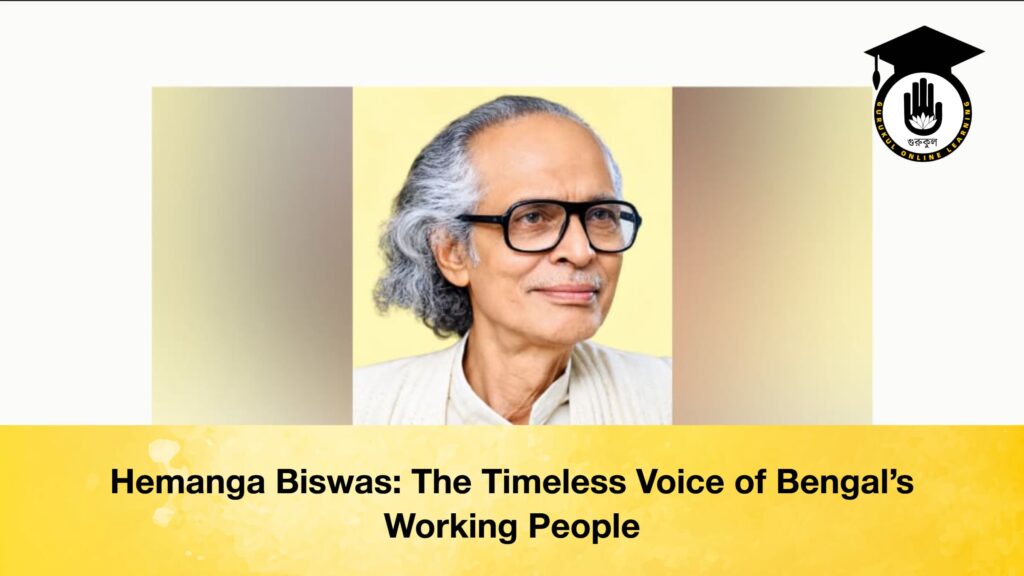
Few artists have given such a powerful musical voice to the struggles, aspirations and resilience of ordinary people as Hemanga Biswas. A celebrated figure in the history of Bengali protest music and the people’s cultural movement, he dedicated his life to portraying the hardships of workers, peasants and the oppressed through songs deeply rooted in their everyday experiences. His compositions became more than musical creations; they evolved into expressions of resistance, solidarity and the enduring demand for a society free from exploitation.
Biswas was a multifaceted cultural personality. He was a singer, lyricist, composer, poet, writer, dramatist and committed political and cultural activist. His contribution to Bengali folk music and the Indian People’s Theatre Movement helped establish a distinctive tradition in which art was closely connected with social realities and the struggles of ordinary people.
Born on 14 December 1912 in Mirashi village, in Chunarughat, under the then Habiganj subdivision of Sylhet district, Hemanga Biswas was the son of Harakumar Biswas and Sarojini Devi. From an early age, he showed a keen interest in music and literature. The rich folk traditions of the greater Sylhet and Assam regions, together with the cultural environment in which he grew up, played an important role in shaping his musical sensibilities.
After completing his schooling at Habiganj Government High School, he enrolled at the historic Murari Chand College in Sylhet. His college years coincided with a period of growing political activity against British colonial rule. He became involved in the independence movement and gradually developed an interest in left-wing political thought.
During the 1930s, communist ideology began to influence his outlook significantly. By 1932, he had established close links with the Communist Party. His political activities brought him into conflict with the British authorities, and he was imprisoned for his involvement in the anti-colonial movement. Although imprisonment and illness took a physical toll, they did not weaken his ideological convictions.
Biswas believed that art and culture could never be separated from the lives of ordinary people. In his view, the true strength of artistic expression lay in its connection with human experiences, collective struggles and aspirations for freedom. This conviction shaped his entire creative career. His songs were never intended merely to entertain; they were composed to challenge injustice, encourage solidarity and inspire social change.
During the late 1930s, he played an important role in the development of the Indian People’s Theatre Movement alongside contemporary cultural activists, including Binoy Roy, Niranjan Sen and Debabrata Biswas. Associated with the ideals and activities of the Indian People’s Theatre Association (IPTA), he devoted himself to organising cultural activities that reflected the lives and concerns of ordinary people.
In 1943, with his initiative and the assistance of Jyotiprakash Agarwala, the Sylhet People’s Theatre Association was established. The organisation sought to use songs, theatre and cultural performances to promote political awareness and bring socially conscious artistic expression closer to the wider population.
The lives of working people formed the central subject of Biswas’s compositions. The struggles of farmers, the sweat of labourers, the deprivation of tea-garden workers, the experiences of boatmen and the joys and sorrows of rural communities all found a place in his music. He gave expression to people whose experiences were often overlooked in mainstream cultural productions.
One of his most recognised compositions, ‘Tomar Kaste-tare Dio Jore Shan’ (Sharpen Your Sickle Well), became a powerful expression of agricultural workers’ rights and struggles. It was more than a song about a farming tool; it conveyed the determination of peasants to defend their livelihoods and stand against exploitation.
His compositions ‘Kishan Bhai Tor Sonar Dhane Bargee’ and ‘Hei Samalo Dhan Ho’ similarly reflected the realities of agricultural life. Through these songs, he highlighted the struggle to protect crops, the vulnerability of farmers and the importance of collective resistance against exploitation.
The appeal of his music lay partly in its simplicity and authenticity. He avoided artificial expressions and the limitations of elite musical conventions, choosing instead to draw upon the language, rhythms and cultural traditions of ordinary people. As a result, his songs travelled beyond formal concert venues, reaching village courtyards, tea-garden workers’ settlements, political marches and public gatherings.
In 1948, during the Telangana peasant movement in India, Biswas was arrested once again and spent an extended period in prison. His political convictions, commitment to the rights of peasants and workers, and association with communist ideals repeatedly placed him at odds with the authorities. Yet imprisonment could not silence his voice or diminish his commitment to the causes he supported.
One of the most distinctive features of his musical career was his extensive use of regional folk traditions. He absorbed melodies and musical styles from different parts of Bengal, incorporating them into his own compositions. His sources of inspiration included Jhumur from Rarh Bengal, Bhawaiya and Chatka from the northern regions, Jari and Sari songs from Bagri, Murshidi, Bhatiyali, Baul music from Birbhum and Fakiri songs from Nadia.
The folk traditions of Sylhet also played an important role in shaping his musical identity. Dhamail, Gazi songs and the musical heritage associated with Hason Raja enriched his creative repertoire.
Biswas did not simply collect traditional songs or reproduce existing melodies. He explored their social significance, philosophical depth and connection with everyday life. By incorporating regional folk melodies into the language of protest music, he created a distinctive musical style that connected local cultural traditions with broader questions of social justice and human dignity.
His contributions extended beyond songs and folk music. He was also actively involved in theatre productions, composing and directing music for several plays, including ‘Kallol’, ‘Teer’ and ‘Lal Lantern’. His work in theatre demonstrated his understanding of music as an integral part of dramatic expression, capable of strengthening a production’s atmosphere and communicating its central message.
His association with cinema was another aspect of his artistic career. His musical involvement in Ritwik Ghatak’s film ‘Komal Gandhar’ remains particularly noteworthy. Through his work across different artistic platforms, he helped establish a connection between music, theatre, cinema and the broader cultural movement.
Biswas also maintained a keen interest in China’s revolution, people’s movements and cultural activities. He played a role in promoting cultural and people-to-people friendship between India and China and visited the country on several occasions. His experiences and observations from these journeys subsequently became part of his literary work, reflecting his interest in understanding different societies and their cultural development.
In 1971, he formed a musical group called ‘Mass Singers’ in Kolkata. Accompanied by the group, he travelled from village to village, taking the message of people’s music directly to ordinary communities. The initiative reflected his lifelong belief that music should remain accessible to the people whose experiences inspire it.
The glamour of commercial entertainment and the pursuit of popularity never became his principal concerns. His artistic identity remained firmly rooted in the lives of ordinary people. Rather than measuring success through commercial recognition, he valued the ability of music to communicate with communities, express their concerns and encourage collective awareness.
Alongside his musical activities, Biswas made significant contributions to literature. He also wrote under the pseudonym ‘Sanchay Sen’. His notable publications include ‘Shankhachiler Gaan’, ‘Hemanga Biswaser Gaan’, ‘Loksangeet Samiksha’, ‘Bangla O Asamer Loksangeet Samiksha’ and ‘Abar China Dekhe Elam’.
His writings covered music, folk traditions, cultural practices and travel experiences. He wrote in both Bengali and Assamese, contributing to the documentation and understanding of regional musical heritage. His research and observations on folk music remain an important part of his intellectual and cultural legacy.
Hemanga Biswas died in Kolkata on 22 November 1987, aged 74. His death marked the end of an extraordinary life devoted to music, literature and cultural activism. However, the ideas behind his compositions continued to resonate across generations.
Thirty-nine years after his death, his songs remain relevant to the struggles of farmers, workers and communities demanding dignity and justice. The sickle of the peasant, the hammer of the labourer and the collective voice of people standing against exploitation remain closely associated with the musical world he created.
His legacy offers a lasting reminder that an artist’s responsibility extends beyond creating beauty and entertainment. Artists can also stand beside people in times of hardship, give expression to their grievances and help preserve their hopes for a better future. Biswas demonstrated that music could become a powerful instrument of protest, bringing people together and inspiring courage in the face of adversity.
His commitment to folk traditions and an inclusive cultural outlook was equally significant. By drawing upon the musical heritage of different regions and communities, he helped preserve a rich cultural inheritance while giving it renewed social meaning. His work demonstrated how local traditions could communicate universal concerns about dignity, equality and freedom.
The image of a storm-battered home that refuses to bow before the storm seems to reflect the philosophy that guided his life. Storms come, circumstances change and generations pass, but the human desire for freedom and dignity does not disappear. Nor do the songs that give expression to those aspirations.
On the 39th anniversary of his death, Hemanga Biswas is remembered with deep respect and affection as an authentic voice of the people, a pioneer of Bengali protest music and an influential figure in the secular cultural movement.
His songs belonged to the people, his melodies were rooted in the soil, and his life’s work was devoted to the dream of a society free from exploitation.
May the songs of the people continue to live among the people. May Hemanga Biswas remain alive through his timeless creations and the generations inspired by his music.