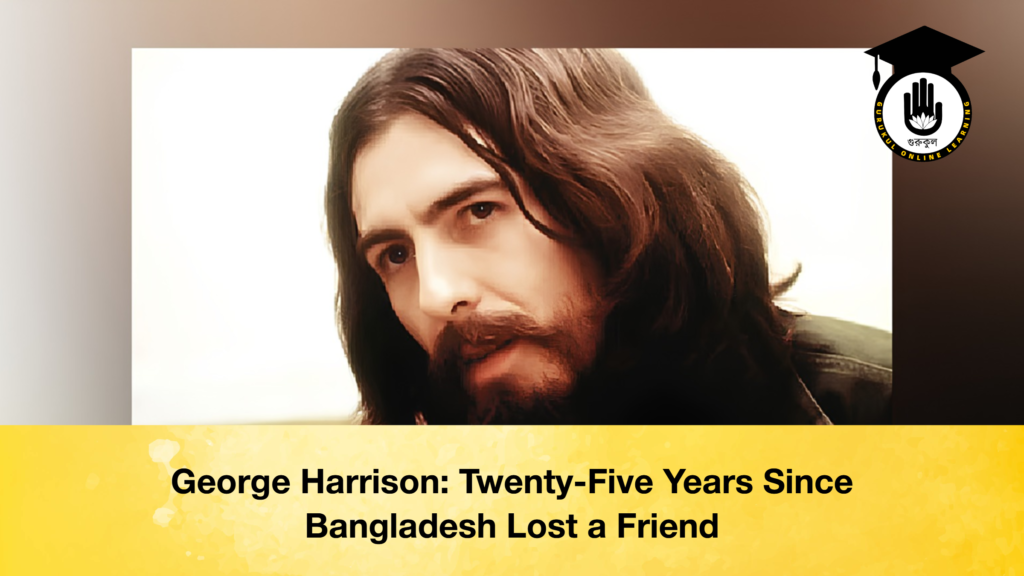
On the stage of Madison Square Garden in New York stood a bearded young man in a white suit, guitar in hand. Time and again, the name of one country rang out from his voice—Bangladesh. The Liberation War was underway, and millions had crossed the border into India to escape atrocities committed by Pakistani forces. George Harrison stepped onto that stage to stand beside them.
The date was 1 August 1971. Harrison was just twenty-eight. The Beatles had already split up, and the British musician had begun his solo career. He channelled that global stardom towards helping the people of Bangladesh.
Thirty years later, on 29 November 2001, Harrison died of cancer in Los Angeles at the age of fifty-eight. Today marks twenty-five years since his passing. To music fans across the globe, he remains a Beatles legend. To Bangladesh, he carries another enduring identity: a steadfast friend in its darkest hour.
Table of Contents
Answered at a Friend’s Call
Harrison held a deep love for Indian classical music. That affinity brought him into contact with sitar maestro Pandit Ravi Shankar, leading to a close friendship. In 1971, it was Shankar who brought the plight of Bangladeshi refugees to Harrison’s attention. In his autobiography, I Me Mine, Harrison recounted that Shankar spoke to him in June 1971 while they were working in Los Angeles about staging a concert to aid refugees from Bangladesh. Shankar then sent him newspaper clippings from around the world covering the Liberation War. Reading those reports made the gravity of the crisis clear to Harrison, who resolved to join his friend’s initiative.
Following the break-up of The Beatles, relations among the former bandmates were strained. Even so, Harrison set aside personal grievances and reached out to colleagues and friends. Ringo Starr, Billy Preston, and Leon Russell agreed quickly. There was uncertainty over whether Bob Dylan and Eric Clapton would take part, though both arrived in New York a day before the event. John Lennon, meanwhile, stated a week earlier that he could not participate.
Ahead of the show, Harrison wrote a song for Bangladesh. Released in July 1971, ‘Bangladesh’ opened with his friend’s plea and urged the world to support an endangered people. Background details of the event were documented in Matiur Rahman’s articles in Prothom Alo, George Harrison o The Concert for Bangladesh and George Harrison-er “Bangladesh Bangladesh”.
Legends on One Stage
Organisers initially planned a single concert. Strong ticket sales meant a second show had to be staged on the same day. Across the afternoon and evening performances, roughly forty thousand people attended. Despite the scale of the event, Harrison had not been able to hold even a single rehearsal with all the performers together. Against considerable uncertainty, the historic gathering succeeded.
The programme opened with ‘Bangla Dhun’, composed by Shankar using melodies from Bangladeshi folk music. Shankar played sitar alongside Ustad Ali Akbar Khan on sarod, Ustad Alla Rakha on tabla, and Kamala Chakravarty on tanpura. Among the Western stars on stage were Harrison, Dylan, Clapton, Starr, Preston, and Russell. Harrison sang favourites including ‘My Sweet Lord’, ‘While My Guitar Gently Weeps’, and ‘Here Comes the Sun’, closing with the song he had written for Bangladesh.
In his liner notes for the 2005 DVD release of The Concert for Bangladesh, Shankar described it as the most memorable concert of his seventy-five-year musical career. In an interview on the same release, Clapton reflected that the day reminded him what it meant to be proud of being a musician.
Ticket sales raised roughly a quarter of a million dollars. A three-record live album followed in December 1971, and a concert film was released the next March. Further funds raised from the album and film went towards children’s welfare initiatives managed by UNICEF. At the 1973 Grammy Awards, The Concert for Bangladesh won Album of the Year, with Starr accepting the award on behalf of the artists and producers.
The ‘Quiet’ Beatle and His Musical Journey
Born in Liverpool, England, in February 1943, Harrison fell in love with the guitar in his youth. Meeting Paul McCartney at school led to his place in The Beatles, where Lennon, McCartney, Harrison, and Starr reshaped popular music.
The youngest of the four, Harrison earned the nickname ‘the quiet Beatle’ for his calm demeanour. Musically, however, his presence was anything but quiet. Alongside the massive profile of the Lennon–McCartney partnership, he carved out a distinct voice as a songwriter and composer, penning enduring Beatles tracks such as ‘Something’, ‘Here Comes the Sun’, ‘Taxman’, and ‘While My Guitar Gently Weeps’.
He also pioneered the use of Indian instruments in Western popular music, notably playing sitar on The Beatles’ 1965 song ‘Norwegian Wood’. After the band dissolved, he released the triple album All Things Must Pass in November 1970, achieving major solo success with ‘My Sweet Lord’. In 1988, he formed the supergroup Traveling Wilburys with Dylan, Roy Orbison, Tom Petty, and Jeff Lynne.
Devotion to Bangladesh and a Lasting Legacy
For Harrison, the concert’s value went beyond raising money. He noted that when he later met waiters in Bengali restaurants, they recalled the days of the Liberation War; knowing that people far away were thinking of them during the conflict meant a great deal. Drawing international attention to events in Bangladesh was central to how he measured the effort’s success.
Nearly a decade after his death, his wife Olivia Harrison visited Bangladesh for the first time. Speaking with Matiur Rahman at Dhaka’s Sonargaon Hotel on 15 February 2011, she said she constantly heard him say there was more he wanted to do for Bangladesh.
His humanitarian work has continued since his passing. Olivia Harrison is a co-founder of the George Harrison Fund for UNICEF, and she visited Bangladesh for three days in February 2011 to see its work, visiting programmes supporting disadvantaged children and young people in Dhaka and beyond.
How people listen to music has shifted from vinyl records, cassettes, and CDs to streaming platforms. On 9 August 2024, The Concert for Bangladesh became available on major digital music services for the first time, bringing the 1971 event to a newer generation. Listeners can readily hear Bangladesh’s name in his voice, allowing those who never witnessed the Liberation War to encounter a chapter of global solidarity during a time of national crisis.
Key Milestones and Figures
| Year / Date | Event or Detail |
| February 1943 | George Harrison is born in Liverpool, England. |
| 1965 | Harrison plays sitar on The Beatles’ song ‘Norwegian Wood’. |
| November 1970 | Following The Beatles’ split, Harrison releases his triple album All Things Must Pass. |
| June 1971 | Ravi Shankar proposes a benefit concert for Bangladeshi refugees while in Los Angeles. |
| July 1971 | Harrison’s song ‘Bangladesh’ is released ahead of the benefit event. |
| 1 August 1971 | The Concert for Bangladesh takes place across two shows at Madison Square Garden in New York. |
| December 1971 | A three-record album from the concert is released. |
| March 1972 | The concert film is released. |
| 1973 | The Concert for Bangladesh wins Album of the Year at the Grammy Awards, accepted by Ringo Starr. |
| 1988 | Harrison forms Traveling Wilburys with Bob Dylan, Roy Orbison, Tom Petty, and Jeff Lynne. |
| 29 November 2001 | Harrison dies of cancer in Los Angeles aged fifty-eight. |
| February 2011 | Olivia Harrison visits Bangladesh for three days to observe UNICEF-supported work. |
| 9 August 2024 | The Concert for Bangladesh is released on major digital music platforms for the first time. |