
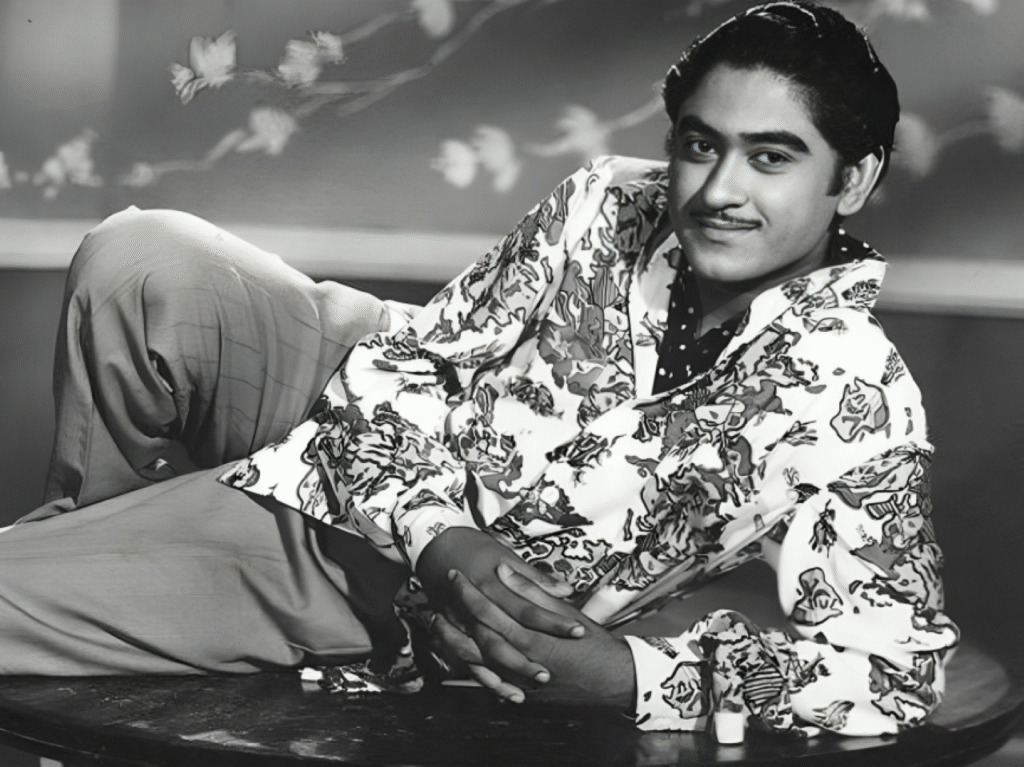
Every few generations, a voice comes along that refuses to fit inside musical rules — it bends them, breaks them, and in doing so, creates something eternal. That voice, in the Indian subcontinent, belonged to Kishore Kumar — the man who didn’t just sing songs, but lived them.
Born Abhas Kumar Ganguly on 4th August 1929 in Khandwa, Madhya Pradesh, Kishore was a man of contradictions — an introvert who made the world laugh, a loner who sang about love, and an untrained singer who became the very soul of Bollywood music. On his birthday, decades after his passing in 1987, his voice still drifts through radios, tea stalls, and film montages — reminding us that genius needs neither rules nor restraint.

Table of Contents
The Untrained Voice That Changed Indian Playback Singing
Kishore Kumar never studied classical music formally. Unlike his elder brother Ashok Kumar, who was already a film star, and unlike trained maestros such as Mohammed Rafi, Manna Dey, or Hemant Kumar, Kishore was entirely self-taught.
And yet, this supposed “shortcoming” became his artistic gift. His voice was raw, flexible, and real — it didn’t aim for perfection, but for truth. Every note he sang carried an emotion, often spontaneous and unpredictable, just like life itself.
He famously once said,
“Main sur mein gaata hoon, lekin dil se.”
“I may sing in tune, but always from the heart.”
That heart became his identity. Kishore’s songs weren’t performances; they were confessions — of joy, pain, humour, and human vulnerability.

The Voice That Could Do Anything
Kishore Kumar’s singing had a shape-shifting quality — it could sound youthful, philosophical, flirtatious, or melancholy, all within one song. His ability to adapt his tone and phrasing to the personality of the actor on screen was unmatched.
When he sang for Dev Anand, his voice had an urbane charm — breezy and mischievous, as in “Khoya Khoya Chand” or “Jeevan Ke Safar Mein Rahi.”
For Rajesh Khanna, his voice became tender, poetic, and deeply romantic — the eternal echo of “Mere Sapno Ki Rani”, “Kora Kagaz Tha Yeh Man Mera”, and “Kuch To Log Kahenge.”
And for Amitabh Bachchan, Kishore’s voice turned bold and commanding — as in “Rote Hue Aate Hain Sab” or “Chal Chal Mere Bhai.”
It was almost magical — as though Kishore’s soul understood the actor’s heart before the song began.
He could make a simple love song feel like poetry (“Pal Pal Dil Ke Paas”), turn a philosophical lyric into a hymn (“Zindagi Ka Safar”), or make even heartbreak sound comforting (“Chingari Koi Bhadke”).

Acting Through Singing
Kishore Kumar wasn’t only a singer — he was an actor who sang. Before his voice ruled the airwaves, he was a screen performer known for his comedic brilliance and physical humour. This theatrical training seeped into his music.
Listen carefully, and you’ll notice how he “acts” every lyric. His phrasing, pauses, sighs, and laughter all become part of the performance. His songs were miniature dramas — each a story, each with its own character.
In “Ek Ladki Bheegi Bhaagi Si”, his playful teasing voice becomes a cinematic scene in itself. In “Paanch Rupaiya Barah Aana”, he slips between tones, almost performing dialogue mid-song. Even in serious songs, he introduced the element of storytelling — he wasn’t singing to you, he was singing with you.
This ability to infuse songs with personality is what made Kishore stand apart from technically brilliant singers. He made music human.

The Magic of Kishore’s Technique
Kishore Kumar’s voice may have been instinctive, but it was also astonishingly technically gifted. His range, modulation, and control defied his lack of formal training.
Here are a few of his hallmark techniques:
Yodelling: Inspired by Western singers such as Jimmie Rodgers, Kishore’s yodelling became his signature. Songs like “Main Hoon Jhumroo” and “Zindagi Ek Safar Hai Suhana” turned this playful technique into a symbol of carefree joy. He brought a global sound into Indian cinema and made it utterly his own.
Voice Modulation: His ability to switch emotions mid-line was unmatched. He could move from laughter to lament within a single phrase — a rare feat that made even simple tunes unforgettable.
Breath Control: Kishore’s long, sustained notes in “Dil Kya Kare” or “O Mere Dil Ke Chain” showed remarkable stamina and breath management.
Rhythmic Improvisation: He often stretched or paused lines at will, giving his songs conversational ease. This rhythmical play made his singing sound alive and unpredictable.
Even his laughter, sighs, or hums weren’t accidents — they were carefully placed emotional ornaments. He wasn’t bound by the notation of the song; he made his own grammar of feeling.

Collaborations That Defined an Era
Kishore Kumar’s partnerships with music directors produced some of the finest moments in Indian film music. His relationship with S. D. Burman was foundational — Burman recognised Kishore’s natural genius early on, offering him songs that suited his expressive, untrained charm. Together, they created gems like “Yeh Dil Na Hota Bechara” and “Jeevan Ke Safar Mein.”
Later, with R. D. Burman, Kishore found his perfect musical soulmate. The father-son duo and Kishore created what many consider the golden triangle of Hindi film music. From the dreamy romance of “Rimjhim Gire Saawan” to the haunting sadness of “Tere Bina Zindagi Se Koi Shikwa Nahi”, every song carried the unmistakable Kishore touch — that effortless blend of joy and ache.
R. D. Burman once said in an interview,
“Kishore was not a singer; he was a complete soundscape. He could make silence musical.”
And it’s true — even Kishore’s humming could convey more emotion than most singers could with lyrics.

The Singer Who Felt What He Sang
Kishore Kumar’s songs endure because they were never mechanical. He didn’t “deliver” songs — he felt them.
He recorded many songs while deeply moved. During the recording of “Kuch To Log Kahenge”, he reportedly grew silent after the take, murmuring that the song “felt too close to home.”
When he sang “Aanewala Pal”, his voice carried the weight of someone who understood the fleeting nature of time and love.
This sincerity is why listeners across generations connect with his songs. Kishore wasn’t performing an act; he was confessing something universal — that life is fragile, beautiful, and painfully human.

A Man of Many Moods
Behind the mic, Kishore Kumar was a kaleidoscope of contradictions. He was famously eccentric — known to talk to trees in his garden, charge double fees for “serious” songs, and once paint “Beware of Kishore” outside his Warden Road bungalow.
He loved solitude, sometimes refusing to meet anyone for days. He was also known for his comic outbursts in studios, sometimes singing gibberish during rehearsals just to see the reaction of composers. Yet, when the red light turned on, he transformed — becoming a perfectionist who demanded complete silence and respect for the music.
People who worked with him often said that he had many personalities, all living within one body — and that’s precisely what made his singing so rich. He wasn’t just performing lyrics; he was channeling every version of himself.

Kishore and the Golden Age of Bollywood Music
The 1970s and 1980s were Kishore Kumar’s kingdom. With the rise of Rajesh Khanna, his songs became the heartbeat of Indian romance. Later, with the rise of Amitabh Bachchan, he evolved again — his voice became more rugged, masculine, and introspective, perfectly complementing Bachchan’s screen persona.
Hits like “Rote Hue Aate Hain Sab”, “Pag Ghungroo Baandh”, and “Jahan Teri Yeh Nazar Hai” show how seamlessly Kishore adapted to changing cinematic moods and music styles.
He could sing a soulful ghazal one day and a disco track the next. With Bappi Lahiri, he explored pop and dance beats (“Yaar Bina Chain Kahan Re”, “Pag Ghungroo”), proving that age never dulled his energy.
Even as music shifted towards electronic sounds in the 1980s, Kishore remained relevant because emotion never goes out of style.

An Artist for All Generations
Kishore Kumar’s appeal transcends time. Young listeners today, raised on streaming platforms and remixes, still hum his classics. His voice bridges generations — grandparents, parents, and children all find something of themselves in his songs.
He represents emotional authenticity in an age of mechanical music. His laughter, sighs, and imperfections remind us that art is not about precision, but about truth.
Filmmakers continue to use his voice in new films and advertisements, as though he were still recording somewhere above the clouds. His songs like “Yeh Shaam Mastani”, “O Saathi Re”, or “Zindagi Ek Safar Hai Suhana” are not old; they are eternal — they belong to every generation that dares to feel.

Legacy Beyond Music
Kishore Kumar was more than a singer — he was an emotion in motion. His influence extends far beyond the music industry. He inspired comedians with his timing, actors with his expressiveness, and singers with his freedom.
His son Amit Kumar carries his musical legacy, while his life continues to inspire countless documentaries, films, and retrospectives. Even today, new singers like Arijit Singh and Shaan cite Kishore as an idol — not merely for his voice, but for his emotional honesty.
Every artist who tries to merge emotion with melody walks the path Kishore paved.

Remembering Kishore Da on His Birthday
Every 4th of August, the airwaves of India turn nostalgic. Radio stations dedicate entire days to his songs. Social media fills with clips of him laughing, singing, and joking. Old vinyl records are dusted off, and people across the world press play on his timeless tunes.
Why? Because Kishore Kumar wasn’t just a man who lived from 1929 to 1987 — he became a part of India’s emotional DNA. His voice accompanies us in moments of love, loss, celebration, and solitude.
His laughter reminds us to live freely. His songs remind us that life, no matter how unpredictable, is still worth singing about.

The Man Who Sang Life Itself
Kishore Kumar didn’t sing to impress; he sang to express. His genius lay in his humanity — in his willingness to sound vulnerable, playful, imperfect, and utterly real.
He was the singer who cried for us, joked for us, and dreamed for us. His music was not a career — it was his soul speaking out loud.
Even now, when “Aanewala Pal” plays on a rainy evening, it feels as though Kishore himself is whispering: live the moment, before it slips away.
His voice was never about style — it was about life.
And life, as Kishore Kumar taught us, is not meant to be sung perfectly — only beautifully.