The silt-washed Kumarkhali Upazila of our Kushtia district, nurtured by the waters of the Ganges, Kapotaksha, and Kaliganga rivers, is not merely a geopolitical administrative boundary; it is a sacred land of spiritual, cultural, and intellectual awakening for Bengal and the Bengali nation. I am a son of Kumarkhali. I grew up immersed in the earthy fragrance of this soil, the generous embrace of this air, and the simple, soulful lifestyle of its people. Whenever I look back at the roots of my birthplace, I am filled with a sense of miraculous wonder. Kushtia is hailed as the cultural capital of Bangladesh, and the pulsating heartbeat of that cultural sanctuary is our very own Kumarkhali.
Looking back at history, a question repeatedly arises in my mind—amidst the hundreds of places, riverbanks, and towns across the Indian subcontinent, why did epoch-making stalwarts like Fakir Lalon Sai, Kangal Harinath Majumdar, and Mir Mosharraf Hossain emerge simultaneously in the very same soil and atmosphere of Kumarkhali? Was it a mere historical coincidence? No, not in the slightest. The soil, breeze, and common people of Kumarkhali were able to cultivate a rare and fertile cultural environment through the ages—one where it was possible to sing the victory song of truth above caste, creed, religion, and colour. It can be said that through the synthesis of this soil and its people, that magnificent historical moment spontaneously “happened”.
It was precisely because such a sacred atmosphere had been created that the World Poet Rabindranath Tagore left behind the bustling cities of India to return repeatedly to Kuthibari in Shilaidaha, Kumarkhali. Sitting aboard his houseboat, the Padma Boat, on the bosom of the River Padma, he discovered a touch of profound peace and penned countless priceless gems of literature. This soil of ours and these people were truly extraordinary—they were our proud ancestors. It is our immense good fortune to have been born on such a land of illustrious heritage.
Yet today, when discrimination, communal toxicity, and fundamentalist darkness threaten to engulf us, we must pause and reflect. This centuries-old pluralistic cultural tradition, which our ancestors built with their blood and devotion, must never be allowed to be poisoned by any evil force or fundamentalist dogma. We must remain fiercely vigilant so that no misguided individual or group can create fractures in our undivided, non-sectarian consciousness. Whenever we lose our way in national life, morality, or humanity, we must turn our eyes back to Lalon Saiji. Saiji is the ‘Guiding Star’ or ‘Pole Star’ of our pluralism. He will show us the path of light.
On the auspicious occasion of today’s Dol Purnima festival and Saiji’s remembrance ceremony, let us rekindle our knowledge and consciousness regarding our unique Guiding Star, Fakir Lalon Sai. Let us rediscover our Saiji, and in doing so, rediscover our own roots.
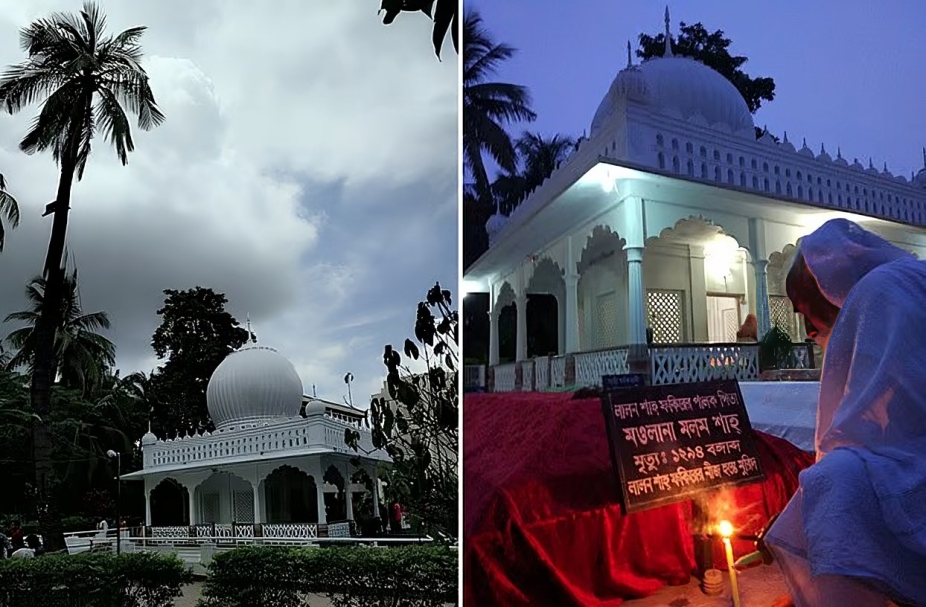
Table of Contents
1. The Pole Star of Pluralism: Why is Lalon Sai Our ‘Guiding Star’?
The greatest crisis in human history has always been division. The process of dividing humanity on the basis of religion, race, caste, clan, and social status has persisted for ages. However, the most potent and compassionate voice against this artificial division was raised right from our Akhrabari (monastery) in Cheuria. Fakir Lalon Sai was not an academic philosopher with institutional degrees, yet he was the supreme luminary of spiritual liberation for mankind.
Lalon Saiji’s philosophy was extraordinarily simple, yet its depth was more bottomless than the ocean. He recognised human beings purely as ‘human’. His famous verse proclaims:
“Everyone asks what caste Lalon belongs to in this world. / Lalon says, ‘What does caste look like? I have never seen it with my eyes.’ “
This single utterance of truth shook the very foundations of the caste system and social inequality across Bengali literature. When Hindu-Muslim communal divides were reaching their peak during the British Raj and fanatical bigotry was fracturing society, the beacon of non-sectarianism lit by Lalon Sai from Cheuria, Kushtia, continues to guide our path to this day.
To view Lalon Sai merely as a Baul saint or poet would do him a grave injustice. He was our social reformer, our universal philosopher, and the ultimate lighthouse of pluralism. Pluralism—the harmonious coexistence and absolute tolerance of all religions, doctrines, beliefs, and philosophies—finds its full expression in Lalon’s life and music. Rabindranath Tagore rightly observed that Lalon Sai had interwoven the esoteric essence of Hinduism, Islam, Buddhism, and Jainism into a singular, exquisite harmony.
In today’s violent and conflicted world, where people slaughter one another in the name of religion, Lalon’s abode reminds us that our true identity is the ‘Religion of Humanity’. He taught us self-knowledge and guided us to discover the ‘Man of the Heart’ (Moner Manush). Therefore, in times of any cultural crisis or moral disorientation, Lalon Saiji remains our sole sanctuary—our ‘Guiding Star’.
2. The Soil of Kumarkhali and the Convergence of Noble Souls
Why is our Kumarkhali so unique? Why has this soil repeatedly birthed the trailblazers of history? Looking at Kumarkhali, one sees an astonishingly fertile landscape of intellectual and cultural vigour.
On one side, seated in Cheuria, Fakir Lalon Sai was meditating on the melodies of human liberation; simultaneously, just a short distance away in Kumarkhali, Kangal Harinath Majumdar (Kangal Fikirchand) was wielding his pen through the journal Gram Barta Prakashika against social oppression and landlord exploitation, while awakening the rural masses through Baul songs with his troupe, Kangaler Fikirchand Sampraday. At the exact same time, another son of Kumarkhali, Mir Mosharraf Hossain, was altering the course of Bengali literature by penning epic novels like Bishad Sindhu and impactful social plays.
It sends a shiver down the spine to imagine that Kangal Harinath knew Saiji, and Mir Mosharraf Hossain was acquainted with him. The mutual respect and presence of these three great souls transformed Kumarkhali into an undivided intellectual and cultural fortress.
Drawn by the cultural magnetism of this soil, World Poet Rabindranath Tagore spent years at Kuthibari in Shilaidaha. While Tagore wrote aboard his boat on the Padma at Shilaidaha, just six miles away in Cheuria, Lalon Saiji was immersed in spiritual practice seeking the ‘Unreachable Being’ (Adhar Manush) alongside his disciples. Rabindranath research reveals that the inner spiritual philosophy of Tagore’s Gitimalya, Gitanjali, and his novel Gora bears a profound and distinct imprint of Lalon. Tagore listened to Lalon’s songs, collected his verses, and described Lalon as the “King of the Bauls”—the uncrowned emperor of mystic minstrels.
This interaction and bond among such noble souls was the gift of Kumarkhali’s soil and air. The people here absorbed tolerance, generosity, and a passion for art into their very bloodstream. We are the descendants of these glorious ancestors. To be born on this soil is a matter of supreme pride and fortune for us.
3. In Search of Lalon Sai’s Life: Folklore and Historical Truth
The life history of Fakir Lalon Sai is like a mysterious and transcendental saga. He never disclosed his own caste, lineage, family background, or birthplace, knowing that revealing a birth identity would lead society to trap him in the cage of a specific religion or caste.
Birthplace and Life-Changing Event
Sribasanta Kumar Pal, a pioneer in Lalon research, posited that Lalon was born in Bhandara village under Chapra Union in the Kumarkhali sub-district of Kushtia. However, various debates surround his early life. According to historical sources and oral traditions, Lalon set out on a pilgrimage with companions during his youth. En route, he was struck down by deadly smallpox. Abandoned and unconscious, his companions assumed he was dead and left him on the banks of the Kaliganga River before proceeding to their destinations.
The dying, floating Lalon was rescued from the river by the ascetic Maulana Malam Shah and his wife, Matijan Bibi. This compassionate couple nursed Lalon back to health with tender care. Due to the ravages of smallpox, Lalon lost an eye and was left with facial scars. Upon recovering, when Lalon returned to his native village, his family and society rejected him, declaring he had ‘lost his caste’ because he had accepted food and shelter in a Muslim household.
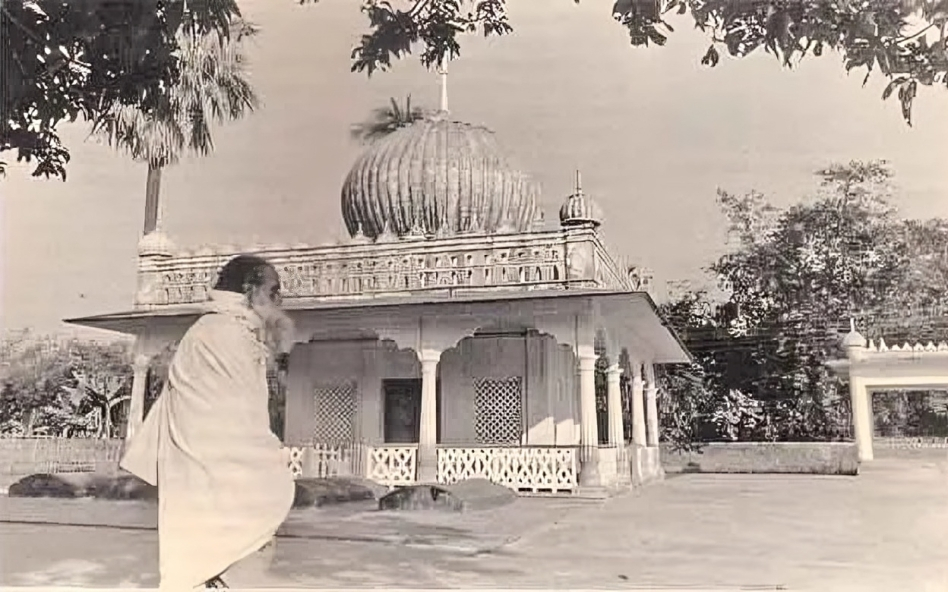
Socially ostracised, Lalon returned to Cheuria. His adoptive parents, Malam Shah and Matijan Bibi, granted him a piece of land near their home, where Lalon built a humble thatched hut. This very Cheuria later evolved into the ultimate pilgrimage site for Bauls worldwide.
Companionship of Guru Siraj Sai and Horsemanship
While residing in Cheuria, the most pivotal event of Lalon’s life took place: he met Darvesh Siraj Sai, an elevated Sufi saint. Under Siraj Sai’s guidance, Lalon gained profound esoteric knowledge of self-realisation and body metaphysics (Dehatattva), accepting Siraj Sai as his spiritual master (Guru). Countless songs of Lalon reflect his deep devotion to his master:
“Siraj Sai reflects, / Lalon, you cannot even master a single string.”
According to accounts in the fortnightly journal Hitakari (31 October 1890), even in advanced age, Saiji possessed remarkable physical stamina. He was an exceptionally skilled horseman and, even in his old age, rode on horseback to attend spiritual gatherings and visit disciples across distant regions.
Debate Over Caste Identity and the Ultimate Truth
Debates regarding Lalon’s caste identity persisted both during his lifetime and after his demise. Basanta Kumar Pal, the author of the first biography of Lalon, wrote in the journal Prabasi: “Whether Saiji was Hindu or Muslim, I too am unable to determine definitively.”
Highlighting Lalon’s elusive identity, eminent scholar Sudhir Chakraborty wrote:
“Kangal Harinath knew him, Mir Mosharraf recognised him, he frequented the houseboats of the Tagores, writers like Rai Bahadur Jaladhar Sen and Akshay Kumar Maitreya saw him face-to-face and heard his songs—yet none could ascertain Lalon’s caste identity, lineage, or religion.”
In his novel Moner Manush, novelist Sunil Gangopadhyay accurately captured Lalon’s faith:
“Lalon was religious, but he had no interest in practising the rituals of any specific religion. Severing the bonds of all religions, he accorded the highest place in life to humanity.”
Lalon followed no orthodox Hindu or Islamic rituals. Through his own spiritual discipline, he acquired deep knowledge of the Vedas, Upanishads, Puranas, as well as the Quran, Hadith, and Sufi philosophy. He believed that within every human resides an ‘Unreachable Being’ or the ‘Man of the Heart’.
4. Historical Documents of Lalon’s Songs, Tunes, and Spiritual Practice (Analysis of Three Core Questions)
Fakir Lalon Sai, one of Bangladesh’s greatest figures of spiritual wisdom, propagated and established his esoteric philosophy through the nectar of his lyrics and melodies during his own lifetime. Due to a scarcity of historical data and a degree of ignorance, many limit Lalon Sai merely to the status of a mystic poet. However, history and documentation prove that he was an extraordinary music composer and practitioner.
We shall analyse the documented history of Saiji’s musical practice through three fundamental questions:
Question 1: Did Fakir Lalon Sai perform songs himself?
Answer: Historical documents and evidence clearly prove that Lalon Saiji was not merely a lyricist; he performed his songs himself with immense spiritual ecstasy.
Just 14 days after Lalon Sai’s passing, on 15 Kartik 1297 Bengali Era (31 October 1890 AD), an investigative report titled ‘Mahatma Lalon Fakir’ based on eyewitness accounts was published in the fortnightly journal Hitakari from Lahinipara, Kushtia. The report noted:
“The name of Lalon Fakir is known to everyone in this region. Not only in this region, but far across Chittagong in the east, Rangpur in the north, Jessore in the south, and far into the west of Bengal, numerous people are disciples of this Lalon Fakir; we hear his disciples number over ten thousand.”
Describing Lalon Sai’s final moments, the editor/reporter wrote in the same issue:
“Even during his illness, he practised spiritual devotion in the name of the Supreme Being as before; occasionally, he would become intoxicated in song. Upon engaging in religious discourse, he gained renewed strength and forgot his bodily suffering. We possess several songs composed during this time. People of many communities found deep satisfaction in discussing religion with him. On the night before his death, he sang almost the entire night, and at 5 o’clock in the morning, he said to his disciples, ‘I am departing.’ “
This account proves that music was Lalon’s lifeblood. Even during severe illness, he immersed himself in song.
Fakir Anwar Hossain Montu Shah, a Lalon-tradition ascetic, provided a moving account of Saiji’s final moments. On the night before his death, Saiji summoned his disciples and said, “Listen, I shall sing a song for you. Moniruddin, write down the song.”
The disciples thought that since Saiji had reached advanced age, he might never sing again, and was offering his final rendition. Saiji began to sing with heartfelt yearning:
“Carry me across, O merciful moon. / Forgive my sins in this worldly prison. / I am your sinful and wretched creature, / If you do not deliver me / Through your grace; / Who else shall call you / The saviour of the fallen?”
As he sang the final line, he gently concluded the song, wrapped himself in a blanket, and fell silent. Though standing close by, his disciples failed to realise that the cherished singing bird of Cheuria’s Akhrabari had passed away while singing the final stanza of his last song.
Question 2: Are there original manuscripts of Lalon Sai’s songs?
Answer: Yes, direct manuscripts and transcribed notebooks of Lalon Sai’s songs exist.
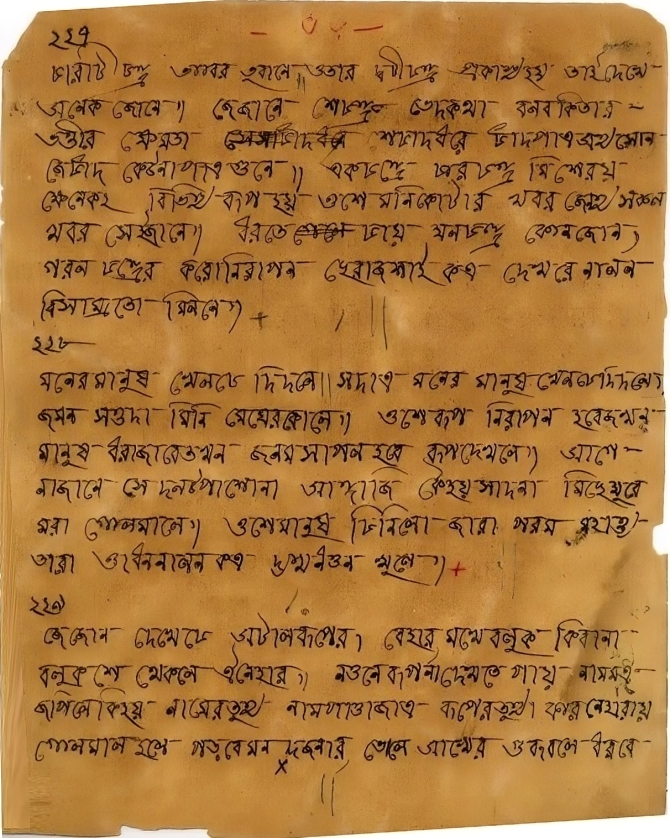
Lalon Sai composed his songs orally and set them to tune spontaneously. His direct disciples (such as Pandit Moniruddin Shah) transcribed the lyrics into notebooks as soon as they heard them from Saiji’s mouth.
The documentation and publication of his songs began during his lifetime:
- First Printed Song (Lifetime): In Agrahayan 1292 Bengali Era (December 1885 AD), in the ‘Upasana’ section of Kangaler Brahma-Veda: Atma O Sadhan Tattva, authored by Kangal Harinath Majumdar and edited by Kangal Fikirchand Fakir, Lalon Sai’s song “Ke bojhe saier lilakhela” (Who understands the playful divine acts of the Lord) was printed. This was the first song of Lalon published in print during his lifetime.
- First Printed Song (Posthumous): On 31 October 1890, alongside his obituary in Hitakari, the song “Sob loke koy lalon ki jat shongshare” (Everyone asks what caste Lalon belongs to) was published.
- Manuscript Collections: Original notebooks handwritten by Lalon’s direct disciples have been preserved through guru-disciple lineages in Cheuria, Jhinaidah, and Chuadanga. Additionally, Rabindranath Tagore had 298 songs transcribed from Lalon’s Akhra into a notebook, which is currently preserved at Rabindra Bhavana, Visva-Bharati.
Question 3: Are the tunes and lyrics of all of Lalon Sai’s songs preserved?
Answer: The authentic corpus of Lalon’s songs totals approximately 650. The preservation of these lyrics and their traditional melodies has a long historical trajectory:
- First Musical Notation: The first musical notation (Swaralipi) of Lalon’s songs was rendered by Rabindranath’s niece, the renowned musician Indira Devi Chaudhurani. She published notations for two songs—“Khomo oporadh o dinonath” and “Kotha koy kache dekha jay na”—in the Magh-Falgun issue (1898-99 AD) of the journal Beena-Badini, edited by Jyotirindranath Tagore.
- Sudhin Das’s Historic Initiative: In 1985, musicologist Sudhin Das initiated a project to preserve the authentic tunes of Lalon. He recorded over a hundred songs from Lalon scholar Khodabaksh Sai between 1983 and 1984, publishing notations for 70 songs in book form in 1986 and 2007.
- International Archives and Recordings: From the 1980s onwards, American scholar Dr Carol Solomon, Japan’s Masayuki Onishi, Azad Rahman, Tapan Majumdar, and others recorded hundreds of songs from traditional masters like Khodabaksh Sai, Moksed Ali Sai, Mohin Shah, and Karim Shah. Dr Carol Solomon’s field recordings are safely housed in the Ethnomusicology Digital Archives at the University of Washington, Seattle.
- Rangan Momen’s Archive: Between 2001 and 2013, London-based researcher Rangan Momen recorded 3,000 songs from ascetics across greater Kushtia, preserving the original tunes and lyrics of approximately 650 Lalon songs.
Basanta Kumar Pal wrote in Prabasi (1925) that whenever Lalon felt an inspiration to sing, he would call out to his disciples, “Oh, my shoal of fish has arrived!” The disciples would rush over, Saiji would begin to sing, and they would write down the lyrics while singing along. Lalon never separated lyrics from melody; both blossomed as one.
5. The Unique History of the Titles ‘Baul Samrat’ and ‘Mahatma’
Today we address Fakir Lalon Sai as ‘Baul Samrat’ (Emperor of Bauls) or ‘Mahatma’ (Great Soul). However, few know that Lalon Saiji was conferred the title ‘Mahatma’ 25 years before Mohandas Karamchand Gandhi received the same title in the Indian subcontinent!
In the fortnightly Hitakari published on 31 October 1890, journalist Raicharan Das titled his article ‘Mahatma Lalon Fakir’. This stands as the first documented record of ‘Mahatma’ used before Lalon’s name in written history.
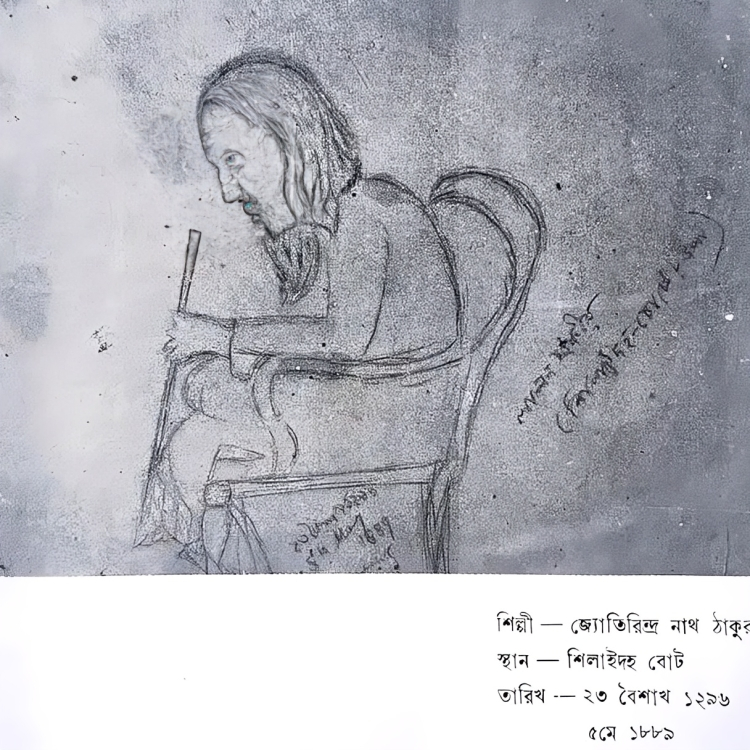
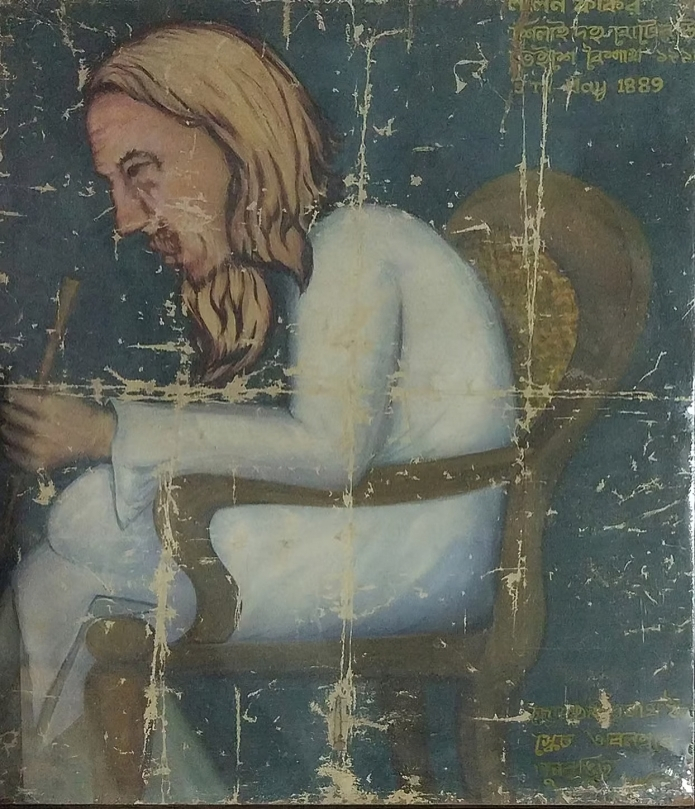
There is also a fascinating history behind Lalon’s sole authentic portrait. On 5 May 1889, sitting aboard the Tagore family’s Padma Boat on the River Padma in Shilaidaha, artist Jyotirindranath Tagore (elder brother of Rabindranath) sketched a pencil portrait of Lalon Saiji. This remains the only authentic portrait drawn during Lalon’s lifetime, currently preserved in a museum in India. The sketch reveals an elderly ascetic—with beard, long hair, and wrapped in a shawl—exuding a profoundly solemn human presence.
On 27 November 2005, UNESCO declared Baul songs a “Masterpiece of the Oral and Intangible Heritage of Humanity”, elevating Lalon Sai’s songs and Baul philosophy to the status of global cultural heritage.
6. Lalon in the Global Sphere: International Influence and Translators
Lalon Saiji was never confined to Cheuria or the geographical boundaries of Bangladesh. His melodies and philosophy have crossed borders to resonate across the globe.
Rabindranath and Allen Ginsberg
Rabindranath Tagore introduced Lalon’s philosophy to the world during his famed Hibbert Lectures at Oxford University. In the 1960s, prominent American Beat Generation poet Allen Ginsberg visited India and was deeply influenced by Lalon’s worldview. Emulating Lalon’s poetic style, Ginsberg composed the famous poem “After Lalon”.
Dr Carol Solomon and ‘City of Mirrors’
American researcher Dr Carol Solomon (1948–2009) returned to Bangladesh repeatedly out of a deep devotion to Lalon. She dedicated her life to establishing authentic texts of Lalon’s songs and translating them into English. Following her death, a bilingual volume featuring 137 of her translated songs was published by Oxford University Press, New York:
“City of Mirrors: Songs of Lalon Sai”
The book was edited by researcher Saymon Zakaria and Professor Jean Openshaw of the University of California. It stands as an invaluable contribution to global Lalon studies.
Other International Initiatives
- Muchkund Dubey: Former Indian diplomat and scholar Muchkund Dubey translated 105 songs of Lalon into Hindi, published by Sahitya Akademi, Delhi, under the title Lalon Shah Fakir Ke Geet.
- Debjani Chaliha: Legendary Manipuri dance exponent Debjani Chaliha translated Lalon’s songs into Assamese (Lalon Sair Geet).
- Other Foreign Scholars: Masahiko Togawa (Japan), Brother James, Father Marino Rigon, and others have disseminated Lalon’s philosophy across various languages.
7. Lalon Sai in Literature, Drama, Cinema, and the Arts
Lalon’s life and philosophy have enriched Bengali literature and culture. Numerous poets, novelists, and playwrights have created artistic works centred on Lalon.
- Novels:
- Sunil Gangopadhyay penned the famous novel Moner Manush.
- Ranjit Kumar wrote Senbaul Rajaram.
- Paresh Bhattacharya wrote Baul Rajar Prem.
- Short Stories: Sunirmal Basu wrote Lalon Fakirer Bhite (1936) and Shaowkat Osman wrote Dui Musafir (1964).
- Drama: Dr Saymon Zakaria authored the acclaimed play Uttar Lalon Charit, based on authentic historical data of Lalon’s life.
- Films and Documentaries:
- In 1972, Syed Hasan Imam directed the feature film Lalon Fakir.
- In 1986, Shakti Chattopadhyay directed a film under the same title.
- In 1988, M. Hamid directed the documentary Daekhe Koyjona.
- In 1996, Tanvir Mokammel directed the documentary Achin Pakhi, and in 2004, the feature film Lalon (where Raisul Islam Asad won the National Film Award for portraying Lalon).
- In 2010, Gautam Ghose directed the joint Indo-Bangladesh production Moner Manush, based on Sunil Gangopadhyay’s novel.
- In 2011, Hasibur Reza Kallol directed Andha Nirangam, highlighting Baul philosophy and lifestyle.
8. Saiji’s Philosophy in the Eyes of Lalon Researchers and the Present Crisis
Numerous scholars and researchers have dedicated their lives to understanding Lalon. Pioneering figures such as Basanta Kumar Pal, Muhammad Mansooruddin (Haramoni), Poet Jasimuddin, Dr Upendranath Bhattacharya, Dr Anwarul Karim, Dr Abul Ahsan Choudhury, Ahmad Sharif, Annada Sankar Ray, Sudhir Chakraborty, Shaktinath Jha, and Saymon Zakaria have enriched the repository of Lalon scholarship through painstaking research.
However, Lalon tradition and Baul heritage face severe contemporary challenges:
- Commercialisation and Distortion of Tunes: Commercial media and performance stages frequently distort Lalon’s authentic traditional melodies and spiritual essence.
- Spurious Attributions: There is a rising trend of attributing songs written by anonymous or contemporary writers to Lalon.
- Fundamentalist Attacks: As Dr Upendranath Bhattacharya rightly noted, orthodox bigots have historically looked upon Lalon with hostility. Even today, disgraceful incidents such as physical attacks on Bauls, forced cutting of their hair, or vandalism of their shrines still occur in various places.
Legal scholar Siraj Pramanik described Lalon as the great icon of Bengali humanism. Academic Divyadyuti Sarkar and researcher Kajal Rashid Shahin have noted that Lalon is no longer confined to Cheuria; in an era of global migration, he has become a universal symbol of spiritual peace.
If We Lose Our Way, We Must Return to Saiji’s Abode
As a son of Kumarkhali and an inheritor of the blood and heritage of this soil, I, Sufi Faruq Ibne Abubakar, wish to state unequivocally—the core strength of our existence lies in this pluralism, in this non-sectarian consciousness.
Fakir Lalon Saiji did not confine us within narrow religious boundaries. He taught us how to love humanity beyond all divisions and how to awaken the ‘Man of the Heart’ within.
On this sacred occasion of Dol Purnima, as we honour Saiji, let us pledge: We shall not allow the soil of Kumarkhali, or Bangladesh as a whole, to be tarnished by any fundamentalist, extremist, or discriminatory forces. The torch of non-sectarianism handed down to us by Kangal Harinath, Mir Mosharraf, Rabindranath, and Lalon Sai shall be kept burning brightly forever.
Whenever we feel disoriented amid the turbulent winds of life and politics, whenever hatred and conflict threaten to blind us, we must look up to the distant sky where our Guiding Star—Fakir Lalon Sai—shines bright. Should we lose our way, we must return to Saiji’s abode in Cheuria, to his lyrics, and to his melodies. He will guide our path.
Long live humanity, long live non-sectarian pluralism!
Sai Doyamoy!
—
Sufi Faruq Ibne Abubakar