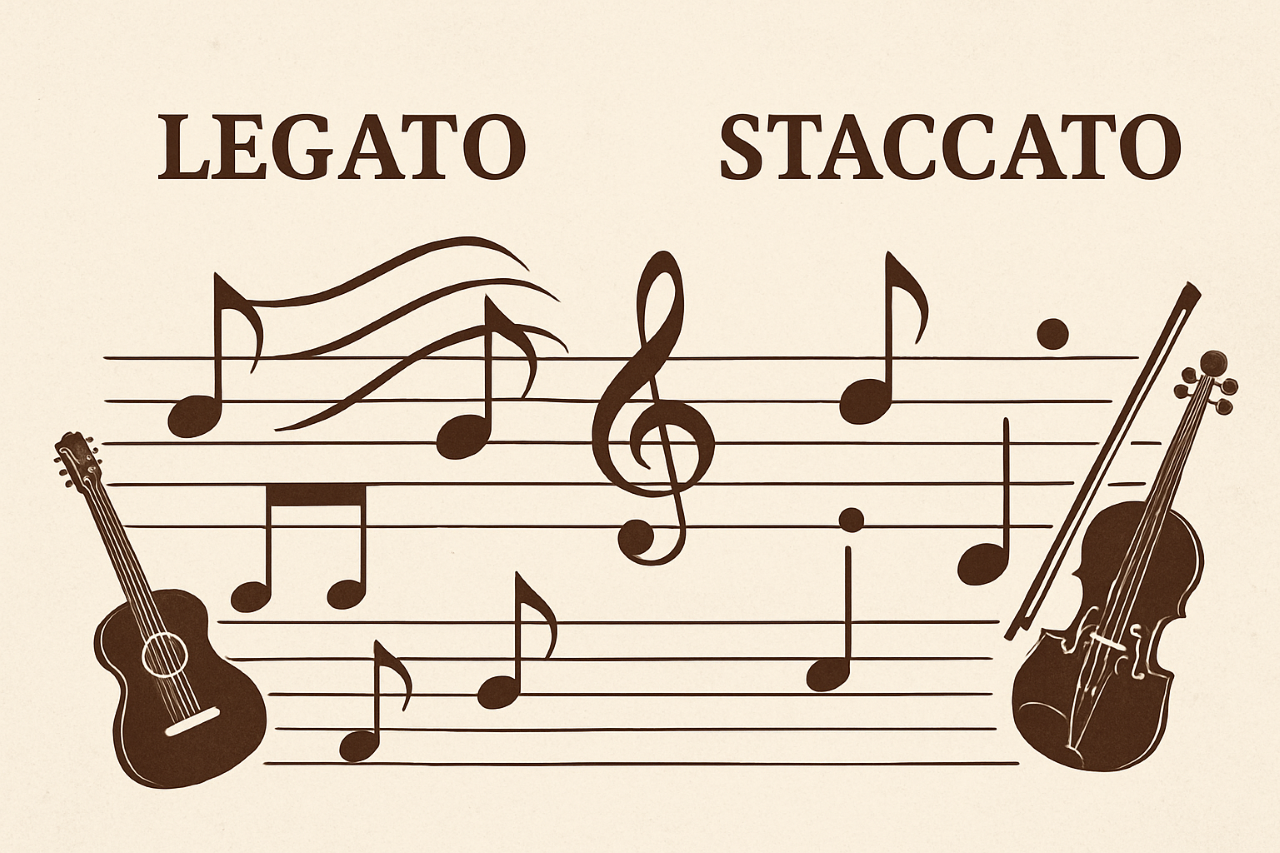
In the world of music, technique is often what separates a competent performance from a captivating one. Among the most fundamental expressive tools available to a musician are the contrasting articulations known as legato and staccato. These two terms appear in virtually every style of music—classical, jazz, folk, film score, and even popular genres—yet their impact on phrasing and musical character is profound and unmistakable.
Although both words come from Italian, their influence extends far beyond vocabulary. They tell performers how to shape a phrase, how to breathe life into a melody, and how to guide the listener’s emotional response. Understanding the difference between legato and staccato is not simply an exercise in terminology; it is an essential step in mastering musical expression.
Table of Contents
What Is Legato?
The word legato literally means “tied together”, and that is precisely how it sounds. In legato playing, each note flows seamlessly into the next as though they were pearls on an unbroken thread. There are no abrupt gaps, no sharp separations—just smooth, connected movement.
Characteristics of Legato Playing
- Notes are sustained to their full value.
- Transitions between them are gentle and fluid.
- The overall effect is lyrical, warm, and expressive.
Instrumentalists achieve this in different ways. A violinist may use a single long bow stroke for several notes; a flautist controls the airflow to avoid noticeable breaks; a pianist overlaps finger movements to create a continuous sound despite the instrument’s naturally percussive nature. Singers, too, rely on steady breath support to produce legato lines.
In many musical settings, legato conveys emotion, tenderness, or introspection. Think of a Romantic-era melody by Tchaikovsky or a gentle folk tune—legato brings these lines to life.
What Is Staccato?
Staccato, by contrast, means “detached” or “separated”. It is marked in notation by small dots placed above or below the notes, and it signals the performer to shorten each sound slightly and create a clear separation between them.
Characteristics of Staccato Playing
- Notes are shorter than their written value.
- Each note has a crisp, articulated attack.
- The effect is lively, energetic, and rhythmic.
On string instruments, this might be achieved by using short, controlled bow movements; wind players use the tongue to separate notes; pianists lift their fingers quickly to produce sharp, precise sounds.
Staccato can add playfulness, urgency, or rhythmic clarity. A Mozart allegro, a jazz trumpet solo, or a lively march often relies on staccato articulation to create sparkle and momentum.
Legato vs Staccato: The Essential Differences
Although the contrast may seem obvious—smooth versus short—the musical implications are far richer.
1. Emotional Tone
- Legato expresses warmth, lyricism, and calm.
- Staccato suggests energy, brightness, or agitation.
Good musicians choose between them not just to obey notation but to communicate mood and intention.
2. Mechanical Technique
Every instrument requires a different physical approach:
- A pianist must adjust finger pressure and pedal use.
- A violinist alters bow speed and contact.
- A singer modifies breath flow and consonant attack.
Thus, the difference is as much physical as conceptual.
3. Rhythmic Character
- Legato blurs the boundaries between notes.
- Staccato highlights the rhythm with sharp, identifiable pulses.
The articulation a performer chooses can dramatically change the feel of a passage.
4. Listener Perception
For the audience, legato often feels soothing and continuous, while staccato feels alert, pointed, or playful. These perceptions help shape the emotional landscape of a piece.
Why Are Legato and Staccato so Important?
Articulation lies at the heart of expressive performance. Two musicians can play the same written notes, yet their interpretations may differ completely depending on their use of legato and staccato. Composers rely on these instructions to guide the listener’s experience, while performers use them to refine their musical voice.
Moreover, mastery of articulation is essential for musical phrasing. Without it, melodies would sound flat or mechanical. With thoughtful use of legato and staccato, a phrase can breathe, dance, lament, or rejoice.
Examples Across Musical Genres
Legato and staccato are not confined to classical music; they appear everywhere.
Classical Music
Legato in Chopin’s nocturnes creates a dreamy, tender atmosphere.
Staccato in Vivaldi’s violin concertos adds brilliance and agility.
Film Music
The sweeping legato strings of a romantic soundtrack contrast sharply with the staccato brass used in action scenes.
Jazz
A saxophonist may alternate between smooth legato phrases and punchy staccato riffs to build tension and release.
Pop and Rock
Even guitarists use articulation—legato through hammer-ons and pull-offs, staccato through muted, percussive strumming.
How to Practise Legato and Staccato
Improving articulation takes time, awareness, and deliberate practice.
For Legato
- Practise slow scales, focusing on seamless transitions.
- Control breath (for singers and wind players) or bow flow (for string players).
- Avoid unnecessary gaps between notes.
For Staccato
- Use short, precise movements—of the fingers, tongue, or bow.
- Keep the rhythm steady and even.
- Practise alternating between legato and staccato to build control.
Ultimately, good articulation comes from listening carefully to one’s own sound and adjusting the technique until the intended effect emerges clearly.
Two Sides of Musical Expression
Legato and staccato are far more than technical markings; they are expressive languages. Legato paints a smooth, flowing picture, while staccato brings sparkle and definition. Together, they allow musicians to shape melodies with nuance, colour, and emotional depth.
Whether you are a budding student or an experienced performer, understanding the contrast between these two articulations will undoubtedly enrich your musical expression. Master them both, and you will gain the ability not just to play notes, but to tell a story through sound.