The musical heritage of Bengal spans more than a millennium. The melodies that have historically resonated across the riverine topography, skies, and human struggles of the Bengal region underwent an unprecedented psychological, stylistic, and artistic metamorphosis in the twentieth century. This transformation culminated in the distinct cultural genre known today as Adhunik Bangla Gan (Modern Bengali Songs). Within the expansive canvas of Bengali music, the emergence of this new idiom during the 1930s was not merely a superficial stylistic shift; rather, it reflected a profound social, psychological, and aesthetic evolution in the Bengali consciousness.
The nomenclature ‘Modern Song’ (Adhunik Gan) attained its initial institutional and documented sanction in the April 1930 issue of Betar Jagat, the official journal of Indian Broadcasting. The publication attempted a taxonomy of Bengali music, categorising ‘modern songs’ separately from traditional performances. Although a comprehensive theoretical definition was not provided at the time, the descriptor ‘modern’ rapidly established itself as a signifier of broader cultural reorientation.
Up until the nineteenth century, Bengali musical compositions were predominantly anchored in North Indian classical ragas. A primary example was the baithaki (chamber) music tradition, cultivated in royal courts, aristocratic salons, and the private soirées of landed zamindars. However, the dawn of the twentieth century initiated a decisive departure from this courtly paradigm. The creative focus gravitated towards poetic sensibility, subjective emotion, nuanced interiority, and individual expression. In his seminal text Prasanga: Bangla Gan (1989), musicologist Rajeshwar Mitra classified this emergent genre as Kavya Sangeet (poetic song), noting that its defining attribute was the primacy of literary sentiment and lyrical nuance over the rigid structural constraints of classical ragas and time cycles (talas).
This heightened literary refine and emotive depth sparked intense critical discourse in contemporary intellectual journals. A notable essay titled “Modern Bengali Songs” published in the periodical Nachghar (1936) observed that in ancient and medieval Bengali compositions, lyricism played a secondary role. The principal appeal of earlier forms resided in intricate melodic ornamentation, virtuosic vocal displays, and rhythmic complexities. Furthermore, theatrical and jatra (folk theatre) songs were so inextricably tied to dramatic narratives that they seldom functioned as standalone artistic pieces outside their theatrical contexts.
Modern Bengali songs liberated the medium from these contextual dependencies. Even when composed for theatrical productions, these works attained autonomous literary and musical validity. Lyrics ceased to exist merely as rhythmic scaffolding for melodic improvisation; instead, they became precise instruments for conveying complex human emotion. As the Nachghar critique articulated, the lyrics of modern Bengali songs possessed intrinsic literary value that could be appreciated as poetry independent of musical accompaniment, precisely because they were no longer bound to rigid classical structures.
This conceptual shift was reinforced in a 1947 editorial in Betar Jagat, which asserted that the novel melodic structures and rhythmic patterns of modern songs directly reflected the desires, anxieties, existential grief, and triumphs of the modern individual. In this genre, melody was composed in direct response to the emotive resonance and semantic weight of the word. Consequently, the modern song evolved into a medium of intimate personal expression—a synthesis where language, melody, and vocal execution converged into a unified aesthetic statement.

Table of Contents
Ancient and Medieval Foundations: A Millennium of Musical Heritage
To fully comprehend the aesthetic architecture of modern Bengali songs, one must examine the thousand-year lineage from which they derived their foundational elements. Modernity did not emerge in a vacuum; it drew sustenance from the historical strata of Bengal’s musical tradition. Musicological consensus traces the earliest documented forms of Bengali music to the reign of the Pala Dynasty (eighth to twelfth centuries CE).
From the Charyapada to the Gitagovinda and Srikrishnakirtan
The earliest literary and musical artifacts of the Bengali language are the Charyapadas, composed by Mahayana Buddhist Tantric Siddhacharyas (spiritual preceptors) as esoteric pedagogical tools. Crucially, each Charyapada verse was assigned a specific raga heading—such as Patamanjari, Mallari, Bhairavi, Kamod, and Devakri—demonstrating that systemic ragas were integral to Bengali song at its inception.
During the subsequent Sena Dynasty (eleventh–twelfth centuries), courtly culture favoured Sanskrit. However, the court poet Jayadeva composed the Gitagovinda, a masterpiece of Prabandha Sangeet (structured composition). The Gitagovinda, alongside the Charyapadas, established classical ragas within the regional repertoire. By the fourteenth century, Baru Chandidas’s Srikrishnakirtan introduced narrative verse-music (Padavali), permanently altering the trajectory of Bengali vocal traditions.
Sri Chaitanya, Kirtan, and the Ramprasadi Idiom
The sixteenth-century Bhakti movement led by Sri Chaitanya Mahaprabhu democratised musical practice across Bengal. Moving music beyond aristocratic enclosures, Chaitanya introduced Nām-kīrtan (congregational chanting) and Nagar-kīrtan (street processions). Kirtan emerged as an authentic regional art form. In both Khando-kirtan and Padavali-kirtan, devotional yearning was expressed through melodic accessibility coupled with complex rhythmic metrics.
In the eighteenth century, the Shakta poet-saint Ramprasad Sen pioneered a distinct genre of devotional music (Shyama Sangeet). Expressing intimacy with the Divine Mother through accessible folk idioms, his signature melodic structure became known as the Ramprasadi tune, leaving an enduring mark on the regional musical psyche.

Nineteenth-Century Urbanisation and Pre-Modern Musical Genres
Following the establishment of Islamic rule in 1201 CE, Persian and courtly influences enriched regional traditions, expanding music’s role into secular and recreational domains. By the nineteenth century, colonial urbanisation in Kolkata generated a vibrant, heterogeneous musical landscape. While landed elites patronised classical baithaki gatherings, a diverse array of urban and semi-urban popular genres flourished among the broader populace, including Panchali, Tarja, Kobi-gan (poetic duels), Akhrai, Half-Akhrai, and theatrical music.
- Panchali and Kobi-gan: The narrative Panchali compositions of Dasharathi Ray and the competitive verse-duels of Ram Basu and Gopal Urey captivated nineteenth-century urban audiences.
- Tappa and Ramnidhi Gupta (Nidhubabu): A pivotal transition occurred through Ramnidhi Gupta (Nidhubabu), who adapted the North Indian/Lucknowi Tappa into Bengali. Nidhubabu shifted the thematic locus of Bengali song away from devotional allegories, introducing secular, humanist love songs.
Nidhubabu’s compositions incorporated classical ragas—including Bageshree, Bhimpalasi, Sahana, Basant, Multan, Jaijaiwanti, and Poorvi—modified to suit Bengali prosody and aesthetic preferences, set to rhythmic cycles such as Yat, Aratheka, Madhyaman, and Posta.
Concurrently, Raja Rammohan Roy’s Brahma Sangeet introduced a somber, monotheistic devotional repertoire, which was later refined by Maharshi Debendranath Tagore and his contemporaries. Meanwhile, stage songs (Mancha-gan) composed for public theatres by playwrights such as Girish Chandra Ghosh and Kshirod Prasad Vidyavinod gained widespread popularity.
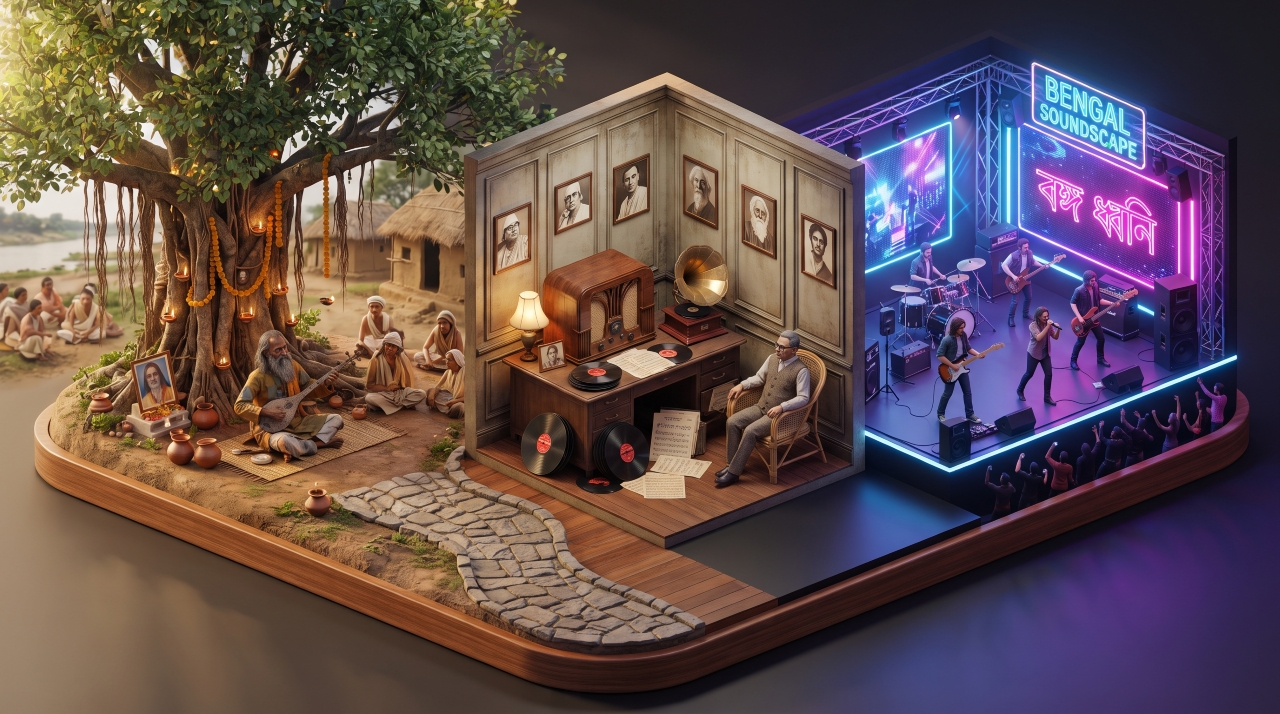
Folk Traditions and Mystical Idioms: The Shashwat Soul of Bengali Music
The formal evolution of modern Bengali song remained deeply linked to regional folk music and mystical traditions. Bengal’s riverine geography and agrarian life cultivated an innate musicality among its people. Music functioned not merely as entertainment, but as a medium for communal expression, spiritual contemplation, and solace amid hardship.
Regional Folk Genres
The folk repertoire exhibits distinct regional and stylistic variations:
- Bhawaiya and Chatka of Northern Bengal express rural romance, longing, and agrarian life.
- Bhatiali, sung by boatmen in the eastern riverine plains, features melancholic, extended melodic lines echoing across wide waters.
- Tusu, Bhadu, Gambhira, Gajan, and Neelgan of the Rarh region serve ritualistic and socio-cultural functions.
- Other traditions include Dhamail, harvesting songs (Dhan Katár Gan), threshing songs (Dhan Bhangár Gan), Sari (rowing songs), Jari (elegy ballads), and Bhashan ballads.
The Alkap and Leto Traditions
Alkap, originating in the Chapainawabganj region, combines satire, music, and theatrical performance. Created primarily by marginalized agricultural and artisan communities, Alkap addressed daily struggles and social inequities through humor. It was within a similar regional troupe—a Leto performer group—that a young Kazi Nazrul Islam began his artistic development.
Mystical Traditions: Lalon Sai to Shah Abdul Karim
The Baul and Sufi mystical traditions integrated humanism into Bengali music:
- Fakir Lalon Sai (c. 1774–1890): Based in Cheuriya, Kushtia, Lalon composed songs rejecting caste hierarchies, sectarian dogma, and ritual orthodoxy in favor of spiritual self-realisation:“I have never seen the form of caste with my own eyes… / He who comprehends the truth of human essence, / Does he care for dogmatic divisions?”Lalon’s philosophy of universal humanism profoundly influenced modern Bengali thinkers, including Rabindranath Tagore.
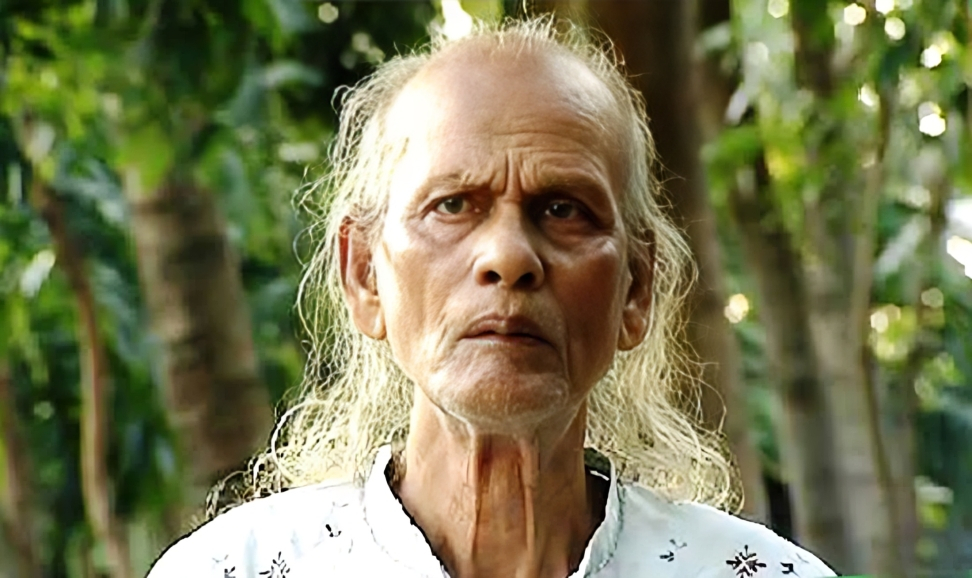
- Hason Raja and Shah Abdul Karim: In Sylhet, the mystic poet Hason Raja renounced aristocratic wealth to compose songs of spiritual detachment. In the twentieth century, Shah Abdul Karim synthesized traditional Baul philosophy with contemporary social consciousness, creating compositions such as “Gari Chole Na” and “Age Ki Sundor Din Kataytam”.
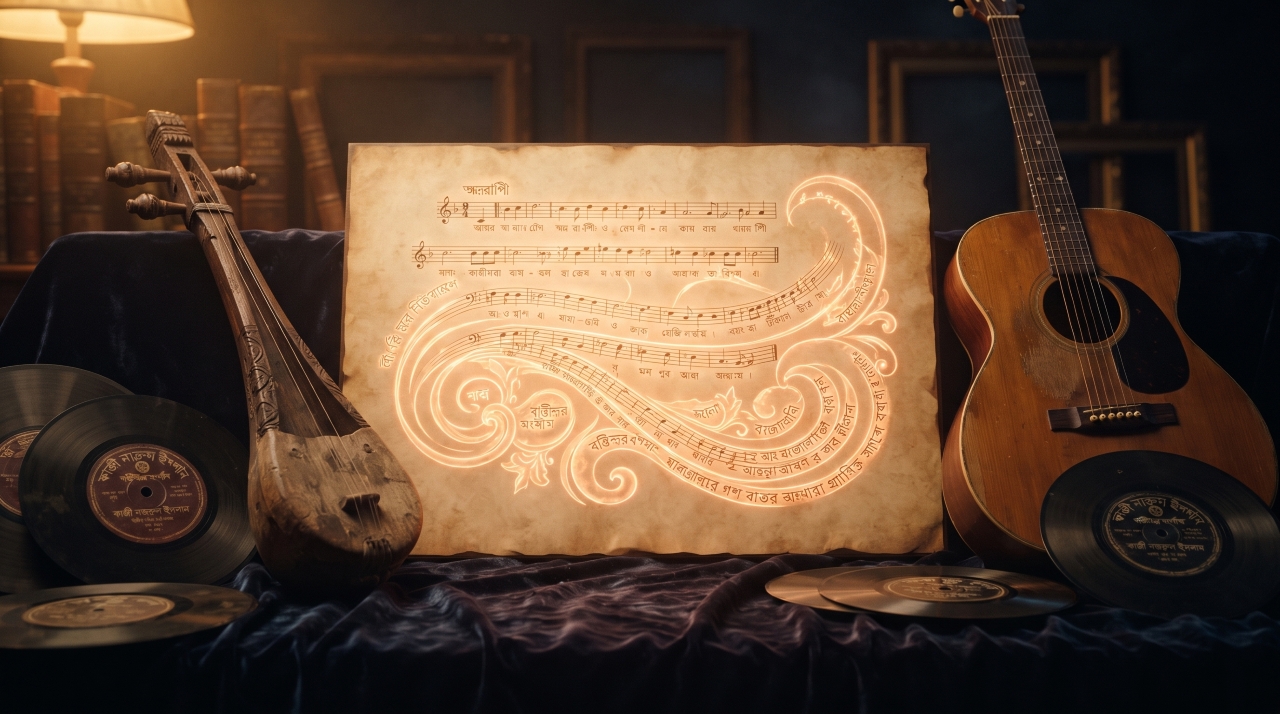
The Era of the Five Poets (Panchakabi): The Architecture of Modernity
The formal entry of Bengali music into modernity was led by five towering figures known collectively as the Panchakabi (The Five Poets): Rabindranath Tagore, Kazi Nazrul Islam, Dwijendralal Ray (D. L. Ray), Rajanikanta Sen, and Atulprasad Sen.
                       ┌─────────────────────────┐
                       │   The Five Poets of     │
                       │   Bengali Songcraft     │
                       └────────────┬────────────┘
                                    │
    ┌───────────────┬───────────────┼───────────────┬───────────────┐
    │               │               │               │               │
┌───┴──────────┐┌───┴──────────┐┌───┴──────────┐┌───┴──────────┐┌───┴──────────┐
│ Rabindranath ││  Kazi Nazrul ││ Dwijendralal ││ Rajanikanta  ││  Atulprasad  │
│    Tagore    ││    Islam     ││     Ray      ││     Sen      ││     Sen      │
└──────────────┘└──────────────┘└──────────────┘└──────────────┘└──────────────┘
1. Rabindranath Tagore (1861–1941)
Tagore fundamentally transformed Bengali music by fusing literary complexity with innovative composition. He adapted North Indian classical ragas, Bengali folk melodies (Baul and Bhatiali), and Western melodic structures to establish an expansive aesthetic universe. Categorised into thematic sections—Puja (Devotional), Prem (Love), Prakriti (Nature), Swadesh (Patriotic), and Bichitra (Miscellaneous)—his compositions formed the bedrock of modern Bengali art song (Rabindra Sangeet). Tagore remains the only composer in history whose works were adopted as the national anthems of two sovereign nations (India and Bangladesh).
2. Kazi Nazrul Islam (1899–1976)
Nazrul introduced rhythmic vitality, dramatic intensity, and stylistic variety to the tradition. Incorporating Persian and Arabic poetic vocabulary, he created the Bengali Ghazal, establishing it as a popular art form. Nazrul composed over 3,500 works spanning martial songs, revolutionary anthems, Shyama Sangeet, and classical raga-based modern compositions:
“Is it a Hindu or a Muslim who drowns? / Helmsman, proclaim: it is a human being who sinks, the child of my mother!”
3. D. L. Ray, Rajanikanta, and Atulprasad
- D. L. Ray: Integrated Western theatrical structures, choral harmonies, and martial brass rhythms into Bengali patriotic music, producing iconic works such as “Dhana Dhanya Pushpa Bhara”.
- Rajanikanta Sen: Synthesised spiritual humility with anti-colonial nationalism, memorable for compositions like “Mayer Deya Mota Kapor”.
- Atulprasad Sen: Based in Lucknow, he merged Hindustani classical idioms (Thumri, Dadra) with Bengali poetic forms, creating enduring works such as “Moder Gorob Moder Asha”.

Technological Revolutions: Gramophone, Radio, Cinema, and the Construction of the Female Voice
The institutionalisation and commercial dissemination of modern Bengali songs were driven by technological advances in sound recording and broadcasting during the early twentieth century.
The Gramophone and HMV
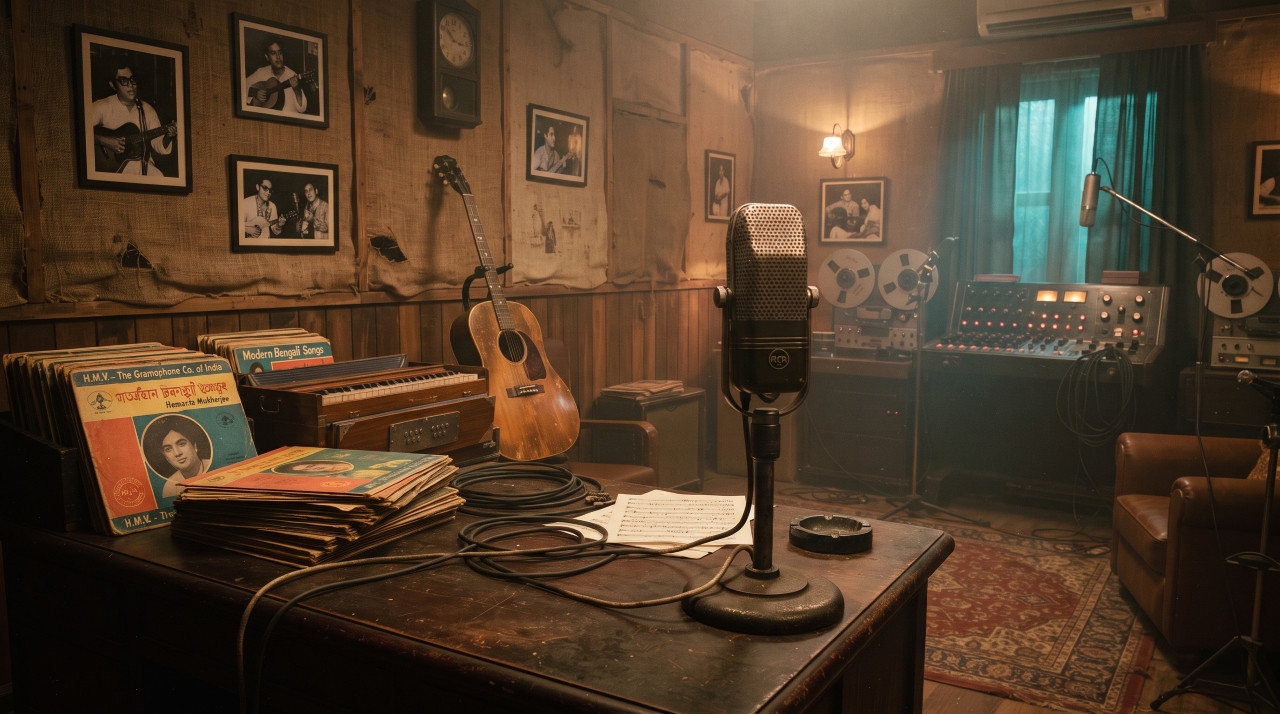
Following Thomas Edison’s 1877 invention of the phonograph and Emile Berliner’s 1887 development of the flat disc gramophone, sound recording transformed music consumption. The establishment of the Gramophone Company (His Master’s Voice / HMV) in Kolkata in 1908 shifted music from private salons to public commercial markets. Early 78 RPM shellac records typically featured one track per side, establishing a concise format for popular songs.
Broadcasting and Radio Culture
The advent of commercial radio broadcasting in the late 1920s and the publication of Betar Jagat brought recorded music into middle-class domestic spaces, broadening the audience for both classical and modern genres.
[Charyapada & Gitagovinda] ──► [Kirtan & Tappa] ──► [Panchakabi Repertoire] ──► [Gramophone & Radio] ──► [Modern Art Song]
Cinema and the Professionalisation of Music Production
The emergence of Bengali sound cinema (talkies) in the 1930s created a commercial market for film music. This transition established a division of creative labor: the roles of lyricist, composer, and vocalist became specialized professions.
Musicologist Dr. Suchetana Bhattacharya’s doctoral research highlights the period between 1930 and 1950, focusing on the artist Kanan Devi to examine the social construction of the modern female singing voice in Bengali mass media. Kanan Devi’s screen performances and commercial recordings helped dismantle nineteenth-century social stigmas regarding women in public performance, establishing a studio-refined vocal aesthetic that paved the way for later vocalists like Sandhya Mukherjee, Aarti Mukherjee, and Lata Mangeshkar.
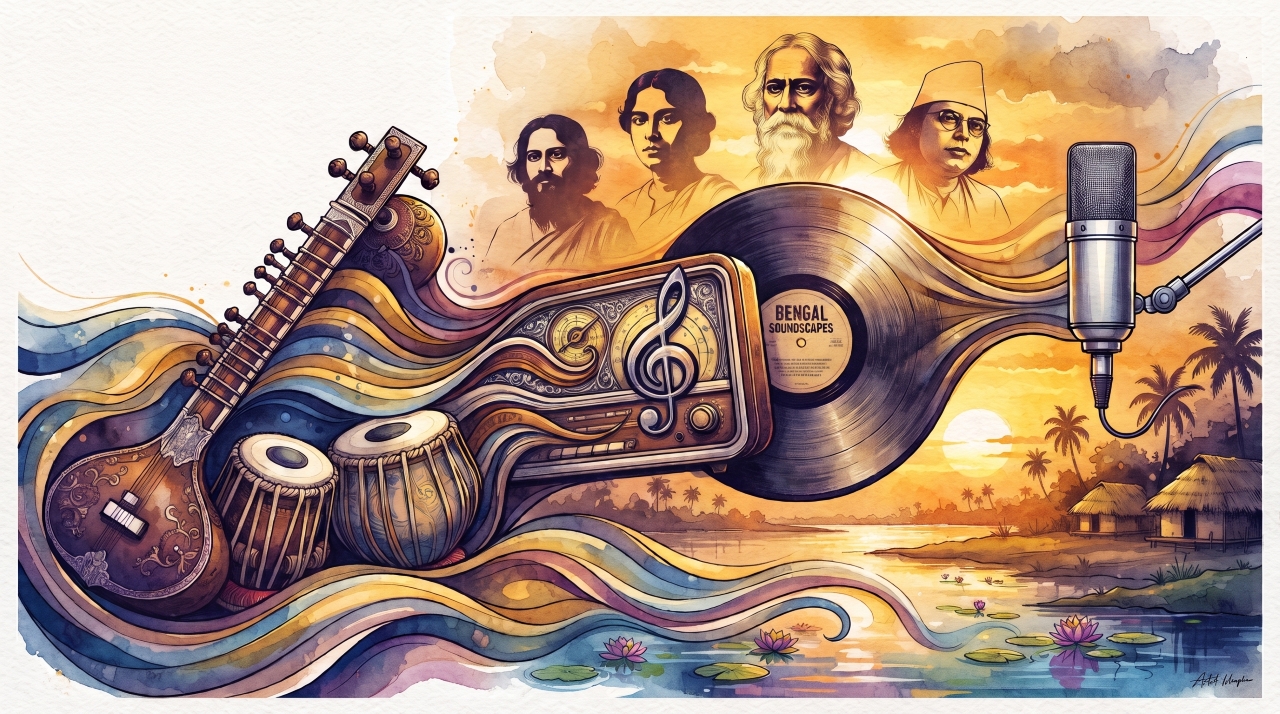
Mid-20th Century to the 1980s: The Golden Age of Modern Songs
The period spanning the 1950s through the 1980s is widely regarded as the ‘Golden Age’ of Adhunik Bangla Gan. Characterized by collaboration among lyricists, composers, and vocalists, this era produced thousands of original compositions released as annual Puja albums (Pujor Gan) and film playback tracks.
Prominent Lyricists and Composers
Distinguished lyricists of this era included Pranab Roy, Gouriprasanna Mazumder, Pulak Bandyopadhyay, Salil Chowdhury, Shyamal Gupta, and Mukul Dutt.
Compositionally, Salil Chowdhury introduced complex Western orchestral arrangements, contrapuntal harmonies, and irregular time signatures, merging them with regional folk themes. Other influential composers and music directors included S. D. Burman, Hemanta Mukherjee, Nachiketa Ghosh, Sudhin Dasgupta, Shyamal Mitra, and Robin Chattopadhyay.
Vocalists
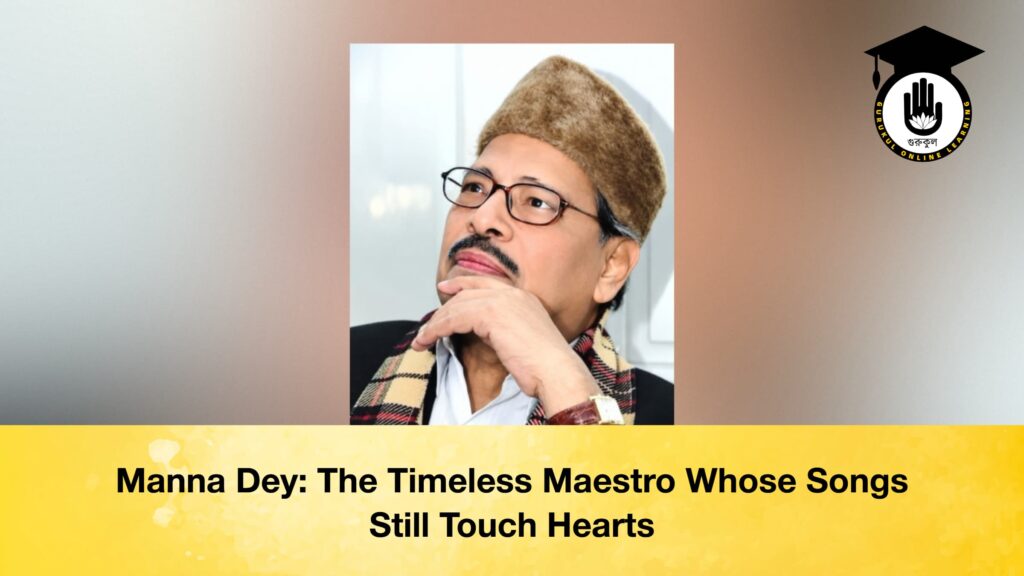
The vocal landscape was defined by artists such as Hemanta Mukherjee, Manna Dey, S. D. Burman, R. D. Burman, Shyamal Mitra, Satinath Mukherjee, and Dwijen Mukherjee. Prominent female vocalists included Lata Mangeshkar, Asha Bhosle, Sandhya Mukherjee, Aarti Mukherjee, Gita Dutt, and Pratibha Basu.
New Media, Pop, and the Band Renaissance (Post-1970)
The introduction of magnetic tape audio cassettes in the 1970s, followed by compact discs (CDs) in the 1990s, democratised production and distribution, lowering costs and enabling independent music production.
[Shellac 78 RPM Records] ──► [Magnetic Cassette Tape] ──► [Compact Disc (CD)] ──► [Digital Streaming Media]
Post-Independence Bangladesh and the Band Movement
Following the 1971 Liberation War, Bangladeshi popular music incorporated Western rock, pop, and blues idioms.
- Azam Khan: Considered a pioneer of Bengali pop music, freedom fighter Azam Khan introduced vernacular themes and urban rock arrangements through songs like “Rail Line-er Oi Bostite”.
- Fakir Alamgir and Pilu Momtaz: Merged folk rhythms with contemporary pop sensibilities.
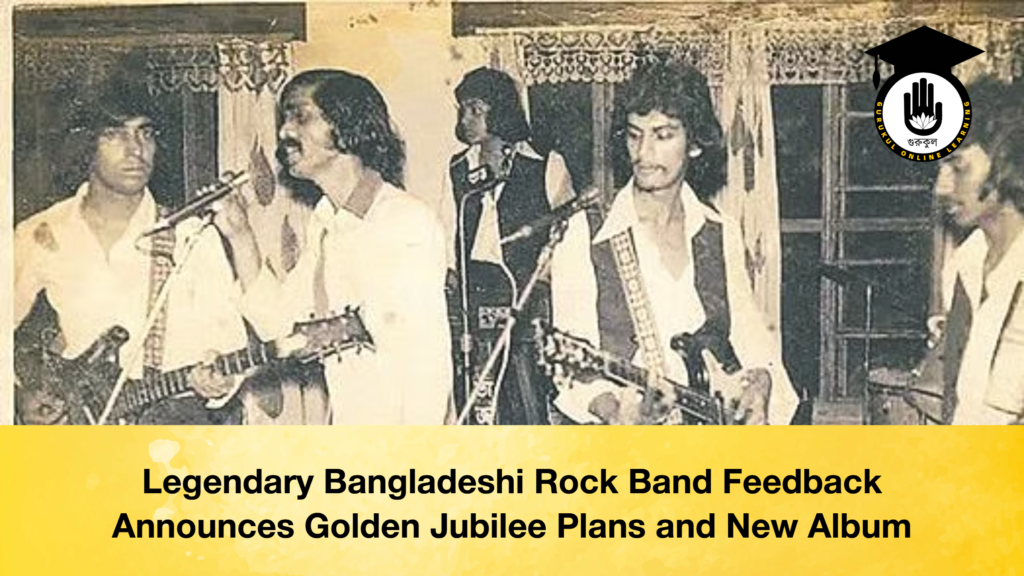
- The Band Movement: The 1980s and 1990s saw the rise of influential bands including Miles, LRB (led by guitarist/vocalist Ayub Bachchu), Nagar Baul (fronted by James), Souls, Renaissance, and Feedback. James’s fusion of Baul philosophy with psychedelic rock and Ayub Bachchu’s blues-rock guitar work introduced new stylistic dimensions to the genre.
The ‘Jibanmukhi’ Movement in West Bengal
In early 1990s West Bengal, artists such as Kabir Suman (Suman Chattopadhyay), Nachiketa Chakraborty, and Anjan Dutt initiated the Jibanmukhi (life-oriented) music movement. Rejecting conventional romantic tropes, these singer-songwriters addressed urban socio-political realities, unemployment, middle-class anxieties, and contemporary civic issues. This narrative-driven approach influenced later bands such as Chandrabindoo, Fossils (led by Rupam Islam), and Cactus.
The Core Elements of Songcraft and the Critique of Pseudo-Modernisation
An analysis of songcraft identifies four foundational structural components:
┌────────────────────────────────────────────────────────┐
│             The Four Pillars of Songcraft              │
└───────────────────────────┬────────────────────────────┘
                            │
     ┌──────────────────────┼──────────────────────┐
     │                      │                      │
┌────┴─────────┐     ┌──────┴──────┐        ┌──────┴──────┐        ┌───────────┐
│ 1. Lyrical   │     │  2. Melodic │        │  3. Vocal   │        │ 4. Instru-│
│    Text      │     │ Structure   │        │ Performance │        │ mental    │
│   (Bani)     │     │    (Sur)    │        │  (Gayaki)   │        │ Arrangem't│
└──────────────┘     └─────────────┘        └─────────────┘        └───────────┘
In modern digital media, Visual Presentation (Music Videos) has emerged as a fifth element. While visual media enhances audience engagement, visual production cannot substitute for structural defects in the underlying songcraft.
Recent trends under the guise of ‘modernisation’ warrant critical examination regarding artistic integrity:
1. Lyrical Text (Bani)
Song lyrics function as condensed literary texts. Historically, lyricists operated as poets, ensuring longevity through thematic depth.
Conversely, superficial approaches to modernisation often reduce lyrical content to repetitive colloquialisms or unintegrated foreign loanwords. Altering pronouns (e.g. substituting the formal tumi with the informal tui) does not inherently constitute innovation; meaningful progress relies on poetic rigor and original thematic exploration. Beyond romantic tropes, modern songwriting must engage broader social, existential, and psychological themes.
2. Melodic Structure (Sur)
Composers such as Tagore and Nazrul expanded musical boundaries through deep familiarity with classical ragas. In contrast, compositions lacking foundational training often result in repetitive, formulaic melodies.
Similarly, direct plagiarism of foreign melodies differs fundamentally from authentic artistic synthesis. True assimilation requires adapting diverse musical influences into a cohesive, culturally resonant work.
3. Vocal Performance (Gayaki)
Vocal execution relies on disciplined vocal training (riyaaz). The overuse of whispery or breathy techniques (husky voice) to mask technical limitations, alongside reliance on visual staging or short-lived reality television visibility, often fails to sustain long-term artistic impact.
4. Instrumental Arrangement (Yantra-Anushanga)
Instrumentation serves an embellictic function designed to complement the vocal line. Replacing musical subtlety with over-amplified electronic production can obscure lyrical and vocal nuance.
Furthermore, re-recording classic compositions under the banner of “fusion” requires aesthetic reverence and technical expertise. Modernising heritage repertoire should enhance rather than diminish the structural integrity of the original work.
Artistic Integrity and the Future of the Genre
As Rabindranath Tagore remarked:
“Of all the wealth found in the treasury of Bengali literature, the most precious are its songs.”
The history of Bengali music reflects an ongoing dialogue between tradition and innovation. From the esoteric verses of the Charyapada to medieval Kirtan, the reformative compositions of the Panchakabi, the mid-century Golden Age, and contemporary band music, the genre has continually adapted to changing cultural landscapes.
Authentic artistic innovation transcends temporary trends. The enduring relevance of century-old compositions demonstrates that true quality relies on structural discipline, literary merit, and emotional resonance. Preserving the legacy of Bengali music requires sustained dedication to craft, scholarly appreciation, and creative integrity, ensuring the tradition continues to thrive for generations to come.