
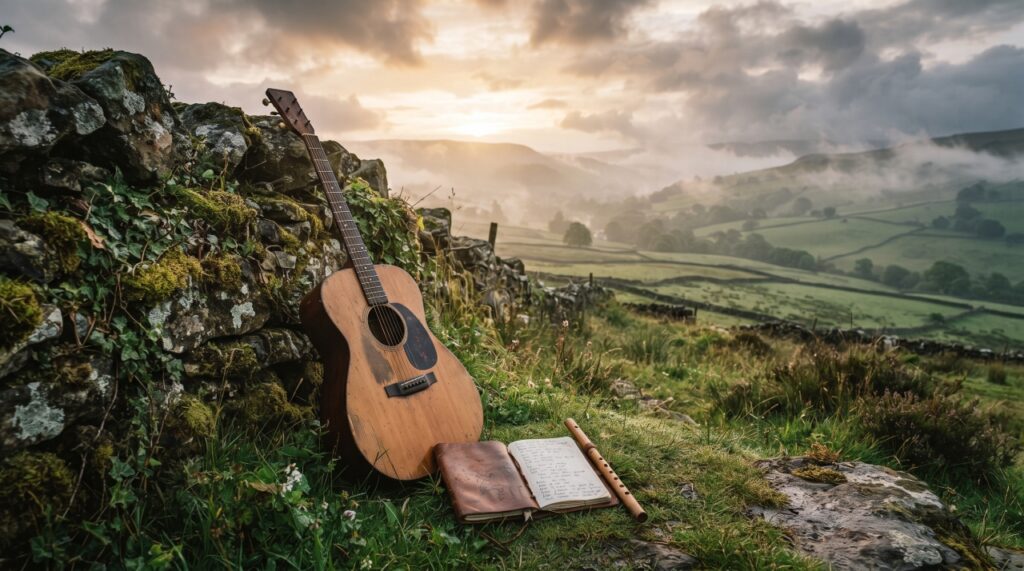
The English folk tradition is one of the most expressive, resilient, and socially revealing musical archives in Western heritage. Long before songs were etched onto wax cylinders or printed on sheet music, these melodies circulated orally through village greens, dimly lit alehouses, coastal ports, and industrial cotton mills. They served as news dispatches, emotional outlets, political protests, and oral histories for working people whose lived experiences rarely made it into official history books.
During the late 19th and early 20th centuries, preservationists like Cecil Sharp, Lucy Broadwood, Ralph Vaughan Williams, and Sabine Baring-Gould recognized that rapid urbanization was threatening to erase this rich oral heritage. Armed with notebooks and early phonograph machines, they traversed rural counties—from the marshes of Norfolk to the valleys of Somerset—cataloguing thousands of tunes directly from aging field workers, sailors, and blacksmiths. Later cross-referenced in modern archives like Steve Roud’s Roud Folk Song Index and Francis James Child’s English and Scottish Popular Ballads, these songs reveal a complex tapestry of historical Britain.
Table of Contents
1. Scarborough Fair
- Roud Index: 12 | Child Ballad: 2
Rooted in medieval riddle ballads—most notably The Elfin Knight—this North Yorkshire melody centers on two former lovers issuing each other a series of impossible tasks as conditions for reconciliation. The suitor demands a cambric shirt made without seams or needlework, executed on an acre of land situated between the salt sea and the sea strand. In response, the maiden demands an equal number of miraculous feats before she will yield.
Parsley, sage, rosemary, and thyme,
Remember me to one who lives there,
For once she was a true love of mine.
The famous recurring refrain functions as a botanical code deeply embedded in medieval folklore. Parsley was associated with taking away bitterness; sage symbolized endurance and wisdom; rosemary represented remembrance and fidelity; and thyme signified courage and passion. Musically, the song’s lingering Dorian mode gives it an ancient, haunting quality that sets it apart from modern major-minor tonality.
While the song achieved worldwide fame through Simon & Garfunkel’s 1966 arrangement on Parsley, Sage, Rosemary and Thyme, Paul Simon actually learned the Dorian-mode arrangement in London in 1965 directly from English folk icon Martin Carthy. Carthy’s intricate fingerpicking guitar style had reinvented the tune for the 1960s British folk revival, cementing its status as a masterpiece of English modal song.
2. Blow the Wind Southerly
- Roud Index: 2619
Originating from the Tyneside region of North East England, Blow the Wind Southerly is a tender maritime ballad sung from the perspective of a woman standing on the banks of the River Tyne, desperately praying for a southerly breeze to carry her lover’s sailing vessel safely back across the North Sea.
The text was first compiled in print by antiquarian Sir Cuthbert Sharp in his 1834 anthology The Bishoprick Garland. Unlike many folk songs that rely on dense narrative storytelling, this piece relies on rhythmic repetition that mimics the rolling motion of ocean swells. The melody shifts between gentle longing and urgent plea, reflecting the constant anxiety faced by seafaring communities along the rugged Northumbrian coast.
Blow the wind southerly, keep the wind blowin',
Moisten my true love's bark, keep the wind blowin',
Blow the wind southerly, blow the wind south,
And bring back the bonny lad kindly to me.
The song’s trajectory changed permanently in 1949 when the legendary Lancashire-born contralto Kathleen Ferrier recorded an uncompressed, a cappella version for Decca Records. Ferrier’s rich, dark vocal timbre and immaculate diction transformed what was once a regional Northumbrian folk tune into a staple of national broadcast culture. In recent years, classical artists such as cellist Sheku Kanneh-Mason and opera singer Bryn Terfel have continued to perform and recontextualize its melody.
3. Greensleeves
- Roud Index: 22229
Few melodies in the English-speaking world carry as much mythic weight as Greensleeves. Registered at the London Stationers’ Company in September 1580 by printer Richard Jones as “A Newe Northen Dittye of the Lady Greene Sleves,” the composition became an instant sensation across Elizabethan England, even earning a explicit mention in Shakespeare’s The Merry Wives of Windsor.
Popular urban legend frequently claims that King Henry VIII composed the song for Anne Boleyn during his agonizing courtship of her in the 1520s. However, musicologists have largely debunked this royal attribution. The song’s structural composition is built upon an Italian harmonic framework known as the passamezzo antico (or in some variations, the romanesca), an instrumental ground bass style that did not spread to the English court until after Henry VIII’s death in 1547.
Alas, my love, you do me wrong,
To cast me off discourteously.
For I have loved you well and long,
Delighting in your company.
The exact meaning of the “green sleeves” has been debated for centuries. Some scholars suggest the green gown implies a woman of worldly experience, referencing the grass stains acquired on clothing during romantic encounters in rural fields. Others argue it simply describes a courtly fashion trend of the late 16th century, symbolizing fickle, ever-changing love. In 1934, composer Ralph Vaughan Williams adapted the melody into his celebrated orchestral work Fantasia on ‘Greensleeves’, extracting the theme from his opera Sir John in Love and placing it firmly within the classical concert hall canon.
4. The Whitby Lad
- Roud Index: 261 / Transportation Ballad
Born out of the harsh legal codes of 18th and early 19th-century Britain, The Whitby Lad represents a distinct subgenre of English street literature known as the “transportation ballad.” Under the Transportation Act of 1717 and subsequent penal statutes, English courts routinely sentenced individuals convicted of petty theft, poaching, or political agitation to forced labor in overseas penal colonies—first in North America, and later in Australia (Botany Bay and Van Diemen’s Land).
Originating from the fishing and whaling port of Whitby in North Yorkshire, this ballad is narrated by a young convict who laments falling in with bad company and succumbing to temptation.
My loving father stood at the bar,
Likewise my mother dear,
A-tearing of her old grey locks,
And rending of her hair.
Broadside printers in Seven Dials, London, as well as regional printers in York and Newcastle, churned out thousands of these sheets to sell for a penny at public executions and court sessions. They functioned simultaneously as sensationalist crime reporting, moral warnings to youth, and outlets for public grief over the loss of family members forcibly shipped across the globe. The minor-key, angular vocal line echoes the windswept cliffs of the North Yorkshire coastline, evoking an atmosphere of inescapable exile.
5. Sweet Nightingale
- Roud Index: 371
Sweet Nightingale is a classic pastoral courting song with strong historical ties to the tin and copper mining communities of Cornwall. First brought to wider public attention by compiler Robert Bell in his 1857 volume Ancient Poems, Ballads and Songs of the Peasantry of England, the song carries a curious editorial note claiming the text was translated from an ancient Cornish-language original that had traveled to Germany via migrant miners.
Down in yon valley, among the sweet bushes,
There sits a sweet nightingale, singing her song.
In the coded lexicon of 19th-century English country song, “going to hear the nightingale sing” served as a widespread polite euphemism for romantic trysts in secluded country lanes. The musical structure of Sweet Nightingale features a distinctive call-and-response refrain designed for group participation in public houses and community gatherings. Verses sung by a soloist alternate with a hearty, multi-part chorus, demonstrating how folk music functioned as a social glue for rural working families.
6. The Four Loom Weaver
- Roud Index: 937
While much of English folk song collection focused on agrarian life, The Four Loom Weaver (originally broadside-printed as The Poor Cotton Wayver) stands as one of the most poignant industrial ballads ever written. Originating in Lancashire around 1819–1820 in the bitter economic aftermath of the Napoleonic Wars, the song documents the human cost of the Industrial Revolution.
As steam-powered mechanical looms were introduced into massive urban factories, independent handloom weavers saw their piece-rate wages collapse by over 70 percent within a single decade. Hand weavers who had previously enjoyed pride, independence, and decent wages were suddenly plunged into severe poverty and starvation.
I'm a poor cotton weaver as many a one knows,
I've nowt to eat i' th' house an' I've worn out my clothes.
You'd hardlly give sixpence for all my old gear,
My clogs are to tear, an' my stockings are out.
The song’s blunt dialect lyrics describe a weaver named John living in a cold cottage, forced to sell his loom fittings to buy basic oatmeal while pleading with his landlord for mercy. The sparse, mournful melody lacks any decorative ornamentation, matching the bleak reality of its subject matter. Revived in the mid-20th century by folk revivalists like Ewan MacColl and Harry Boardman, The Four Loom Weaver remains an essential social document of working-class resistance and economic displacement.
7. The Water Is Wide (O Waly, Waly)
- Roud Index: 87 | Child Ballad: 204
Tracing its stylistic ancestry back to 17th-century Scottish border broadsides such as Jamie Douglas, The Water Is Wide gradually evolved across the English countryside into one of the most universally recognized love laments in the English language.
The song utilizes classic folk imagery—impassable rivers, fragile wooden boats, cockleshells, and fading summer flowers—to explore the pain of betrayal and unrequited devotion.
The water is wide, I cannot get o'er,
And neither have I wings to fly.
Give me a boat that can carry two,
And both shall row, my love and I.
The genius of The Water Is Wide lies in its pentatonic scale and open phrasing, which allowed it to adapt easily as it migrated. When English, Scottish, and Irish settlers crossed the Atlantic in the 18th century, they carried this song into the Appalachian Mountains, where folklorists like Cecil Sharp transcribed it under various regional titles in the early 1900s.
In the 20th century, classical composer Benjamin Britten penned an influential arrangement for voice and piano, while folk revival artists like Joan Baez, Pete Seeger, and Bob Dylan adopted it into the American counterculture movement.
8. Bobby Shafto
- Roud Index: 1359
Unlike many anonymous folk creations, Bobby Shafto revolves around a real-life historical figure: Robert Shafto (1732–1797), a wealthy landowner from Whitworth Hall in County Durham who served as a Member of Parliament for County Durham from 1760 to 1790.
The song’s origins are tied to political campaigning in North East England. During the 1760 parliamentary election, Shafto’s supporters adapted an existing bouncy nursery rhyme to rally voters across the region. However, local narrative lore added a tragic romantic subplot. Legend claims that Bridget Belasyse, an heiress from nearby Brancepeth Castle, was deeply in love with Shafto. When he married Anne Duncombe of Wiltshire instead, Belasyse allegedly died of a broken heart.
Bobby Shafto's gone to sea,
Silver buckles on his knee;
He'll come back and marry me,
Bonny Bobby Shafto!
While parish records indicate that Bridget Belasyse actually died of pulmonary tuberculosis shortly before Shafto’s wedding, the ballad preferred the romantic tragedy. Its syncopated, dance-like 2/4 rhythm and repetitive structure made it a favorite children’s singing game across Tyneside and broader England for generations.
9. O No John (No, Sir, No)
- Roud Index: 146
Collected by Edwardian folklorist Cecil Sharp in Somerset in 1903 from singers like Mrs. Louie Hooper of Hambridge, O No John is a humorous courting ballad built on a clever play on words.
In the song, a suitor approaches a young woman whose husband has gone away on a long voyage. Before leaving, the jealous husband made his wife promise to answer “no” to every question asked of her. Realizing this constraint, the suitor structures his questions so that every negative response works in his favor—culminating in asking if he may stay with her until morning.
"Madam, will you walk and talk with me?
Will you show me your sweet face?"
"No, sir, no, sir, no, sir, NO!"
The song offers an insightful look into Edwardian editorial interventions. When Cecil Sharp transcribed the ballad from field singers, he found that older broadside sheets from London printers like Pitts contained explicit verses regarding garters and bed chambers. To make the song acceptable for use in English public schools, Sharp edited out the erotic stanzas and published a “cleaned up” version in Novello’s School Songs in 1904. This sanitized edition became a popular singalong piece in British classrooms throughout the mid-20th century.
10. The Water of Tyne
- Roud Index: 1364
First printed in Newcastle upon Tyne in John Bell’s landmark 1812 collection Rhymes of Northern Bards, The Water of Tyne is an expressive love song written in the regional Geordie dialect of Northumbria.
Before modern bridge construction and ferry networks transformed North East England, the River Tyne was a formidable geographic barrier. The lyrics tell of a maiden standing on the southern bank in County Durham, gazing across the fast-flowing water at her lover on the northern bank in Northumberland, unable to find a boatman willing to row her across.
O where is the boatman? My bonny lad's waiting,
He's waiting for me on the side of the Tyne.
O row me across, for the water is deep,
And I long for to see that sweet laddie of mine.
The song’s simple melody relies on long, soaring vocal lines that echo across open water. It highlights how regional topography directly influenced the themes of local folk composition. Operatic baritone Sir Thomas Allen, a native of County Durham, brought the song into the international art-song repertoire, demonstrating how regional dialect songs can carry universal emotional weight.
11. Pastime with Good Company
- Roud Index: 21122
Composed by King Henry VIII shortly after his accession to the throne in 1509 at the age of eighteen, Pastime with Good Company (also recorded as The King’s Ballad) stands at the intersection of courtly Renaissance art music and popular street song.
Preserved in the famous Henry VIII Manuscript (British Library Add MS 31922), the song was written in three-part vocal harmony. The lyrics serve as an apology and defense for the young king’s love of hunting, singing, dancing, and jousting, framing these athletic and artistic pursuits as noble virtues that prevent the soul from slipping into moral idleness.
Pastime with good company
I love and shall until I die.
Gudge who will, but none deny,
So God be pleased, thus live will I.
Because of its catchy, metric melody and simple modal construction, the song quickly spilled outside the walls of Greenwich Palace and Windsor Castle. Within decades, it was being sung by town criers, tavern musicians, and broadside minstrels across England. The piece remains a cornerstone of the English early music and choral traditions.
12. John Barleycorn
- Roud Index: 164
John Barleycorn is perhaps the most famous allegorical folk ballad in the British Isles, with printed broadside versions dating back at least to the reign of King James I in the early 17th century.
The ballad personifies the cereal crop barley as a heroic figure named John Barleycorn, who is subjected to terrible violence at the hands of three men from the west. He is plowed into the earth, scorched by the summer sun, cut down at the knee with scythes, threshed, ground between millstones, and boiled in a vat—only to rise again as ale and whisky to conquer his oppressors.
They let him lie for a long, long time,
Till the rain from heaven did fall,
And little Sir John sprung up his head,
And so amazed them all.
Anthropologists and folklorists, including James George Frazer in The Golden Bough, identified John Barleycorn as a surviving cultural memory of pre-Christian pagan agricultural rites centered on the dying-and-rising vegetation god. The brutal treatment of Barleycorn mirrors the ancient sacrificial rituals once believed necessary to guarantee a bountiful harvest.
Scottish poet Robert Burns famously published his own version in 1782, but the older English broadside versions remain the blueprint. In 1970, British rock band Traffic recorded a landmark progressive-folk adaptation on their album John Barleycorn Must Die, introducing this centuries-old agricultural myth to a modern rock audience.
13. The Unquiet Grave
- Roud Index: 51 | Child Ballad: 78
Collected extensively throughout southern England—particularly in Sussex, Hampshire, and Devon—The Unquiet Grave is one of the most haunting supernatural ballads in the English tradition.
The story follows a grieving lover who sits weeping on his sweetheart’s grave for “a twelvemonth and a day.” At the end of this traditional mourning period, the ghost of the deceased maiden speaks from beneath the earth, gently scolding him. She warns that his endless weeping keeps her from resting in peace, and warns that if he were to kiss her cold clay lips, his own life would quickly end.
"The stalk is withered dry, my love,
So will our hearts decay.
So make yourself content, my love,
Till God calls you away."
The song preserves archaic British folk beliefs concerning death, mourning limits, and the delicate boundary between the living and the dead. Musically, the melody rests in the natural minor (Aeolian) scale, featuring a descending melodic line that conveys deep grief. Iconic recordings by Shirley Collins, June Tabor, and Luke Kelly have kept its eerie beauty alive in modern folk music.
14. Early One Morning
- Roud Index: 960
First published in print by William Chappell in his monumental 1859 volume The Ballad Literature and Popular Music of the Olden Time, Early One Morning is a classic pastoral lament set in the English countryside.
The lyrics depict a young woman standing in a secluded valley at dawn, her voice echoing as she mourns being abandoned by her sailor lover. The refrain carries a poignant plea against deceit and emotional cruelty:
Oh, don't deceive me, oh, never leave me!
How could you use a poor maiden so?
Unlike the modal complexities of medieval riddle songs, Early One Morning features a bright, diatonic major key structure characteristic of late 18th and early 19th-century English art-folk song. Its clean melodic structure led to its inclusion in national songbooks used across British schools throughout the late 19th and early 20th centuries.
15. The Foggy, Foggy Dew
- Roud Index: 558
Traced to traditional singers across East Anglia, Somerset, and the West Country, The Foggy, Foggy Dew tells the story of a bachelor weaver who offers shelter to a young woman frightened by the cold winter mist, leading to a night that changes both of their lives forever.
So I took her by her lily-white hand,
And I kissed her cheek and chin,
And I took her into my bedroom,
And I blanketed her from the foggy, foggy dew.
In the late 19th and early 20th centuries, Victorian and Edwardian moral sensibilities made this song controversial. Broadside printers like James Catnach of Seven Dials had sold thousands of unedited copies, but early radio broadcasters initially banned the song due to its frank depiction of premarital romance.
In the 1940s, composer Benjamin Britten wrote a delicate arrangement for tenor voice and piano, recorded by Peter Pears. Shortly thereafter, American folk singer Burl Ives was briefly arrested in Utah for singing the song in public—an incident that only heightened its popularity. Today, it is recognized as a masterclass in narrative folk songwriting.
Anatomy of the English Folk Tradition
To fully understand how these fifteen songs survived across centuries, it is necessary to examine the mechanisms of their preservation: the broadside press, the collectors, and the unique musical structures that define the English sound.
                      ┌─────────────────────────────────────────┐
                      │          ORAL TRADITION                 │
                      │  (Singers, Laborers, Village Musicians) │
                      └────────────────────┬────────────────────┘
                                           │
                                           ▼
                      ┌─────────────────────────────────────────┐
                      │          BROADSIDE PRESS                │
                      │   (16th-19th Century Street Sheets)     │
                      └────────────────────┬────────────────────┘
                                           │
                                           ▼
                      ┌─────────────────────────────────────────┐
                      │         EDWARDIAN COLLECTORS            │
                      │ (Cecil Sharp, Vaughan Williams, Roud)   │
                      └────────────────────┬────────────────────┘
                                           │
                                           ▼
                      ┌─────────────────────────────────────────┐
                      │      MID-CENTURY FOLK REVIVAL           │
                      │ (Ewan MacColl, Carthy, Fairport Conv.)  │
                      └─────────────────────────────────────────┘
1. Broadsides: The Mass Media of the Street
Before radio and gramophone records, the broadside press was the primary engine of popular music in England. Printed on cheap rags using wooden blocks, broadside sheets contained song lyrics (often without musical notation, instead noting “to be sung to the tune of…”) and were sold by itinerant chapmen at country fairs, markets, and street corners for a halfpenny or penny.
Printers clustered in London’s Seven Dials district—such as James Catnach and John Pitts—printed millions of sheets covering everything from sensational court cases and public executions to love ballads and political satires. While these broadsides standardized many lyrics, field singers continually adapted the printed words back into their own regional dialects, creating a dynamic exchange between print and oral performance.
2. The Great Collectors and Preservation
By the late 1800s, industrialization, compulsory literacy, and the decay of rural village life threatened to extinguish oral traditions. A dedicated group of scholars and musicians formed the Folk-Song Society in London in 1898 to rescue these songs before they vanished.
- Cecil Sharp (1859–1924): The most prolific collector of the era, Sharp transcribed thousands of tunes across Somerset, Devon, and later the Appalachian Mountains in America. While criticized by later scholars for sanitizing erotic or politically radical lyrics, his field notebooks preserved priceless musical material.
- Ralph Vaughan Williams (1872–1958): Collecting extensively across Norfolk and Essex, Vaughan Williams used field recordings made on wax cylinders. He directly integrated these folk melodies into his symphonic works, creating a distinctly English classical sound.
- Steve Roud: In the late 20th century, librarian Steve Roud created the Roud Folk Song Index, a digital database that catalogues over 250,000 individual song references from across the English-speaking world, assigning a unique “Roud Number” to every distinct song type.
3. Modal Scales: The Technical DNA of English Melodies
One reason English folk music sounds instantly recognizable is its reliance on gregorian modes rather than standard major/minor scales. While 19th-century European classical music relied heavily on major keys and strong leading tones, English folk singers preserved older melodic modes:
| Mode | Key Characteristic | Typical Mood | Example Song |
| Dorian | Minor scale with a raised 6th degree | Haunting, noble, ancient | Scarborough Fair |
| Aeolian | Natural minor scale | Mournful, melancholic, serious | The Unquiet Grave |
| Mixolydian | Major scale with a flattened 7th degree | Bluesy, rhythmic, driving | John Barleycorn |
| Pentatonic | Five-note scale omitting 4th and 7th degrees | Open, adaptable, memorable | The Water Is Wide |
Field singers rarely used equal temperament tuning. When Percy Grainger brought a Edison wax cylinder recorder to Lincolnshire in 1908 to record singer Joseph Taylor, he noted microtonal shifts and subtle rhythmic fluctuations that could not be captured on a standard piano keyboard.
4. The 20th-Century Revival and Electrification
In the post-WWII era, the British Folk Revival breathed new life into these archival songs through two distinct waves:
- The Second Folk Revival (1950s–1960s): Led by figures like Ewan MacColl, A.L. Lloyd, Shirley Collins, and Martin Carthy, this movement established a network of folk clubs in pub basements across the UK. It emphasized authentic acoustic performance, vocal micro-decoration, and respect for working-class material.
- Electric Folk (Late 1960s–1970s): Bands like Fairport Convention (notably on their landmark 1969 album Liege & Lief), Steeleye Span, and Pentangle paired traditional ballads with electric guitars, bass, and drums. They demonstrated that traditional ballads like Matty Groves and John Barleycorn possessed the narrative power and musical drive to match modern rock music.
The Living Heritage
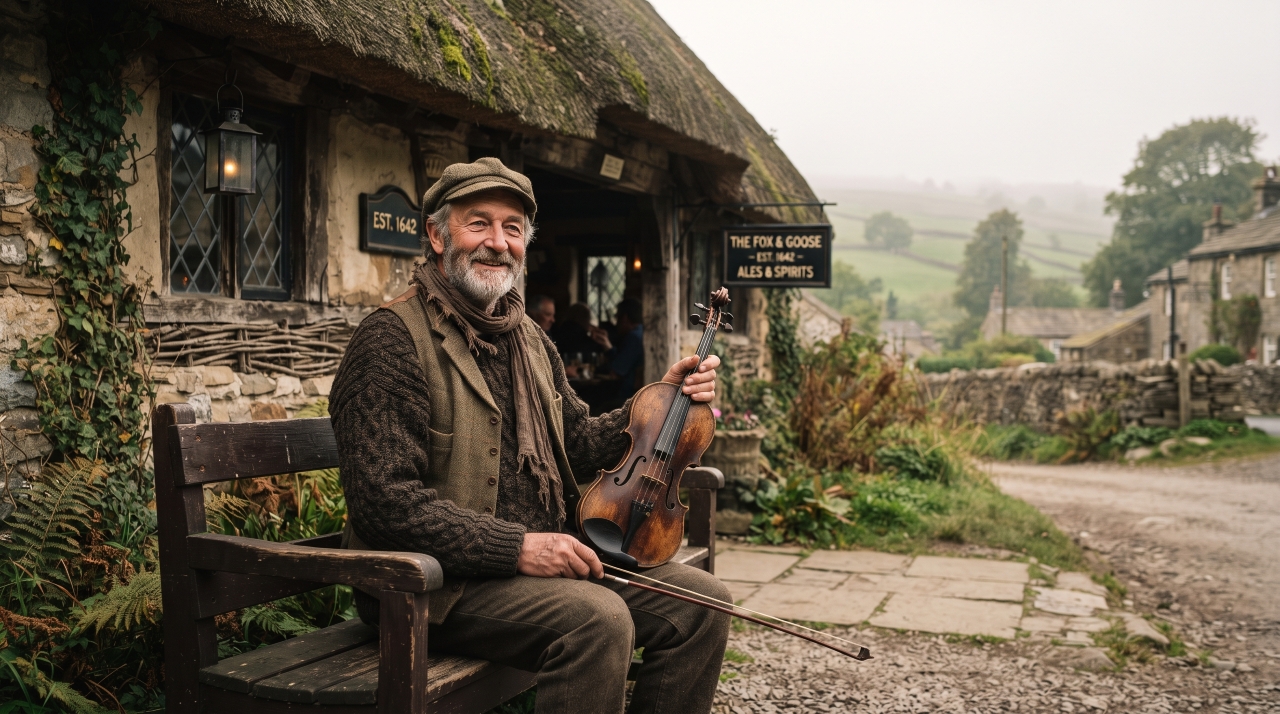
The fifteen songs detailed above are not static museum pieces preserved under glass; they remain living narratives that continue to adapt to new voices and instruments. From medieval riddles to industrial protests, maritime prayers to courtly celebrations, they offer an unvarnished window into the human experience across centuries of English history.
As contemporary artists like Sam Lee, The Unthanks, Laura Marling, and Eliza Carthy continue to re-interpret these melodies for new generations, the English folk canon demonstrates that a great song, once rooted in the human voice, never truly dies.