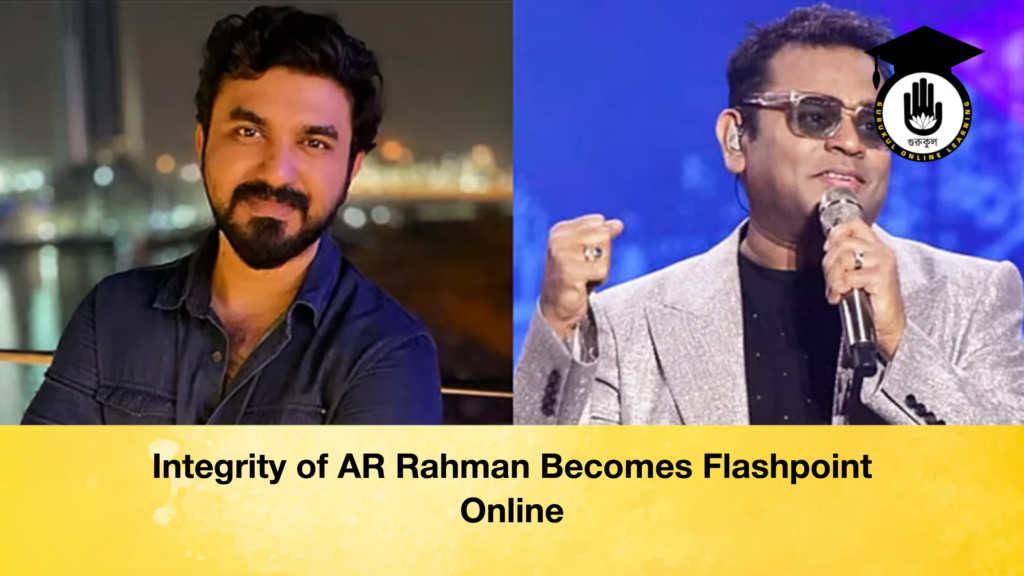
A recent comment by Oscar-winning Indian composer and musician A R Rahman has triggered a wave of debate across social media platforms, sparking intense discussion within India’s cultural and artistic circles. While opinions have been sharply divided, the globally renowned composer has largely remained unfazed by the controversy, choosing instead to clarify his position with composure and restraint.
The debate gained further attention when acclaimed Malayalam music composer Kailas Menon publicly expressed his support for Rahman. In a widely shared Instagram post, Menon argued that much of the reaction directed at Rahman went far beyond legitimate criticism and crossed into the territory of hate speech. According to Menon, disagreement with an artist’s viewpoint is natural, but personal attacks and attempts to undermine an individual’s integrity are neither fair nor constructive.
In his note, titled “Disagree, But Do Not Disrespect,” Menon emphasised that those criticising Rahman for speaking openly were overlooking a fundamental principle: the right to express personal feelings and lived experiences. He wrote that Rahman merely articulated his perspective, something every individual is entitled to do. While others may choose to disagree, denying him the freedom to share his experiences amounts to suppressing free expression.
Menon further observed that the backlash following Rahman’s remarks had escalated beyond healthy disagreement into what he described as “abuse and character assassination.” He criticised attempts to ridicule Rahman’s recent work, question his personal beliefs, or dismiss his life experiences as a so-called “victim narrative.” Such responses, Menon argued, should not be mistaken for critique, as they erode the basic respect owed to an artist of Rahman’s stature.
Highlighting Rahman’s legacy, Menon reminded audiences that he is not a fleeting or incidental voice in popular culture. Over several decades, Rahman has played a pivotal role in shaping Tamil culture, Indian cinema, and global music. Differences of opinion regarding a film, composition, or public statement are inevitable, Menon noted, but public humiliation or attacks on an artist’s integrity are unacceptable. He added that freedom of speech applies equally to critics and to Rahman himself.
Amid the ongoing controversy, Rahman addressed the issue directly on Sunday (18 January) by sharing a video message on Instagram. In his calm and measured response, he clarified that he never intended to hurt anyone’s feelings. He reiterated that music, for him, has always been a means of connecting cultures, celebrating diversity, and fostering mutual respect.
“Music has always been a way to unite, celebrate, and honour cultures,” Rahman said in his video message. Describing India as his inspiration, his teacher, and his home, he explained that his lifelong mission has been to uplift, respect, and serve through music. He also stressed that his remarks were never meant to cause distress or offence.
The scale of Rahman’s influence and contribution to music provides important context to the debate:
| Aspect | Key Details |
|---|---|
| Global recognition | Academy Award winner and international honours |
| Fields of work | Indian and international films, independent albums |
| Musical range | Indian classical, contemporary, and world music |
| Cultural impact | Modernised Indian film music globally |
As the discussion continues, many observers believe the episode underscores a broader challenge facing public discourse today: balancing the right to disagree with the responsibility to maintain respect. In the case of A R Rahman, supporters argue that while criticism is legitimate, questioning the integrity of a globally respected artist sets a troubling precedent for cultural debate.