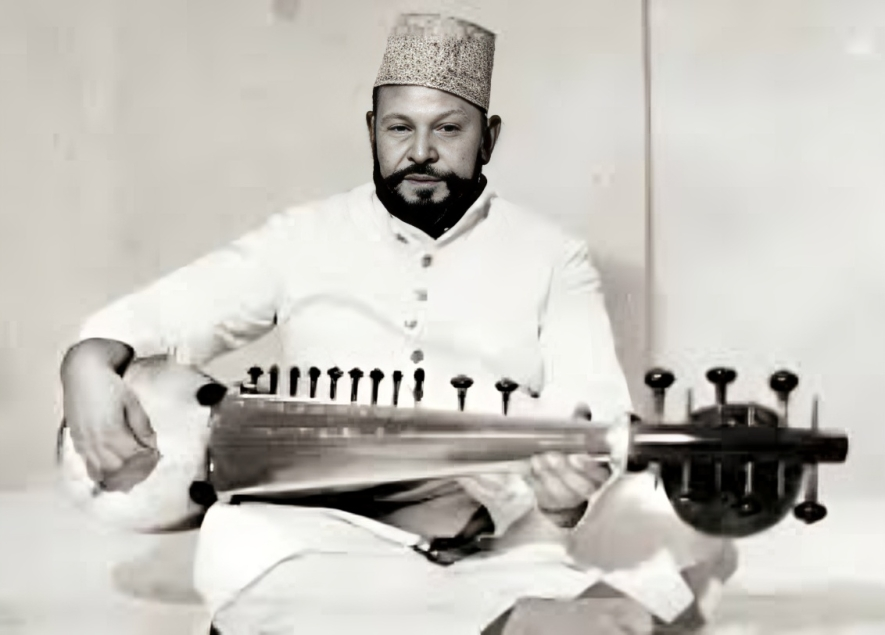
In the history of Indian classical music, Ustad Hafiz Ali Khan Sahib occupies a unique and exalted place—an artist who endowed the sarod with vocal-like emotion, radiant clarity, and regal dignity. On his death anniversary today, Music Gurukul remembers this legendary maestro with deep reverence and gratitude. His lifelong dedication and artistic legacy continue to enrich and inspire the world of Indian classical music.
Table of Contents
Lineage and Musical Foundation
Ustad Hafiz Ali Khan was a fifth-generation descendant of the Bangash (Gwalior Gharana) tradition of sarod playing—a lineage deeply rooted in the Senia parampara. His father, Nanneh Khan, was himself a distinguished sarod player. Naturally, Hafiz Ali Khan grew up immersed in a musical environment and received his initial training from his father.
He later pursued advanced musical instruction under several eminent gurus, including:
- his cousin Abdulla Khan,
- his nephew Mohammad Amir Khan, and
- most importantly, the renowned beenkar of Rampur, Ustad Wazir Khan.
Ustad Wazir Khan is believed to have been a descendant of Tansen through the latter’s daughter. Notably, the legendary Ustad Allauddin Khan of the Maihar Gharana was also a disciple of Wazir Khan during the same period—further underscoring the depth and prestige of Hafiz Ali Khan’s musical heritage.
In addition, Hafiz Ali Khan studied dhrupad under Ganeshilal Chaubey in Mathura and received training in thumri from Bhaiya Ganpatrao. This rare combination resulted in a distinctive musical style that blended the gravitas of dhrupad with the emotive richness of thumri.
Musical Style and Aesthetics
Ustad Hafiz Ali Khan Sahib was especially renowned for the crystal-clear tone of his sarod strokes, his long and seamless meend, controlled use of gamak, and an inherently lyrical approach to performance. His playing often evoked the feeling of a singing voice. Some critics observed that his imagination occasionally leaned closer to the semi-classical thumri idiom than to the austere discipline of pure dhrupad—but this very quality defined his individuality and humanistic musical language.
Career and Regal Presence
Hafiz Ali Khan’s regal appearance, commanding stage presence, and magnetic personality made him one of the most captivating musicians of his era—particularly noteworthy at a time when classical vocal music dominated the concert stage. Despite this, he achieved extraordinary popularity as an instrumentalist.
While serving as a court musician in Gwalior, he frequently travelled to Bengal, performing at major music conferences and festivals. Two eminent Bengali aristocrats and music patrons—Raychand Boral and Manmatha Ghosh—were among his admirers and students at different stages.
He was also highly regarded within the viceregal circles of colonial India, especially for his distinctive and stylised renditions of “God Save the King” on the sarod.
Recognition and Honours
In recognition of his immense contribution to Indian classical music, the Government of India honoured Ustad Hafiz Ali Khan with the Padma Bhushan in 1960—one of the most significant acknowledgements of his artistic stature.
Legacy and Remembrance
Ustad Hafiz Ali Khan passed away in December 1972 at the age of 84 in New Delhi. To commemorate his lasting contribution, a road near Nizamuddin Railway Station in Delhi was named “Hafiz Ali Khan Road.” The road was inaugurated on 10 February 2010 by the then Chief Minister, Smt Sheila Dikshit. In the capital city, this stands as a rare distinction—being among the very few roads named after artists, following legends such as Tansen and Thyagaraja.
Yet, his greatest legacy lives on through his family and disciples—most notably his son, Ustad Amjad Ali Khan, through whom the magnificent sarod tradition has reached unprecedented global heights.
Ustad Hafiz Ali Khan Sahib was not merely a sarod virtuoso; he was a philosophy, a value system. His music embodied restraint, elegance, and profound human emotion. Though his passing marked the end of an era, the melodies he created continue to resonate—alive in the strings of the sarod, the pathways of raga, and the collective consciousness of Indian classical music.