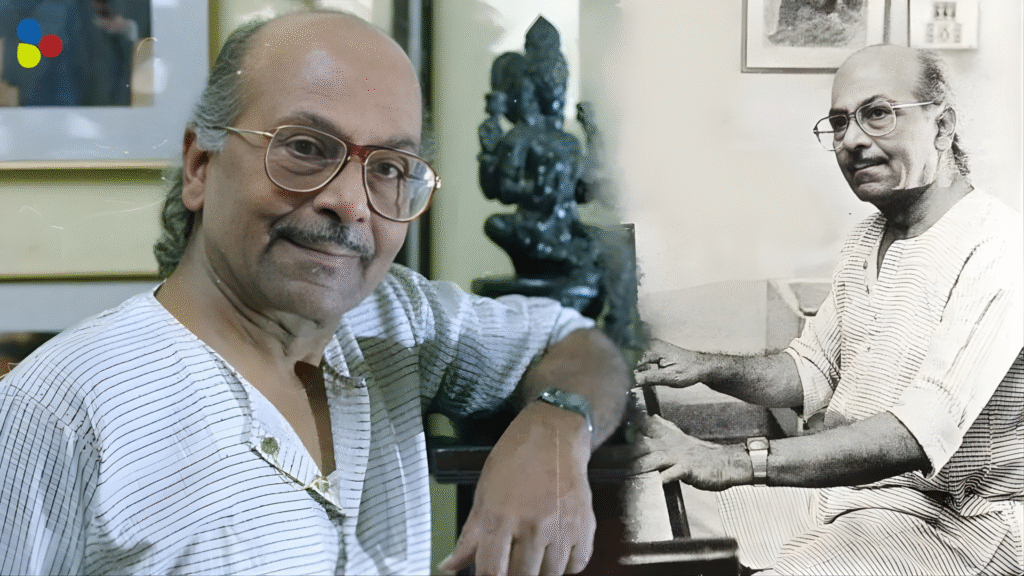
Salil Chowdhury’s music is not just a collection of songs, but rather an immense tapestry woven with multiple layers of melody and harmony. His compositions often resemble a vast, vibrant carpet that, while appearing singular at first glance, is filled with intricate, colourful threads. It is this unique fusion of classical Indian and Western music, combined with his revolutionary spirit, that made his work truly extraordinary.
Table of Contents
Early Life and Musical Roots
Born on November 19, 1925, in the village of Chingripota in the 24 Parganas district of West Bengal, Salil Chowdhury spent much of his childhood in Assam’s tea gardens, where his father, Gyanendranath Chowdhury, worked as a doctor and was also deeply passionate about music. During his early years, Salil was influenced by local folk songs and Assamese music, as well as Western classical music, thanks to his father’s collection of records by Beethoven, Bach, and Mozart. His fascination with nature’s sounds—the rustling of leaves, the calls of birds—also played a formative role in shaping his musical sensibilities.
The Mumbai Journey
In the 1950s, having already made a name for himself in Bengal, Salil moved to Mumbai where his first film, Do Bigha Zamin, became a landmark in his career. Adapted from his own story, the film’s score, composed by Salil, introduced him as a multifaceted musician. His compositions for the film, especially the song “Dharti Kahe Pukarke,” became instantly popular. Songs from later films like Madhumati, Anand, and Chhaya established him as a prominent composer not only in Bengali but also in Hindi cinema.
Revolutionary Music and Political Influence
Salil Chowdhury was an active member of the Indian People’s Theatre Association (IPTA) and was deeply influenced by leftist ideologies, which found expression in his music. His revolutionary folk songs like “Desh Bheshe Bane Jole” and “Poushali Batashe Paka Dhaner Basha” became anthems of peasant movements and social change. These songs reflected his commitment to political activism and his belief in the power of music to bring about societal transformation.
A New Era in Modern Bengali Music
Salil was not just a composer for films; he played a crucial role in shaping modern Bengali music. His collaborations with legendary singers like Hemant Kumar, Manna Dey, and Lata Mangeshkar produced timeless classics. Songs like “Ujjwal Ek Jhak Payera” and “Aaja Re Pardesi” remain evergreen in the hearts of music lovers. His children’s songs, such as “Bulbul Pakhi Maina Tiye” and “Ek Je Chhilo Machhi,” continue to