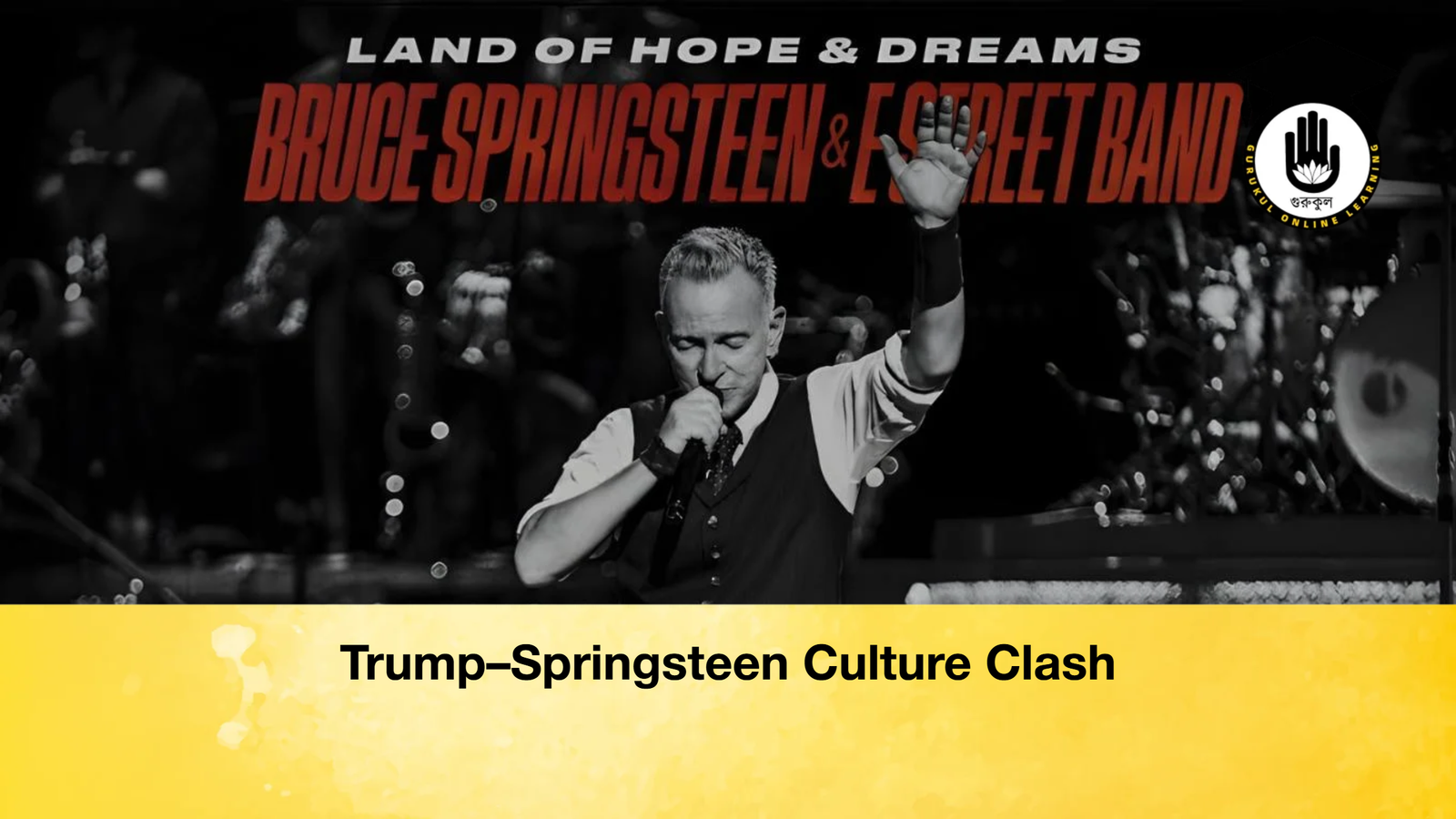
A renewed wave of political and cultural tension has swept across the United States following a public confrontation between former President Donald Trump and acclaimed musician Bruce Springsteen. The dispute intensified after Trump openly urged his supporters to boycott Springsteen’s ongoing concert tour, reigniting a long-standing ideological and cultural divide between the two figures.
The controversy escalated when Trump issued a series of strongly worded posts on social media, criticising Springsteen’s music, stage performances, and political views. He claimed that the concerts were excessively expensive and largely inaccessible to ordinary Americans. According to Trump, the events catered predominantly to elite audiences, reinforcing what he described as growing cultural exclusivity in the entertainment industry.
Trump further linked his criticism to broader political grievances, drawing comparisons between Springsteen’s publicly expressed views and the policies associated with the current Democratic administration in the United States. His remarks were widely interpreted as an attempt to frame the debate within a larger ideological struggle, further deepening the country’s already pronounced political polarisation.
Springsteen, meanwhile, had already sparked discussion at the opening night of his latest tour in Minneapolis, where he used the stage to express concern about the nation’s political climate. He suggested that the United States was facing reputational challenges internationally and raised questions about transparency and governance within the administration. His remarks were consistent with his long-standing practice of incorporating social commentary into his performances.
The artist has previously stated in interviews that his tours are not solely entertainment-driven but also serve as a platform to reflect on contemporary social and political realities. He maintains that artists have a responsibility to engage with societal issues, even at the risk of controversy. In earlier comments, he has implied that Trump is resistant to criticism and dissenting viewpoints.
Following Trump’s boycott call, major music industry organisations defended Springsteen, emphasising the importance of artistic freedom and freedom of expression. They argued that political disagreement should not be used as a justification for targeting performers or limiting their professional opportunities.
Springsteen has not directly responded to Trump’s latest remarks. However, he has repeatedly affirmed in the past that political pressure will not deter him from expressing his views through music.
Timeline of Key Events
| Period | Development |
|---|---|
| Opening night of tour | Springsteen delivers political remarks during performance |
| Following day | Trump criticises Springsteen via social media |
| Shortly after | Trump calls for public boycott of concerts |
| Same period | Music organisations defend artistic freedom |
| Subsequent response | Springsteen remains publicly silent but reaffirms past positions |
Analysts suggest that the episode reflects more than a personal rivalry between two prominent figures. Instead, it highlights a deeper cultural and ideological divide within American society, where entertainment, politics and freedom of expression are increasingly intertwined. Observers warn that such confrontations are likely to become more frequent as public discourse continues to polarise.