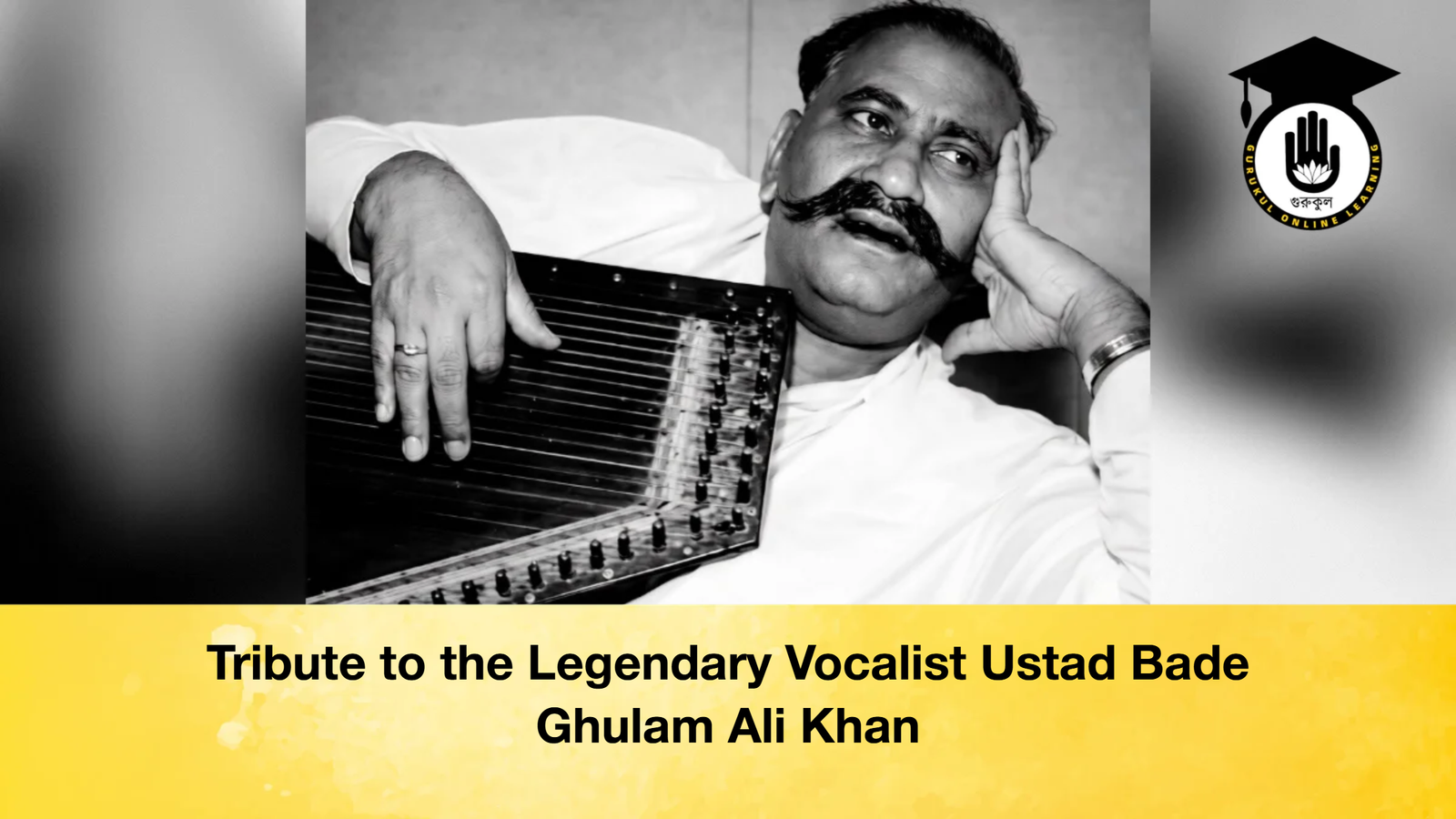
The final months of 1947 marked a turbulent chapter in the subcontinent’s history. The partition had left fresh scars on the land and its people. Amid this backdrop, the legendary vocalist Ustad Bade Ghulam Ali Khan, born in what became Pakistan, charted a musical journey driven not by religion, but by history itself.
Early Journey in Pakistan
Invited by Radio Pakistan, Khan performed with his characteristic passion. Yet, even after recording sessions, he did not rest. He traversed the country, performing at music conferences in Peshawar and Karachi, his melodies breaking the silence of the night. For him, music was as essential as breath; song was his sole identity.
Upon returning from one such engagement, he received a telegram from the programme director of Radio Pakistan. Khan attended the meeting, greeted with fragrant tea and sweetened delicacies, only to encounter a delicate but significant request:
“Please remove the words ‘Hai Ram’ from the opening of your song.”
Khan was initially taken aback. The phrase appeared in his iconic thumri:
“Yaad piya ki aye, Hai Ram…”
This was more than words; it was feeling, love, and the distilled essence of a heritage. His response was unequivocal:
“You remove Ram, I shall remove myself.”
This moment marked a pivotal turn in musical history. The very next day, Khan wrote to India’s first President, Rajendra Prasad, expressing the heartfelt wish of an artist:
“Music woven with love, longing, and sorrow must be preserved. I wish to remain a citizen of secular India to safeguard it.”
Within fifteen days, the decision was made. Khan permanently left his birthplace and relocated to Kolkata—a city where music flourished freely, unbound and sacred to the soul.
Legacy in Kolkata
In Kolkata, Khan’s voice became part of the city’s musical fabric. His renditions, alongside maestros like Ustad Faiyaz Khan and Pandit Bhimsen Joshi, remain timeless:
| Artist | Notable Composition | Distinctive Quality |
|---|---|---|
| Ustad Faiyaz Khan | Khelat Nandkumar | Subtlety of classical expression |
| Bade Ghulam Ali Khan | Hari Om | Evocative, soul-stirring renditions |
| Pandit Bhimsen Joshi | Anupam Bhairavi | Mastery in Bhairavi raga |
Their music continues to mesmerise listeners, evoking the first notes of Bilawal, the depth of Darbari Kanada, or the serenity of Behram Khani. Those unfamiliar with such subtleties may reduce music to a hollow performance, unaware of the years of struggle and devotion that shape it.
A Cultural Reflection
Today, Kolkata is changing. Simplicity is replaced by consumerism, authenticity by artifice. Yet hope endures: the city that once listened to Khan and Joshi through the night may awaken again to the magic of its musical heritage. The traditions of Rabindranath, Nazrul, and Sukanta, the camaraderie of local gatherings, and the vibrancy of its neighbourhoods all remain the pulse of its culture.
| Life Milestones | Details |
|---|---|
| Birth | 2 April 1902 |
| Death | 23 April 1968 |
| Main Base | Kolkata, India |
| Musical Genre | Hindustani Classical Vocals |
| Key Contribution | Preservation of secular musical heritage |
In memory and reverence, Ustad Bade Ghulam Ali Khan remains an enduring symbol of dedication, artistry, and the transcendent power of music.