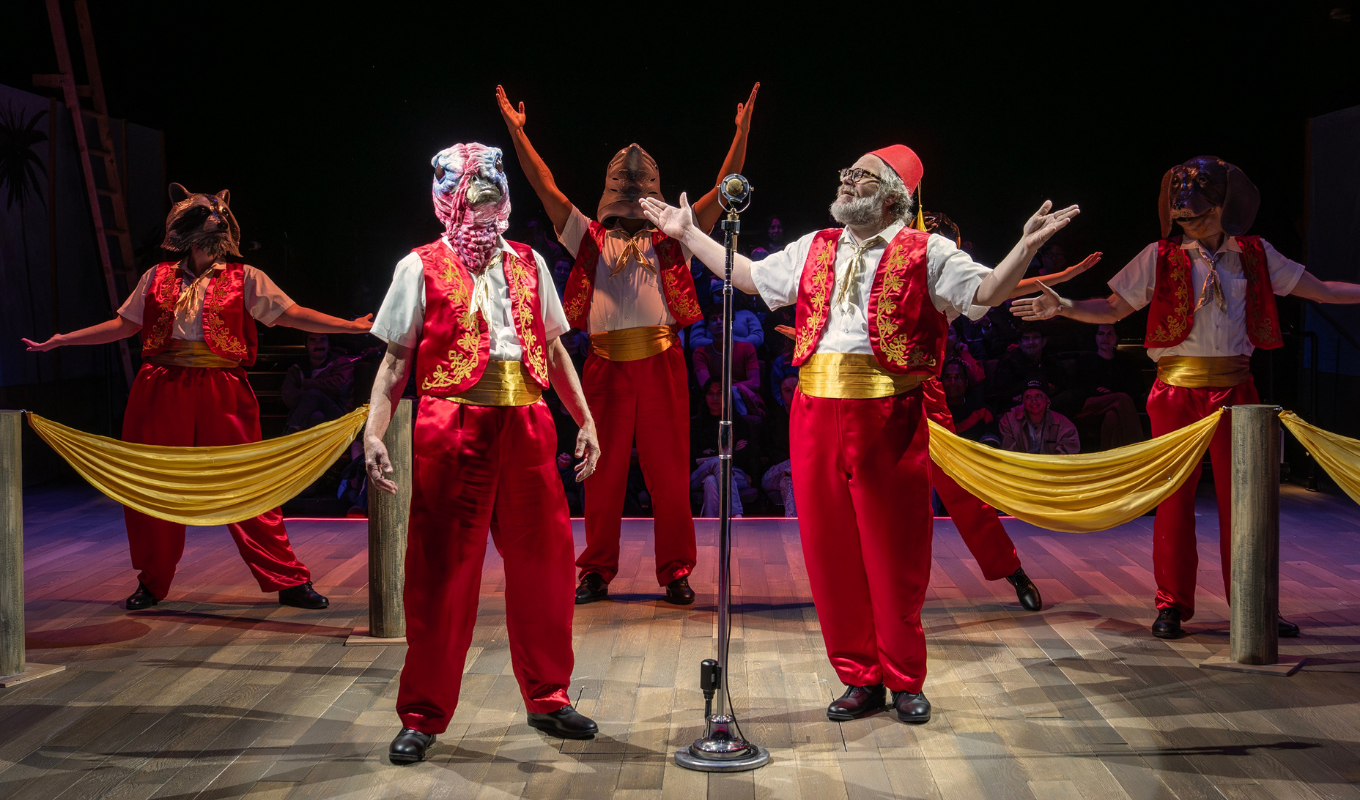
The Public Theater’s new musical, The Seat of Our Pants, is a wonderfully chaotic and surprisingly moving adaptation of Thornton Wilder’s The Skin of Our Teeth. The show takes the impossible-to-adapt play and embraces its absurdity, presenting it with gleeful self-awareness and electrifying energy. In the process, it transforms Wilder’s monumental, metaphoric triptych of Ice Age, Flood, and War into a hilariously subversive and heartening musical experience.
What makes The Seat of Our Pants stand out is its playful, yet sincere, approach to Wilder’s difficult material. Ethan Lipton’s adaptation strikes a delicate balance between homage, parody, and excavation. He doesn’t just decode the overwhelming complexity of Wilder’s text — he brings it to life through laughter, embracing the chaos of the original while shaping it into something digestible and lovable. The show doesn’t attempt to make sense of Wilder’s biblical imagery or apocalyptic themes; instead, it celebrates their ridiculousness through song and humour. This approach finally makes Wilder’s dense, abstract play feel accessible and, dare we say, fun.
Table of Contents
The Cast: An Unstoppable Ensemble
The cast delivers uniformly excellent performances, each bringing the sprawling Antrobus family to life with nuance and charm. Micaela Diamond is a standout as Sabina, the show’s trickster and truth-teller, breaking the fourth wall with sharp wit. Her line, “Added songs! ‘Cause that’s what it’s missing!” is delivered with such sarcastic brilliance that it becomes the show’s thesis, acknowledging the absurdity of adapting Wilder’s work into a musical while making the case that it might just be the best bad idea ever.
Shuler Hensley anchors the production as Mr. Antrobus, bringing gravity to the role of the eternal patriarch. Ruthie Ann Miles shines as Mrs. Antrobus, grounding the chaos with emotional clarity. Damon Daunno (Henry) and Amina Faye (Gladys) both deliver compelling performances, their characters navigating the moral complexity of their family’s shifting dynamics. And Andy Grotelueschen, Ally Bonino, and Michael Lepore inject much-needed comic relief, ensuring that even the most outlandish moments are played with precision.
The Direction: A Joyful Exploration of Absurdity
Director Silverman brilliantly navigates the tonal shifts of the musical, keeping the journey from Ice Age comedy to apocalyptic war drama both sharp and surprisingly coherent. The staging, designed by Lee Jellinek, is agile and witty, a shape-shifting tribute to both Wilder’s epic vision and the Public’s more playful sensibility. Sunny Min-Sook Hitt’s choreography brings character-specific flair, while Daniel Kluger’s orchestrations—alongside co-music supervisor Nathan Koci—weave together the show’s fractured logic through rhythm rather than reason.
The Design: Transforming Chaos into Theatre
Visually, the production is a feast for the eyes. The costumes, designed by Kaye Voyce, are clever and specific, transitioning from prehistoric furs to post-war grit with seamless ease. Lap Chi Chu’s lighting navigates the apocalyptic shifts with precision, and Drew Levy’s sound design ensures that the chaos stays crisp and controlled, helping the jokes land and the music resonate.
Despite its absurdity, the musical brings a surprising depth to Wilder’s ideas. Rather than presenting the cyclical survival of the Antrobus family as a philosophical burden, the musical shows it as something human, messy, and oddly comforting. When the Antrobuses emerge from the rubble in the third act, the humour suddenly gains weight, and the show circles back to Wilder’s view of survival — that it’s rarely neat or inspirational, but always infused with hope.
Final Thoughts
In the end, The Seat of Our Pants is a theatrical miracle. It takes Wilder’s strange, complex, and at times bewildering epic and transforms it into something joyous and exhilarating. It may not provide clarity on every metaphor or symbol, but it embraces the uncertainty with exuberance. By adding heart, humour, and a theatrical wink, the team behind this production proves that even the most impossible of adaptations can succeed — and perhaps, in doing so, creates something even Wilder would have appreciated.
In a world full of chaotic uncertainty, that’s a miracle worth celebrating.