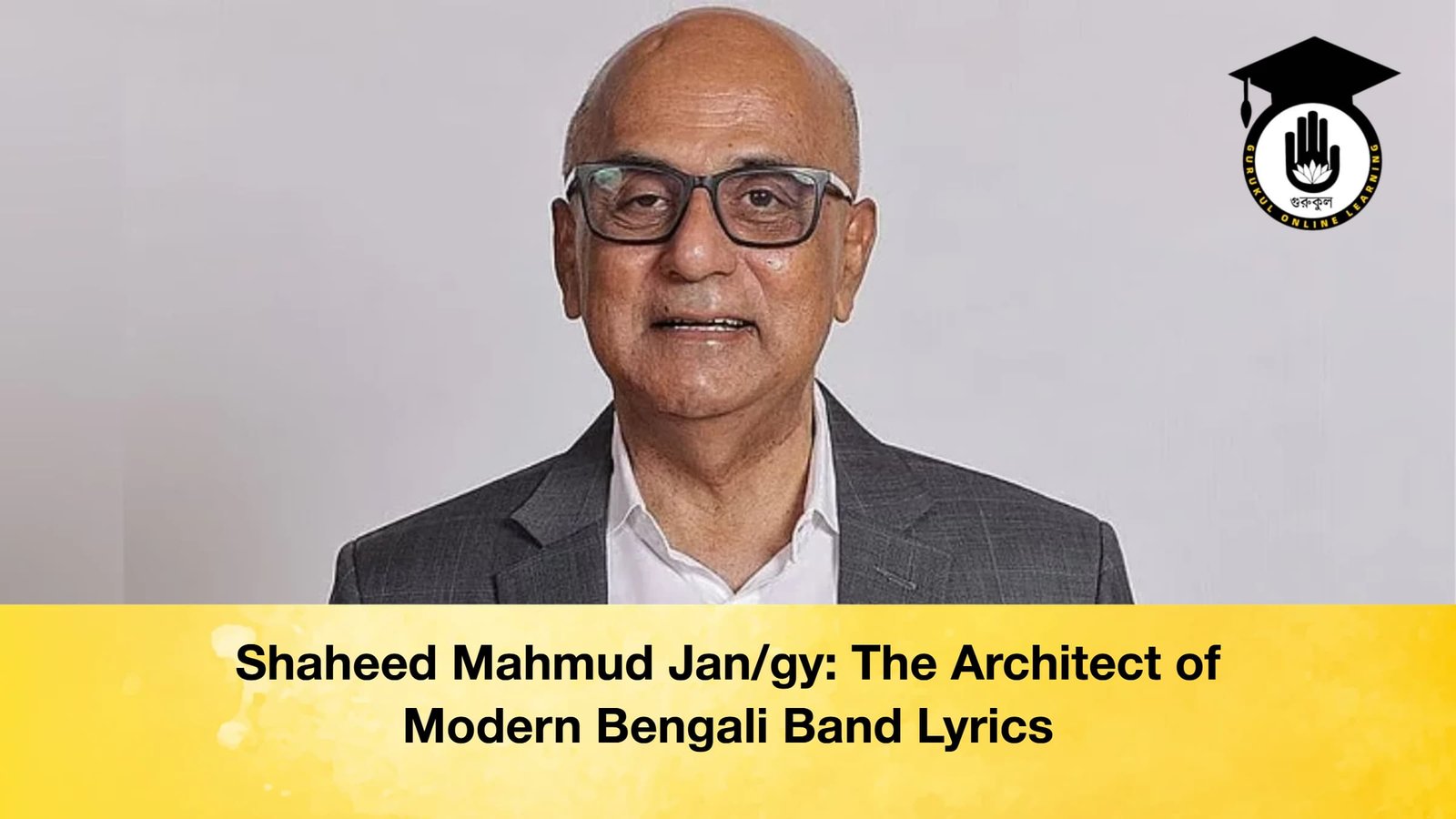
From the evocative strains of “Aj Je Shishu” to the urban resonance of “Ekdin Ghum Bhanga Shohore,” the landscape of Bangladeshi band music is inseparable from the pen of Shaheed Mahmud Jangy. A lyricist, educator, entrepreneur, and cultural organiser, Jangy celebrated his birthday on 6th February, marking a journey that began in the coastal breezes of Chattogram and culminated in the bustling creative hubs of Dhaka.
Table of Contents
Roots: A Cultural Cradle in Chattogram
Born in 1956, Jangy was raised in a household where politics and art coexisted. His father, A.L. Chowdhury, was a prominent social worker and politician associated with the United Front in 1954. Interestingly, the family surname “Jangy” was adopted by his father to shorten a long title, drawing inspiration from the spiritual lineage of Abu Saleh Musa Jangy.
Growing up in the 1960s, Jangy’s home hosted regular musical soirées every Sunday. This exposure to everything from Nazrul Sangeet to Maizbhandari folk laid the foundation for his lyrical sensibilities.
From School Runaway to Student Revolutionary
Jangy’s youth was defined by a cinematic restlessness. Frequently escaping the monotony of the classroom for public libraries or cinema halls, he was eventually sent to boarding school to instill discipline. However, it was a compassionate headmaster at MES High School who transformed him by making him a class captain and casting him in the lead role of the play “Montur Pathshala.”
His activism peaked during the turbulent years of 1969–1971. As a student leader, he was embroiled in movements against the Pakistani regime, eventually facing a nine-month prison sentence in absentia under Martial Law, forcing him to flee to Dhaka until the liberation of Bangladesh.
The Birth of a Band Network
Post-independence, Jangy became the connective tissue for a fledgling music scene in Chattogram. He was a founding member of the cultural group “Suchana,” which hosted the first public performance of a band then called Surela—the group that would later become the legendary Souls.
Jangy’s influence extended to mentoring future icons. He famously encouraged Ayub Bachchu to transition from English rock to Bengali lyrics, gifting him his first Bengali composition, “Harano Bikeler Golpo.”
Defining the “Signature” Hits
Jangy’s work is characterised by lyrical depth and social consciousness. He didn’t just write songs; he built careers. Below are ten of his most influential works that redefined the genre:
| Song Title | Composer | Original Artist / Band |
| Aj Je Shishu | Pilu Khan | Renaissance |
| Ekdin Ghum Bhanga Shohore | Ayub Bachchu | LRB / Souls |
| Hridoy Kadamati | Naquib Khan | Renaissance |
| Somoy Jeno Kate Na | Pilu Khan | Samina Chowdhury |
| Chayer Kape Porichoy | Partha Barua | Souls |
| Ami Bhule Jai | Partha Barua | Partha Barua |
| Hey Bangladesh | Pilu Khan | Renaissance |
| Kolahol Theme Gelo | Naseem Ali Khan | Souls |
| Tritiyo Bishwa | Pilu Khan | Renaissance |
| Shudhumatru Tomar Jonno | Naquib Khan | Kumar Bishwajit |
The “Blue Nile” Era and Creative Pressures
In the 1980s, Jangy moved to Dhaka, where his advertising firm and the “Blue Nile” hotel became epicentres for musicians. Many hits were written on napkins over cups of coffee.
“Aj Je Shishu” was born from a place of profound guilt, inspired by the sight of shivering children at railway stations during his commutes between Dhaka and Chattogram. Conversely, “Ekdin Ghum Bhanga Shohore” was a product of high-speed creativity, written inside a microbus while travelling to a television recording.
Legacy and Leadership
In recent years, Jangy has taken on the mantle of leadership as the founding president of the Lyricists Association of Bangladesh (GitiKobi Sangha), advocating for the rights and dignity of wordsmiths. For Jangy, the success of a song isn’t measured by charts, but by its ability to remain a “line of life” for listeners decades later.