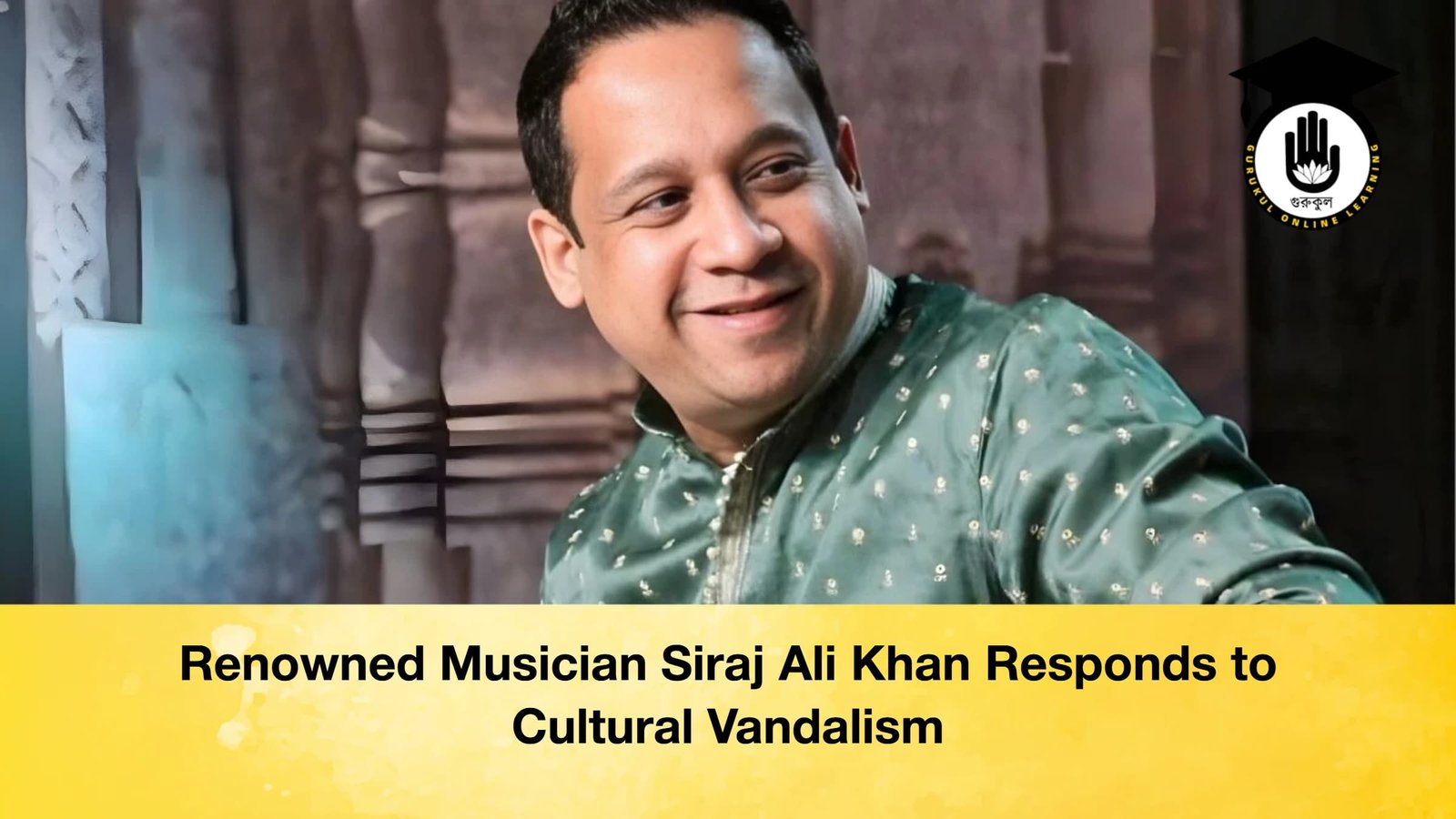
Siraj Ali Khan, the grandson of legendary Ustad Alauddin Khan, has announced that he will no longer return to Bangladesh until artists, musicians, and cultural institutions can operate safely. Speaking candidly for the first time, he revealed that he had experienced fear as a performer—a sentiment unfamiliar to him throughout his career.
Siraj Ali Khan arrived in Dhaka on 16 December to perform at the prestigious Chhayanaut cultural centre. A violent attack took place at Chhayanaut on Thursday, the day before his scheduled performance on Friday. In a heartfelt Facebook post on Sunday, he expressed his dismay:
“The country is finished, Bangladesh is finished—for me, as an artist.”
He recounted the incident: “On 19 December, I was scheduled to perform at Chhayanaut. In the early hours of the same day, a group of people attacked and vandalised one of Bangladesh’s most respected cultural institutions.”
Siraj Ali Khan, a distinguished exponent of the Maihar Gharana, is the son of Ali Akbar Khan and the grandson of Ustad Alauddin Khan, living and performing primarily in India.
Earlier this year, on 8 October, he had performed in Dhaka at Lalbagh Fort during the 163rd birth anniversary celebrations of Ustad Alauddin Khan, organised by the Ministry of Cultural Affairs, earning widespread acclaim.
Reflecting on his decision to stay away from Bangladesh until conditions improve, Siraj Ali Khan stated:
“With a heavy heart, I must make it clear—until artists, music, and cultural institutions are safe and respected, I will not return. This decision is not born of anger but of responsibility: to my family’s legacy, my art, and my personal safety.”
He emphasised his continued belief in music as a force for healing and unity: “I hope that one day respect for art and culture will be restored so that bridges can once again be built.”
Siraj Ali Khan described his visits to Bangladesh as a way to reconnect with his roots, share the musical heritage of Ustad Alauddin Khan, and preserve the living tradition of the Maihar Gharana.
“I came with nothing but music, humility, and respect,” he added. “For the first time in my life, I am speaking with profound sorrow—I felt fear for my life. I had never imagined that simply presenting myself as an Indian artist in Bangladesh could place me in danger. I am grateful to have returned to India safely.”
He condemned the attack not just as vandalism of instruments or an organisation but as an assault on “culture, artists, and our shared heritage.” Music has always been a bridge connecting nations and histories; when that bridge is broken by fear and violence, something deeper is lost.
In his Facebook post, he clarified: “My grievance is solely with the mentality of those who attack cultural and educational institutions. Music and art have always stood above politics and violence; when they become targets, it causes profound pain.”
Despite describing Bangladesh as his homeland, he stressed that his criticism stems from concern, not rejection: “I remain hopeful that wisdom, dialogue, and respect for culture will ultimately prevail, as has been the case throughout this land’s long history.”
Tagging the Ministry of Cultural Affairs and the Bangladesh Shilpakala Academy, he emphasised that his post was not directed against the government or the educated, cultured citizens of Bangladesh, who have always shown him immense respect and love. Reflecting on the warmth and admiration he received in Dhaka, especially at historic cultural events, he said: “I will never forget it.”
Optional Table for Key Details:
| Event/Detail | Information |
|---|---|
| Date of arrival in Dhaka | 16 December 2025 |
| Scheduled performance | 19 December 2025 at Chhayanaut |
| Incident | Attack and vandalism at Chhayanaut |
| Family heritage | Grandson of Ustad Alauddin Khan; son of Ali Akbar Khan |
| Musical style | Maihar Gharana |
| Previous performance | 8 October 2025, Lalbagh Fort, Dhaka |