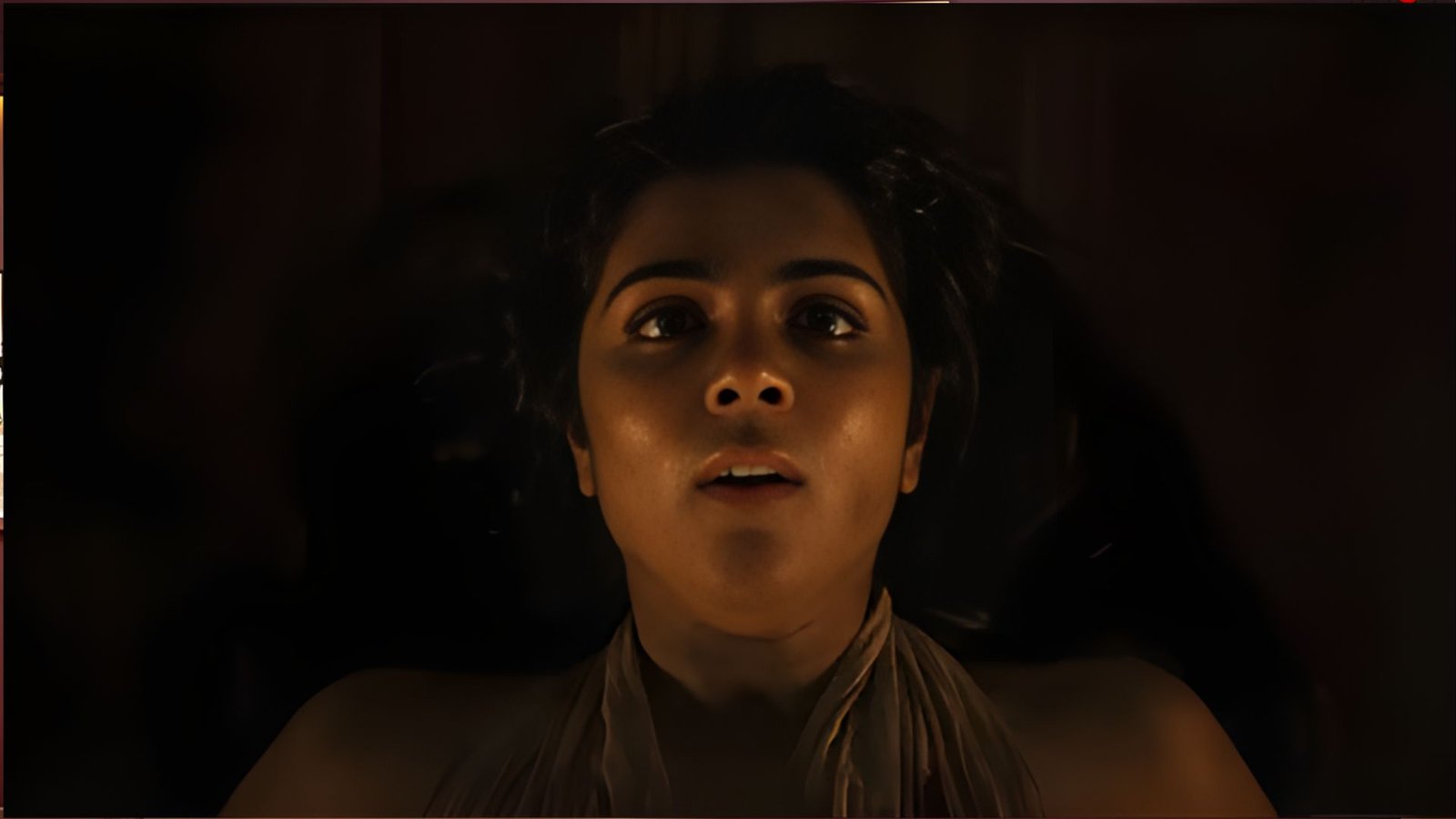
Chandra is not just an ordinary woman—this idea is established right from the beginning of the film. In a dark alley of the city, typically dominated by muscular men, Chandra stands alone. In a fierce brawl in a parking lot, she defeats her opponents in a way that’s not just visually impressive but conceptually new. Bystanders—neighbours and passers-by alike—can only watch in awe, muttering, “This girl is different.”
This is the essence of Lokah Chapter One: Chandra. After surprising audiences with Minnal Murali in 2021, Basil Joseph shocked again by introducing a female-centric superhero film. Directed by Dominic Arun, Chandra has broken records, grossing over ₹300 crore on a budget of just ₹30 crore. It is now the highest-grossing Malayalam film of all time, and the film has generated significant buzz even among Bangladeshi audiences.
Kalyani Priyadarshan plays Chandra, a character who is both a goddess and a harbinger of destruction. Some worship her, while others fear her. The story follows this Malayalam woman, who has recently moved into a shabby apartment in the city. Initially perceived as an ordinary woman, the more the story unfolds, the clearer it becomes that Chandra is the bearer of a mysterious power.
While creating a cinematic universe can sometimes make films feel artificial, Lokah avoids this pitfall. The world of Lokah is rich and engaging, far from being a mere superhero film. It creates a fully developed universe, where red is not just a decorative colour but a symbol of Chandra’s identity. Whether it’s the red streak in her hair, the maroon of her jacket, or the neon red explosion of smoke during action scenes, this colour represents much more than just visual appeal—it is Chandra’s signature.
Set in Bengaluru, the film makes a conscious choice to showcase a city where language, culture, and identity merge into a unique diversity. On one side, there’s a Malayali superhero; on the other, a Kannadiga criminal syndicate, along with a Tamil police officer. These varied elements create a melting pot of cultures, each contributing to the narrative. Bengaluru, in this sense, reflects the loneliness of immigrants, a theme that resonates deeply with Chandra’s own sense of isolation.
Chandra can fly, is skilled in combat, and protects the weak. But what about her past? The director intentionally keeps this a mystery. The plot introduces a subtle division midway through the film, an interval, where Chandra’s past and present merge dramatically. Here, the film reveals that Lokah is deeply intertwined with Kerala’s legends and folklore, where kings, yakshis (spirits), and deities blend into the realm of imagination. This fusion of myth and reality is one of the film’s strongest elements.
Chandra’s neighbours, Sani (Naslen) and Venu (Chandu Salimkumar), add a humorous touch to her life. Their dirty apartment, bottles of liquor, a drunken guest, and the cat “Jango” all contribute to the film’s lighter moments. When Chandra enters this world, everything changes—strangely, yet gently.
On the other side, there’s the character of Nachiyappa Gowda (played by Sandy), a misogynistic police officer who’s irritated by orders from his female superior and openly mocks women. Though his dialogues are somewhat stiff, he proves to be an effective foil to Chandra, standing as a direct contrast to her feminist image.
The second half of the film takes on a heavier tone. New characters and dialogues are introduced to hint at the sequel, but the director’s focus seems to be more on building anticipation. Nevertheless, Jakes Vijay’s music and Yannick Ben’s action choreography maintain the film’s mood. This collaboration feels like a symphony, blending reality with animation to create a mysterious aura around Chandra’s powers. Ben deliberately leaves some scenes incomplete, allowing the imagination to fill in the gaps, which makes Chandra’s aura of strength even more captivating.
Kalyani Priyadarshan shines in the role of Chandra. Her eyes speak volumes about the goddess’s fury and the woman’s loneliness. Lokah isn’t just her superhero debut; it marks a bold addition to the genre of women-led action films in South Indian cinema. Naslen also brings Sani’s character to life with a charm of his own. Sandy’s Nachiyappa Gowda, though partially effective, doesn’t instill much fear.
While the screenplay of Lokah has its emotional weak points—especially in how Chandra and Sani’s relationship develops—the film still manages to deliver a compelling experience. A strong antagonist is crucial for a successful superhero film, and Gowda’s character fails to generate the tension needed. Moreover, the second half slows down abruptly, and while there are numerous side characters in Chandra’s world, many are underdeveloped.
Historically, Indian cinema—particularly Malayalam cinema—has rarely featured female-centric superhero stories. Lokah dares to take this step, and for the most part, it succeeds. The film’s main goal isn’t to battle an evil villain, but rather to create an entirely new world. Director Dominic Arun has broken the traditional superhero mold to establish a cinematic universe.
Who could have thought of blending Kerala’s folklore and mythology so seamlessly into the framework of a modern superhero story? Lokah does just that, and in doing so, it creates a unique cinematic experience that defies expectations.