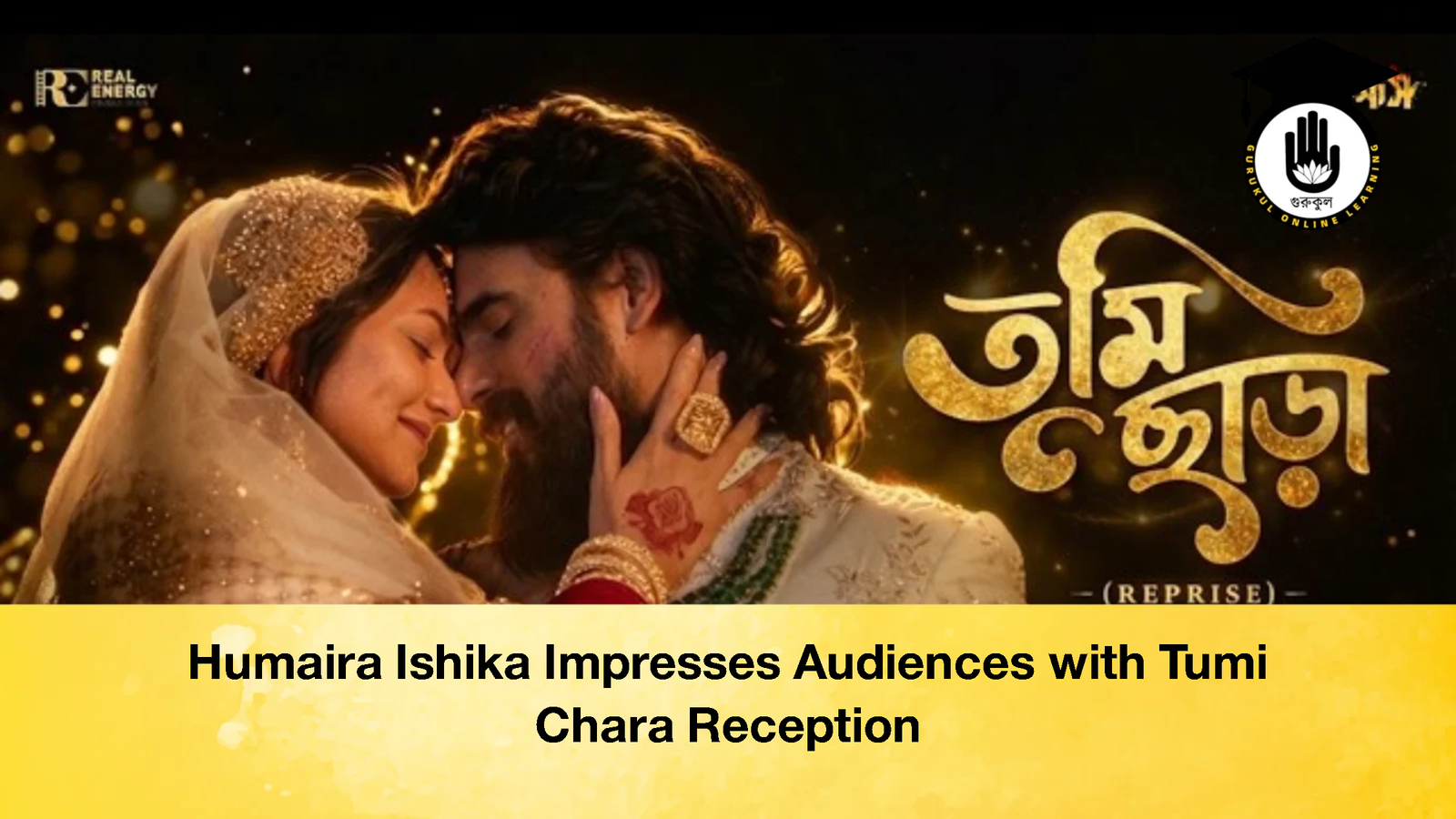
The Eid release film Rakhkhos has attracted notable attention for its musical highlight “Tumi Chara”, with emerging playback singer Humaira Ishika earning widespread praise for her expressive vocal performance. The song, presented in two distinct versions, has rapidly gained traction among listeners, who have responded positively to its emotional depth, melodic arrangement, and cinematic integration.
Composed and arranged by acclaimed music director Imran Mahmudul, with lyrics written by Robiul Islam Jibon, the track stands out within the film due to its prominent placement in the narrative. Unlike conventional background scores, “Tumi Chara” has been structured as a central musical sequence, allowing it to function both as a storytelling device and a standalone musical piece.
Song overview
| Category | Details |
|---|---|
| Song title | Tumi Chara |
| Film | Rakhkhos (Eid release) |
| Vocalist | Humaira Ishika |
| Composer & Music Director | Imran Mahmudul |
| Lyricist | Robiul Islam Jibon |
| Versions | Solo version, Soft version |
| Audience reception | Highly positive, trending widely |
The dual-version release has played a significant role in the song’s popularity. The solo version highlights vocal strength and clarity, while the soft version offers a more subdued, emotionally textured interpretation. Both renditions have been praised for their arrangement and vocal sensitivity, but it is the softer version that has particularly resonated with Ishika herself.
Speaking about the audience response, Ishika described the soft version as the most personally meaningful. She noted that its gentle orchestration and emotional tone align closely with her artistic expression. The singer further expressed that the overwhelmingly positive reception has been both unexpected and deeply motivating, reinforcing her commitment to playback singing.
She also shared that audience engagement has extended beyond digital platforms, with many cinema-goers approaching her directly after screenings of Rakhkhos. According to her, these personal interactions—where viewers congratulated her on the song—have provided strong encouragement and renewed enthusiasm for her future projects.
Born in Bogura, Humaira Ishika began her musical journey at the exceptionally young age of three and a half. From her early years, she displayed a natural affinity for music, which later developed into formal training and participation in national-level competitions. Her early exposure to performance helped shape her confidence and versatility as a vocalist.
Her breakthrough in the Bangladeshi film industry came with Kajal Rekha, where she contributed vocals to seven tracks out of a total of 24 in the film’s soundtrack. This opportunity marked her transition from emerging talent to a recognised playback singer, significantly expanding her visibility in the industry.
She later achieved wider recognition through the duet “Parbo Na Tomake Chharte”, performed alongside Imran Mahmudul. The collaboration is widely regarded as a defining moment in her career, establishing her presence in contemporary Bangladeshi film music and introducing her voice to a broader audience.
Ishika’s early accomplishments also include her selection as a top-seven finalist in Notun Kuri 2016, one of Bangladesh’s most respected children’s talent platforms. Over the years, she has continued to build on this foundation, earning several industry recognitions. These include the Channel i Music Awards 2023 for Best Newcomer and the BIFA Awards 2024, where she was honoured as Best Music Artist for her contributions to Kajal Rekha.
Despite her growing prominence in the music industry, she continues to balance her academic commitments alongside an increasingly demanding recording schedule. Her ability to manage both education and professional work has been widely appreciated, reflecting discipline alongside artistic dedication.
Looking ahead, Ishika remains optimistic that “Tumi Chara” will achieve even greater popularity once it is released independently of the film context. She believes that a standalone release would allow the song to reach a wider audience and further highlight its emotional and musical strength beyond the cinematic narrative of Rakhkhos.