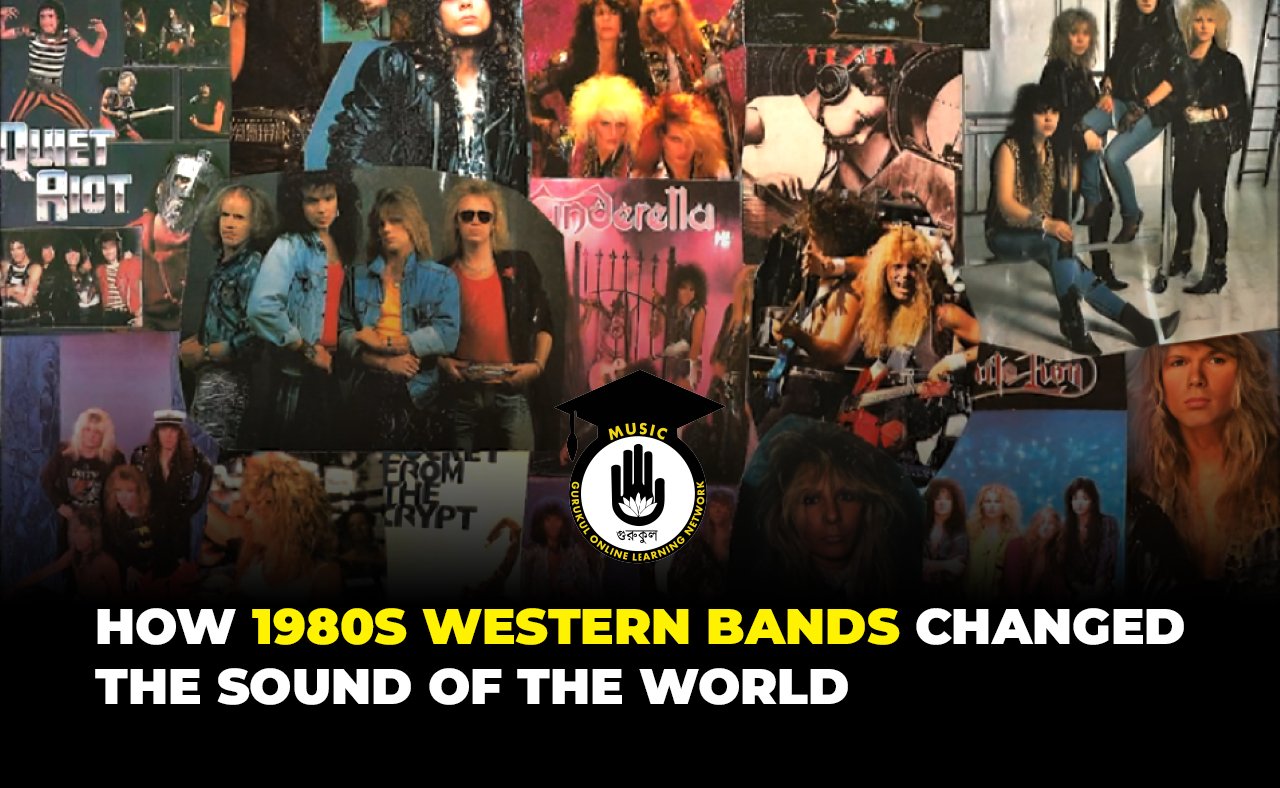
The 1980s were a decade of audacity, ambition, and amplification — a time when Western music reinvented itself and, in doing so, changed the way the entire world listened, looked, and lived. It was an age of synthesisers and sequencers, eyeliner and electric guitars, political protest and neon pop. The 80s didn’t just soundtrack a generation; it defined it.
From the pulsating beats of New Wave to the explosive choruses of Arena Rock, from the mechanical precision of Synthpop to the raw energy of Heavy Metal, 1980s Western bands built an empire of sound that still resonates across today’s charts.
Table of Contents
The Birth of a New Sonic Era
After the experimentation and rebellion of the 1970s, the 1980s ushered in an era of digital technology, globalisation, and a brand-new creative optimism. The introduction of affordable synthesisers, drum machines, and MIDI technology revolutionised how musicians composed, recorded, and performed.
Suddenly, artists could sculpt entire orchestras from keyboards, create beats on computers, and manipulate sounds that had never existed before. This shift didn’t just change how music was made — it changed what music could be.
It was the decade that gave rise to a new kind of star — one who understood that music was as much about sound as it was about style.
The Rise of Pop Powerhouses
If the 1980s had a heartbeat, it was pure pop — vivid, melodic, and irresistibly danceable. At the forefront was Michael Jackson, the undisputed King of Pop, whose 1982 album Thriller became the best-selling record of all time. Its fusion of funk, R&B, rock, and electronic innovation — combined with Jackson’s mesmerising videos and choreography — set a new global benchmark for what an artist could achieve.
Meanwhile, Madonna redefined female stardom. Bold, provocative, and endlessly reinventive, she transformed pop into a platform for expression and empowerment. From Like a Virgin to Vogue, Madonna not only dominated the charts but also re-engineered fashion, feminism, and identity for the MTV age.
In the UK, George Michael and Wham! brought soul and sophistication to the pop scene, while Prince blurred the boundaries between funk, rock, and sexuality, his flamboyant persona and genre-bending sound making him one of the most influential artists of the century.
Pop in the 80s wasn’t just music — it was a movement. It was loud, colourful, global, and unapologetically glamorous.
The Golden Age of Rock and Metal
The 1980s were also the decade when rock music went big — and then went bigger.
Arena rock and heavy metal ruled the airwaves, filling stadiums with power chords, pyrotechnics, and unparalleled spectacle.
Bands like Bon Jovi, Def Leppard, Guns N’ Roses, and Aerosmith brought guitar-driven anthems to millions, crafting songs that were tailor-made for lighters in the air and stadium singalongs.
Meanwhile, across the Atlantic, U2 emerged from Dublin with a brand of emotionally charged, politically conscious rock that made them one of the defining bands of the decade. Albums such as The Joshua Tree (1987) elevated them to global superstardom, marrying spiritual depth with sonic grandeur.
At the heavier end of the spectrum, Metallica, Iron Maiden, and Motörhead took heavy metal to new extremes — both sonically and technically — creating the blueprint for the genre’s future.
In the UK, the New Wave of British Heavy Metal (NWOBHM) saw bands such as Judas Priest and Saxon take metal from underground clubs to mainstream recognition. Their speed, precision, and showmanship would influence generations of hard rock musicians to come.
Synthpop and the New Wave Revolution
If guitars dominated one side of the 80s, synthesisers conquered the other.
The emergence of Synthpop and New Wave gave Western music an entirely new language — sleek, modern, and often introspective.
British bands led the charge: Depeche Mode, Duran Duran, The Human League, Ultravox, OMD (Orchestral Manoeuvres in the Dark), and Tears for Fears pioneered electronic music that was both futuristic and deeply emotional.
Their melodies were infectious, their production revolutionary. Songs like Enjoy the Silence, Don’t You Want Me, and Everybody Wants to Rule the World remain timeless examples of electronic pop at its most artful.
In Germany, Kraftwerk and Alphaville built upon earlier experiments with electronic minimalism, influencing not just pop but the birth of techno and electronic dance music.
Synthpop’s cinematic textures and melancholy lyrics reflected a world on the cusp of digital transformation — where technology and emotion collided in perfect harmony.
The MTV Generation: When Music Met the Camera
In 1981, MTV (Music Television) was born — and nothing would ever be the same again.
For the first time, audiences didn’t just hear their favourite artists; they saw them.
Music videos became cultural events, launching careers overnight and transforming musicians into visual icons.
Duran Duran’s exotic, cinematic videos (Rio), A-ha’s animated masterpiece (Take On Me), and Michael Jackson’s Thriller set new artistic standards. The medium blurred the lines between music, cinema, and fashion, turning every release into a global visual spectacle.
With MTV, appearance became inseparable from artistry. Bands carefully cultivated their image — whether it was The Police’s minimalist cool, Culture Club’s flamboyant colour, or The Cure’s gothic aesthetic.
This symbiosis between sound and sight made the 1980s not only a golden age for music, but also for pop culture imagery itself.
Music, Politics, and the Power of the Band
The 1980s were also a time when musicians recognised their influence on world affairs.
Western bands became voices of conscience during political upheaval and humanitarian crises.
In 1984, Band Aid’s “Do They Know It’s Christmas?” and the subsequent Live Aid concerts in 1985, organised by Bob Geldof and Midge Ure, united the world in song to combat famine in Ethiopia. It was one of the largest and most significant global music events in history.
U2’s “Sunday Bloody Sunday” became a rallying cry for peace in Northern Ireland, while Sting, Peter Gabriel, and Bruce Springsteen used their music to speak out on human rights, war, and apartheid.
Western bands proved that music wasn’t merely entertainment — it was a force for awareness, empathy, and global unity.
The Underground and the Alternative
While pop and rock dominated the mainstream, the 80s also nurtured a vibrant underground.
Punk, which had exploded in the late 1970s, evolved into Post-Punk and Alternative Rock, genres that thrived on experimentation and introspection.
Bands like The Smiths, Joy Division, The Cure, and Echo & the Bunnymen gave voice to alienation, love, and melancholy — themes that contrasted sharply with the glamour of mainstream pop.
In America, the seeds of college rock and grunge were sown with acts like R.E.M., Sonic Youth, and Pixies, whose DIY ethic and unconventional sound paved the way for the alternative explosion of the 1990s.
The indie spirit of the 80s championed creativity over commercialism, leaving an artistic legacy that remains deeply influential.
Production, Innovation, and the Studio as an Instrument
Behind every iconic 80s band was a visionary producer.
Names like Trevor Horn, Brian Eno, Quincy Jones, Mutt Lange, and Nile Rodgers revolutionised how music was recorded and heard.
With multi-track recording, digital reverb, and synthesiser layering, the recording studio became an instrument in itself. Producers sculpted vast sonic landscapes, giving songs a clarity and polish that was unprecedented.
This technological evolution also democratised music-making — smaller bands could now access tools previously available only to major studios. It laid the foundation for the modern home studio revolution that dominates today’s music industry.
Legacy: The Echoes of the Eighties
Four decades later, the spirit of the 1980s is everywhere.
Modern pop, rock, electronic, and indie artists continue to draw from its sound palette and aesthetic.
The Weeknd, Dua Lipa, Harry Styles, Lorde, Daft Punk, The 1975, and Arctic Monkeys have all embraced retro synth textures, gated drums, and nostalgic melodies in their work.
The rise of the 80s revival across film, fashion, and digital culture — from Stranger Things to Drive — shows how deeply the decade continues to captivate the imagination.
Why? Because the 1980s were about possibility.
They were about experimentation, emotion, and energy — about believing that music could be anything you wanted it to be.
A Decade that Never Fades
In the final analysis, the music of the 1980s was more than a sound — it was a statement.
It celebrated individuality, innovation, and the idea that art could shape identity.
From the shimmering synths of Depeche Mode to the soaring guitars of U2, from the anthems of Queen to the power ballads of Bon Jovi, the decade produced an unrivalled diversity of music that bridged genres, continents, and cultures.
It was the decade that taught the world how to dance, how to dream, and how to dare.
And though time has moved on, the echo of that electric decade still pulses beneath the beat of modern music — reminding us that, once upon a time, the world truly lived in stereo.