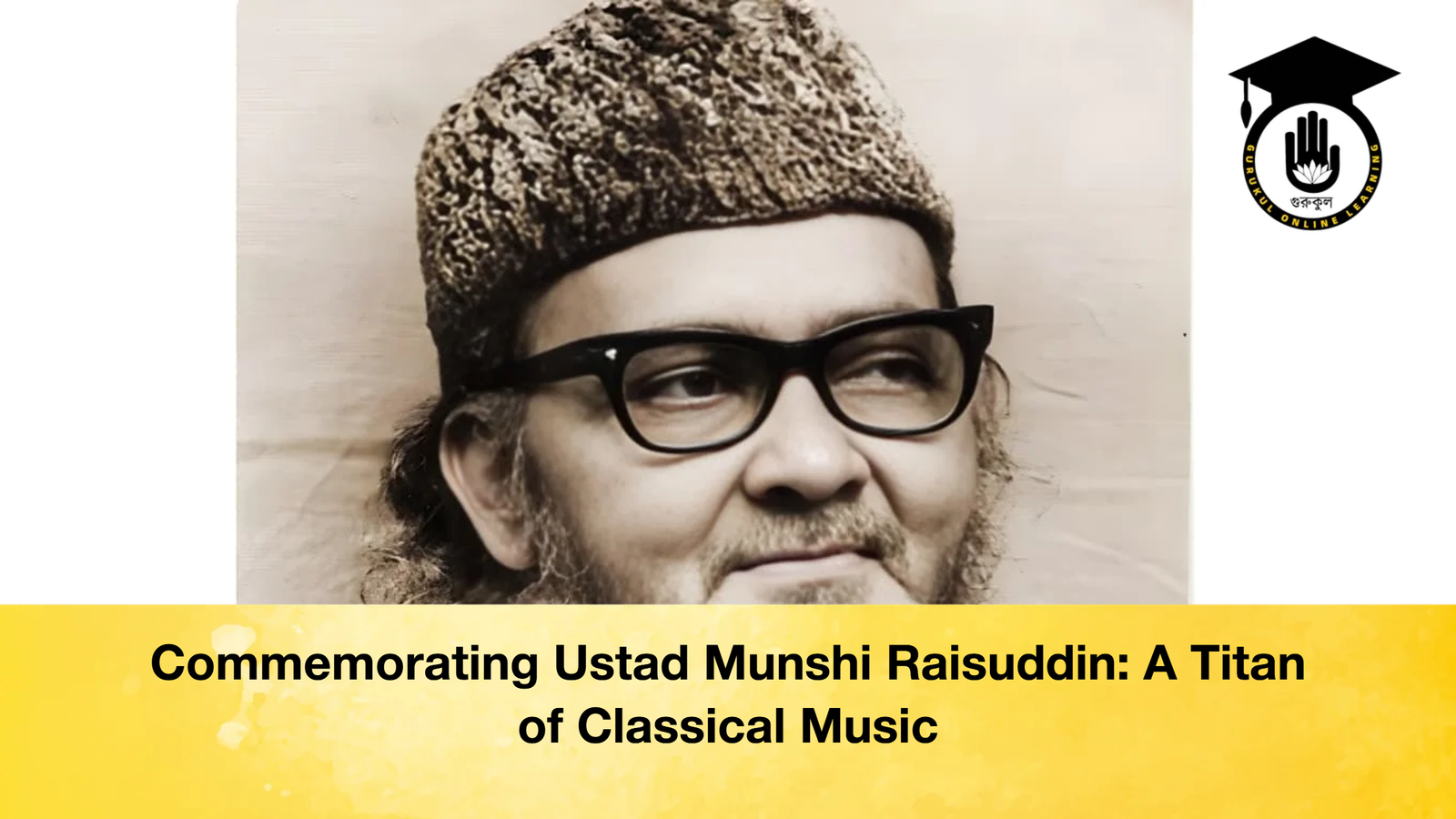
The landscape of Bengali classical music remains profoundly enriched by the lifelong dedication, creative ingenuity, and pedagogical contributions of Ustad Munshi Raisuddin. A pre-eminent figure in the subcontinent’s musical history, his work transitioned classical forms into institutional frameworks, ensuring the preservation of the craft for future generations.
Table of Contents
Early Life and Formative Training
Munshi Raisuddin was born on 10 January 1901 in the village of Nakol, located in the Magura district. Despite being born into a prestigious family, he faced significant financial hardships during his youth. His affinity for melody was evident from an early age, and he received his primary musical induction from his cousin, Shamsul Haque.
At the age of 17, driven by economic necessity, Raisuddin moved to Kolkata. It was here that his formal pursuit of music flourished alongside his professional life. He spent twelve years under the rigorous tutelage of the renowned musician Rasbihari Mallick, mastering the complexities of Dhrupad and Khayal. His quest for excellence led him to the Sangeet Kala Bhavan, managed by Girija Shankar Chakravarty, and later to Lucknow to study under Sarajit Kanjilal, which added significant depth to his repertoire.
Professional Career and Institutional Impact
Ustad Munshi Raisuddin’s broadcasting career commenced in 1938 at All India Radio, Kolkata. Following the partition of 1947, he relocated to Dhaka and joined the radio service there as a regular performer. Settling in Narayanganj, he became a pillar of the local cultural scene, founding the Prabeshika Sangeet Bidyalay, an institution that became a crucible for emerging talent.
His administrative and academic influence expanded in 1955 when he joined the Bulbul Academy of Fine Arts (BAFA) as Vice-Principal upon its inception. By 1964, he ascended to the role of Principal. Under his stewardship, the academy became a premier centre for the revival and systematic study of classical music in the region.
Literary Contributions and Innovations
Recognising the need for structured musical education, Raisuddin authored several foundational textbooks. His literary works bridged the gap between complex theory and student accessibility. Furthermore, he was an innovator who composed several new Ragas, expanding the classical canon.
| Category | Details |
| Notable Publications | Saral Sangeet, Abhinaba Shataraga, Sangeet Parichay, Rag Lahari, Gita Lahari |
| Major Awards | Ekushey Padak (Posthumous, 1986), Adamjee Literature Award, Presidential Award |
| Specialisation | Dhrupad, Khayal, and Raga Composition |
| Institutional Roles | Principal of BAFA, Founder of Prabeshika Sangeet Bidyalay |
Legacy and Honours
For his unparalleled contributions, Ustad Munshi Raisuddin was posthumously awarded the Ekushey Padak in 1986, Bangladesh’s second-highest civilian award. His research and creative excellence also earned him the Adamjee Literature Award and the Presidential Award.
Beyond his institutional achievements, his legacy was preserved through his children and a vast number of students who are now acclaimed artists in their own right. Ustad Munshi Raisuddin passed away on 11 April 1973. His systematic approach to musicology and his devotion to the purity of the Raga remain the bedrock of classical music education in Bangladesh today.