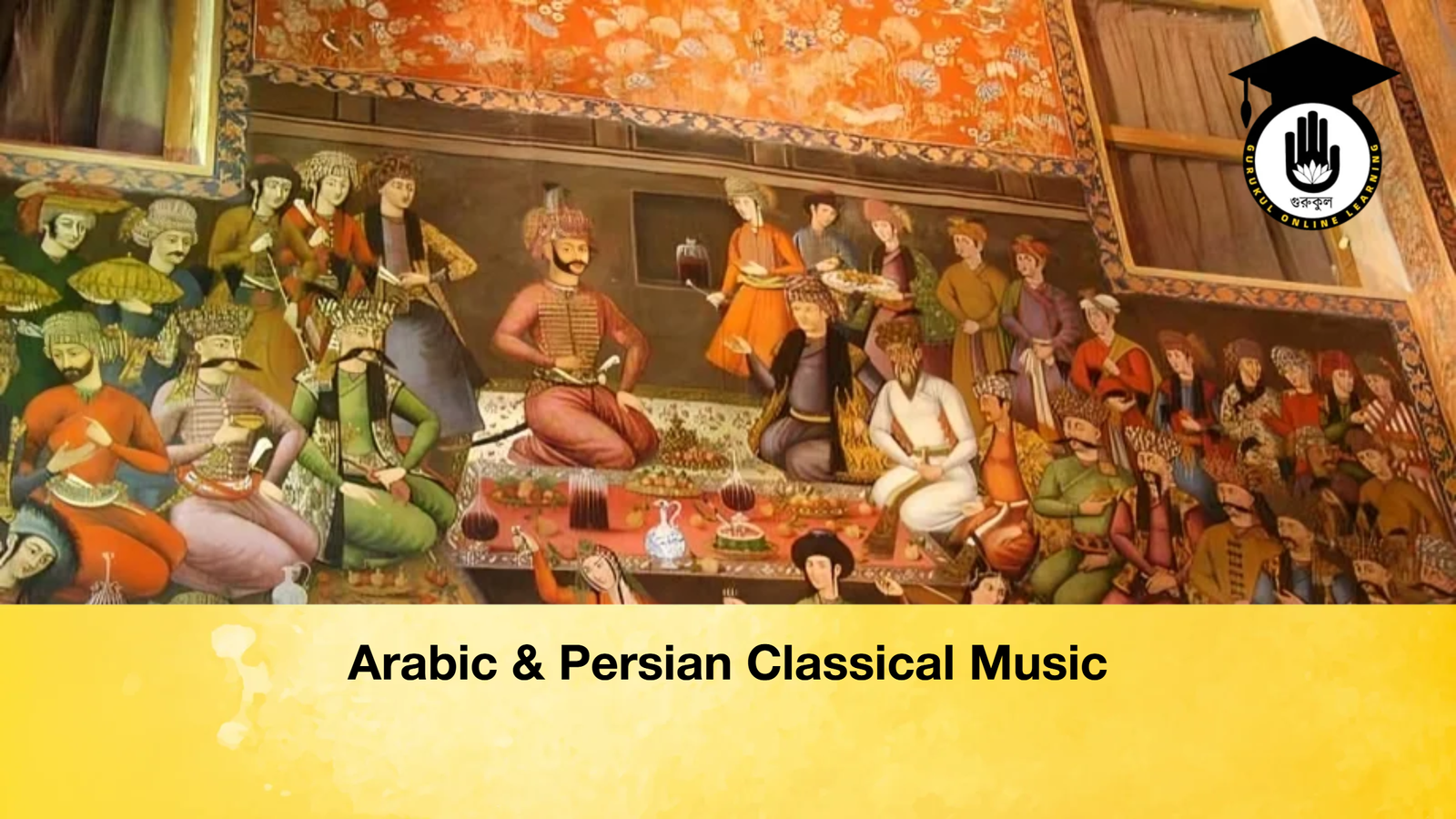
Arabic and Persian classical music represent two of the world’s richest and most enduring musical traditions. While rooted in distinct cultural, linguistic and historical contexts, they share a number of structural and conceptual features — modal systems, improvisation, the centrality of melody, and a strong attachment to poetic and spiritual expression. To explore them side by side is to gain insight into how music developed in the Islamic and pre-Islamic Middle East, how it responded to cross-cultural exchange, and how its legacy continues to resonate globally.
In this article we will examine the origins, evolution, theory, instrumentation, performance practices and modern continuities of Arabic and Persian classical music — and highlight how these traditions remain relevant for learners, scholars and music lovers alike.
Table of Contents
Tracing Two Great Modal Traditions of the Middle East
Historical Origins
Arabic Classical Music
The history of Arabic classical music traces back to pre-Islamic Arabia where itinerant poets and musicians performed songs to accompany tribal gatherings, journeys and festal occasions. Much of this early repertoire is undocumented, though later Islamic scholars refer to it as the jahilliyah period (the “pre-Islamic age”).
With the spread of Islam and the rise of the Abbasid Caliphate (8th–13th century), musicians, theorists and poets gathered in centres such as Baghdad, Damascus and Cairo. They absorbed influences from Persia, Byzantium, India, and North Africa, developing sophisticated theories of modal structure (maqām) and rhythm (iqāʿ).
In the nineteenth century and into the twentieth, the advent of recording, radio and the first Cairo Congress of Arab Music (1932) marked a renewal and systematisation of Arabic art music in modern form.
Persian Classical Music
The classical music of Persia (modern-day Iran) shares a deep heritage. As early as the Achaemenid and Sassanid eras, music was patronised in royal courts and religious settings.
After the Islamic conquest and through the medieval period, Persians developed important musical theory, repertory and performance practice. In the 18th–19th centuries the radif repertoire and dastgāh modal system crystallised.
In the 20th century, Persian classical music expanded in urban centres, endured political upheaval, and adapted despite periods of suppression or transformation.
Theoretical Foundations
Modal Systems: Maqām and Dastgāh
In Arabic music the modal system is known as the maqām (plural maqāmāt). Each maqām is a melodic framework with characteristic intervals (often including quarter-tones), typical melodic phrases, and prescribed tonal centres, designed to evoke particular moods.
For Persian music the analogous system is the dastgāh (plural dastgāh-hā). Each dastgāh contains a number of gūshé (melodic pieces or motifs) which establish the melodic character of the mode. The full repertory is called the radif.
Despite different names, both systems emphasise improvisation, melodic development, and the use of modal “homes” and “routes” through which the performer navigates.
Rhythm, Ornamentation & Notation
Arabic music employs complex rhythmic cycles (iqāʿāt) and makes abundant use of microtonal ornamentation — the melodic intervals often include quarter-tones and the performance embraces improvisation.
In Persian music, the rhythmic element is often more flexible; the focus may shift to a free (non-metric) introduction (pishdaramād) and then to a rhythmic section (chaharmezrav). Ornamentation (e.g., tahrīr vocal ornament) is typical, as is the gradually modulating emotional expression.
Notation systems historically were sparse, oral transmission prevailing for centuries. In the nineteenth and twentieth centuries both Arabic and Persian traditions adopted Western-style notation or adapted systems to document modal and rhythmic content.
Key Instruments & Performance Practices
Arabic Tradition
Some of the central instruments in Arabic classical music include:
- ʿūd (lute): often considered the king of Arab instruments, fretless, enabling microtonal motion.
- Qānūn (plucked zither): provides melodic and harmonic support.
- Nay (reed flute): representative of the breath and ornamented melodic lines.
- Darbuka / Ṭablah (goblet drum): foundational for rhythmic cycles.
- Violin / cello / Western instruments: adopted in the 20th century to accompany larger ensembles.
Performance practice emphasises solo or small ensemble settings, vocal-dominated concerts, improvisation (taqāsīm), and the prominent role of the singer. The iconic Egyptian singer Umm Kulthūm epitomised this tradition, holding legendary monthly live concerts for decades.
Persian Tradition
In Persian classical music some of the principal instruments are:
- Tār & Setār (long-neck lutes): the tār with frets, setār without.
- Santūr (hammered zither): whose shimmering timbre is emblematic of Persian music.
- Kamancheh (bowed spike fiddle) and Ney (reed flute): often used in vocal and instrumental ensembles.
- Tombak (goblet drum) / Zarb: essential rhythmic accompaniment.
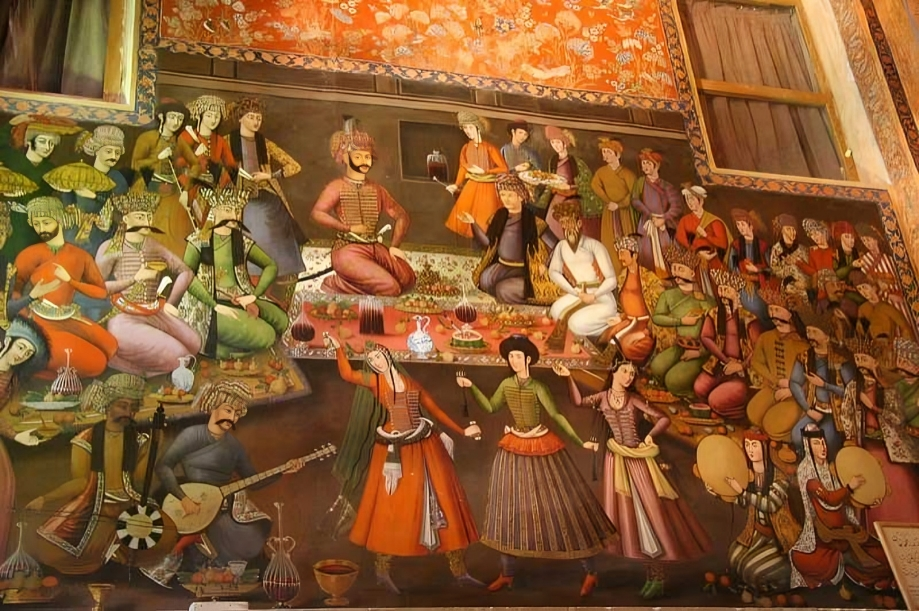
Performance often comprises a radif-based sequence: an unmetered introduction, followed by rhythmic elaborate pieces; the vocalist or instrumentalist traces through gūshé with both preservation of tradition and personal creativity.
Major Periods & Figures
Arabic Music
- Pre-Islamic Period: Oral poetry and simple songs; little documentation.
- Medieval to Ottoman Period: The development of maqām theory, treatises, and the consolidation of Arab art music.
- Modern Era (19th–20th century): Recording era, Egyptian film and radio boom, first Cairo Congress (1932) — modern Arab classical was formalised.
Prominent Egyptian and Lebanese singers and composers such as Umm Kulthūm, Mohammed Abd el-Wahab, Farid Al-Attrach, Sayed Darwish remain emblematic figures.
Persian Music
- Pre-Islamic & Early Islamic Era: Royal patronage of musicians in Achaemenid, Sassanid, and early Islamic courts.
- Safavid / Qajar Era: Systematisation of performance practices and modal theory, development of the radif.
- 20th Century Revival: Urban centres, recordings, re-organisation of classical schools, and modern ensembles.
Key figures include Mirza Abdollah (radif master), Hossein Alizadeh and the Hamāvāyān Ensemble (contemporary revivalists).
Inter-Cultural Exchange & Shared Elements
Although Arabic and Persian traditions developed in distinct environments, the two are not isolated. The court cultures of the Islamic world, the idea of a trans-regional lāhza (moment) of the art music performance, and the modal system (maqām–dastgāh) evolved through mutual influence.
For instance, Persian musicians disseminated theoretical and performance practices (often described under the term dastān) across the Islamic empire; Arabic musicians likewise transmitted ideas westwards into Andalusia, North Africa and beyond.
Transmission, Pedagogy & Oral Tradition
A key feature in both traditions is the master-disciple relationship. The radif of Persian music is passed from teacher to student in oral form, often memorised before being notated.
In Arabic tradition, formal notation emerged later; much performance remains based on memory, improvisation and listening. The 19th-century adoption of Western-style notation did not displace oral transmission.
The Role of Poetry and Spiritual Dimensions
In both traditions, poetry, spirituality and philosophy play central roles. Arabic classical music often draws on the Arabic poetic canon (qāṣida, ghazal), Sufi themes and the Qur’anic recitation tradition (tajwīd). Persian classical music likewise embeds Persian poetic forms (Hafez, Rumi) and mystical-Sufi significance into its performance ethos.
Thus the performance of a maqām or dastgāh is never purely a technical display — it is a journey of emotion, reflection and subtle meaning.
Modern Developments & Global Reach
Arabic Music Today
Despite modernization and popular music influence, the classical tradition of Arabic art music continues as a prestige genre. Contemporary Arabic composers experiment with fusions of jazz, electronic music and classical forms.
Persian Music Today
Similarly, Persian classical music continues robustly. Digital archiving (e.g., IRMA dataset) and renewed international tours of ensembles show its vitality.
Both traditions have found new audiences thanks to global interest in world music, heritage preservation, and fusion projects.
Significance for Students & Practitioners
For the student of music (including readers of Music Gurukul, GOLN), learning Arabic and Persian classical traditions offers:
- Insight into modal thinking (beyond Western major/minor harmony)
- Appreciation for microtonality, improvisation and modal development
- Exposure to instruments and performance practices seldom found in standard curricula
- Connection to cultural history, poetic forms and spirituality embedded in musical expression
By studying these traditions, one can expand one’s musical horizon and gain fresh inspiration for improvisation, composition or fusion work.
Arabic and Persian classical music together present a rich spectrum of musical thought, history and aesthetic. Their influence extends far beyond their immediate regions; they inform global music culture, theory and practice. For those passionate about music as an art of depth and meaning, exploring these traditions is both rewarding and illuminating.
At Music Gurukul, GOLN, we honour these musical legacies while making them accessible and relevant for learners and lovers of music everywhere. By engaging with Arabic and Persian classical music, you join a journey of sound, tradition and innovation that bridges epochs, geographies and artistic worlds.