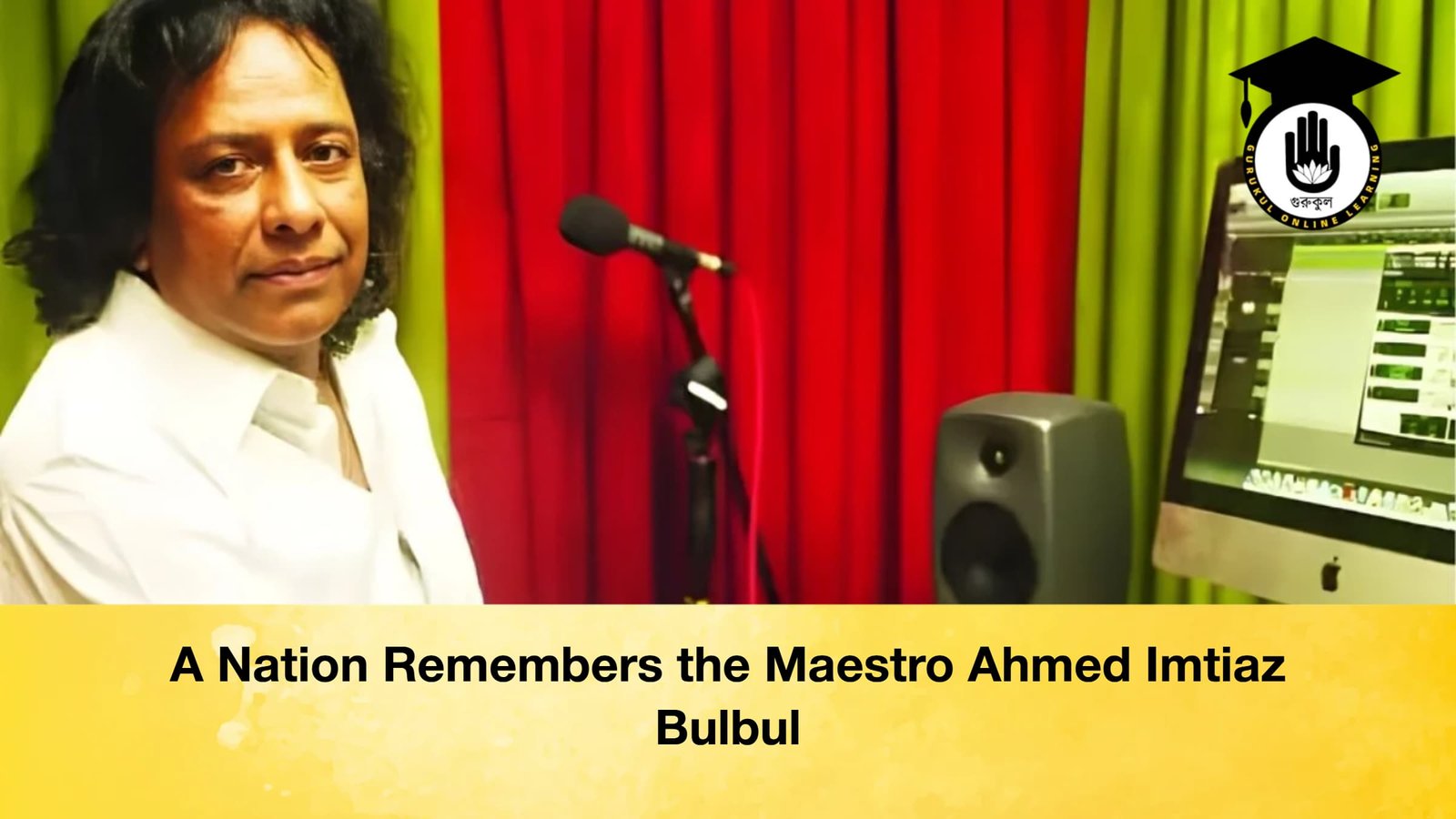
“Please do not forget me.” This haunting appeal, shared on social media by the legendary Ahmed Imtiaz Bulbul in early 2018, served as a rare moment of vulnerability from a man whose life had been a pillar of national strength. Sitting at the airport upon his return from Kolkata, the maestro posted a simple self-portrait with a caption that betrayed a deep-seated anxiety about the fleeting nature of fame and affection. As the nation marked his 70th birth anniversary on 1st January 2026, the overwhelming digital tribute paid to his memory suggests that his fear was, fortunately, misplaced.
Ahmed Imtiaz Bulbul was far more than a composer; he was a revolutionary whose melodies were forged in the fires of the 1971 Liberation War. Born in 1956, Bulbul was merely fourteen and a half years old when he joined the struggle for independence. This early sacrifice became the spiritual essence of his work. His patriotic anthems, such as ‘Sab Kota Janala Khule Dao Na’ and ‘Mago Ar Tomake Ghumpadani Mashi Hote Debo Na’, did not just capture the pain of a war-torn country—they gave a voice to its very soul.
The Architect of Modern Bengali Melody
Following the war, Bulbul spent nearly a decade focused solely on patriotic and revolutionary music before making a seamless transition into the world of cinema. His 1978 debut in ‘Megh Bijli Badol’ paved the way for the 1984 classic ‘Noyoner Alo’, a film that cemented his status as the industry’s premier music director. Over a career spanning four decades and more than 300 films, he collaborated with every major vocal talent in Bangladesh, including Runa Laila, Sabina Yasmin, and the late Andrew Kishore.
Bulbul’s genius lay in his versatility; he was a virtuoso on the guitar, violin, and keyboard. He was a “natural poet” who often composed both lyrics and melody simultaneously, believing that the two should be born of the same heartbeat. Despite his status as a National Film Award winner and an Ekushey Padak recipient, he lived a simple, almost bohemian life. He was a selfless mentor, particularly as a judge on the reality show CloseUp One, where he acted as a paternal guardian to the next generation of musical talent.
The Legacy of Ahmed Imtiaz Bulbul
| Category | Details of a Musical Legend |
| Birth | 1 January 1956, Dhaka |
| National Service | Joined the 1971 Liberation War as a teenager |
| Cinematic Impact | Music Director for 300+ feature films |
| Signature Anthem | Sab Kota Janala Khule Dao Na |
| Top Accolades | Ekushey Padak; National Film Award |
| Core Instruments | Guitar, Violin, Keyboard |
| Passing | 22 January 2019 |
In his final years, Bulbul’s health declined sharply, leading to a reclusive existence marred by cardiac complications. He passed away on 22nd January 2019, but the “rain” of his songs continues to fall softly on the Bengali conscience. While he may have worried that his face would be forgotten, his music has ensured that his spirit remains an indelible part of the landscape he fought so hard to liberate.