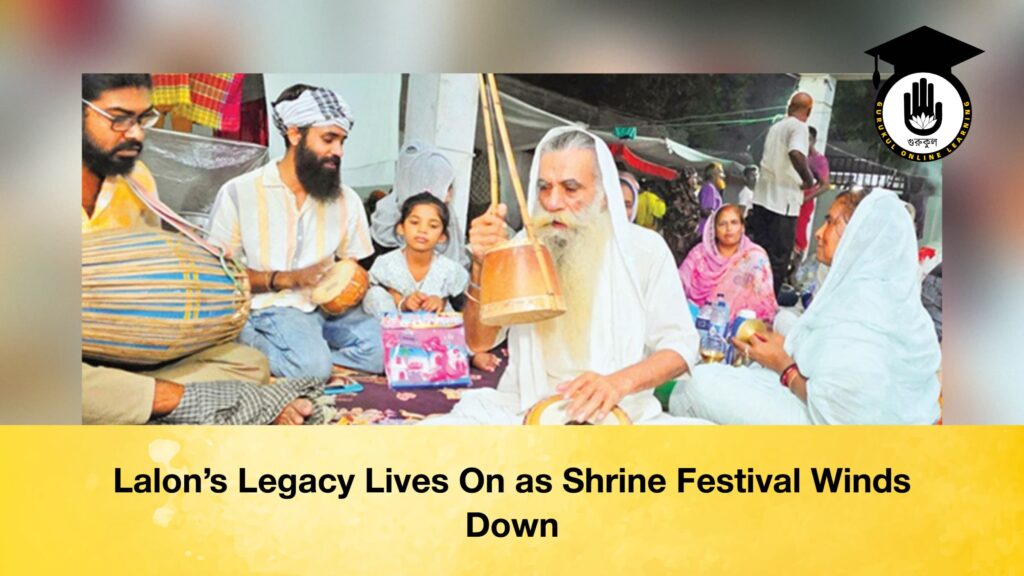
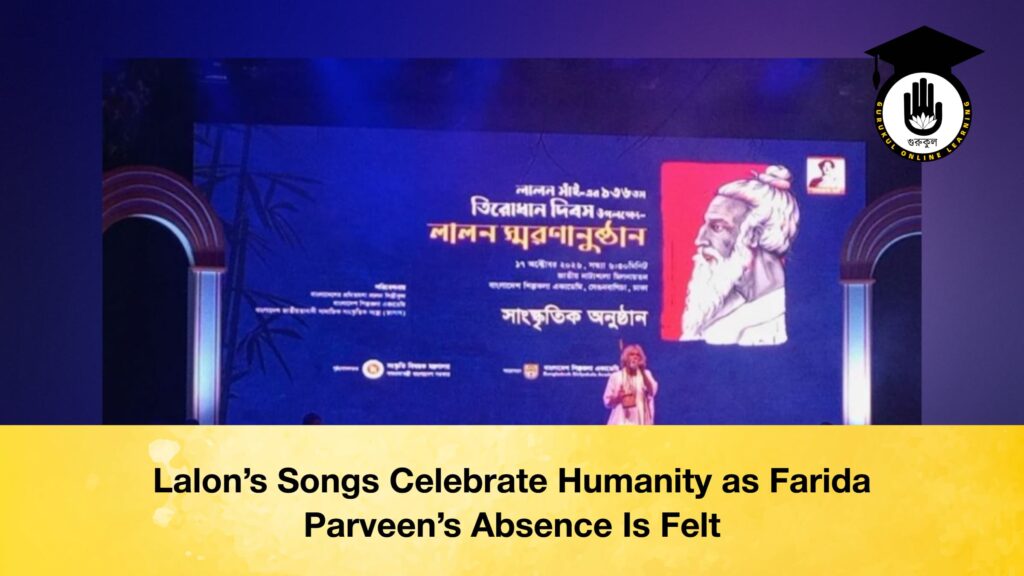
The timeless songs and humanist philosophy of Baul maestro Fakir Lalon Shah took centre stage at a commemorative programme marking the 136th anniversary of his death, while the absence of celebrated folk singer Farida Parveen cast a poignant note over the proceedings.
Held on Saturday, 17 October, at the National Theatre Hall of Bangladesh Shilpakala Academy in Dhaka, the event brought together folk musicians from different generations to celebrate Lalon’s enduring musical and philosophical legacy. Although the performances highlighted the richness of his compositions, the memory of Parveen, widely known as the ‘Daughter of Lalon’, remained a significant presence throughout the programme.
Organised by Bangladesh Shilpakala Academy under the patronage of the Ministry of Cultural Affairs, the event began with a discussion session at around 6.30pm before moving into a series of musical performances. The artists revisited some of Lalon’s best-known songs, creating an emotional atmosphere that reflected the spiritual depth and universal appeal of his work.
Table of Contents
Lalon’s philosophy and the importance of equality
Speaking at the event, State Minister for Cultural Affairs Ali Newaz Mahmud Khaiyam emphasised equality, freedom of belief and freedom of expression. Referring to the mob killing of a man in Satkhira over his religious beliefs, he urged people to embrace Lalon’s humanist philosophy and uphold the dignity of every individual, regardless of religious or social identity.
Lalon’s teachings have long challenged divisions based on caste, religion and social status. His songs encourage listeners to look beyond outward identities and consider the deeper questions of human existence, compassion and mutual respect. The minister’s remarks brought these principles into the context of contemporary society, where intolerance and violence linked to differences in belief continue to raise concerns.
The discussion was chaired by Md Harun-or-Rashid, director-general of Bangladesh Shilpakala Academy, who was serving in the role in an additional capacity. Other speakers included Cultural Affairs Secretary Yasmin Begum; artist and researcher Professor Dr Ahmed Shakil Hasmi, who delivered the keynote address; BNP cultural affairs secretary Ashraf Uddin Ahmed Ujjal; and Jatiyatabadi Samajik Sanskritik Sangstha (JASAS) member-secretary Zakir Hossain Rokon.
The speakers highlighted the importance of preserving Lalon’s musical heritage and keeping his ideas relevant to younger generations. His compositions remain significant not only as works of folk music but also as expressions of a worldview that places humanity above social divisions.
Folk musicians bring Lalon’s timeless compositions to life
The musical programme began with folk singer Latif Shah performing ‘Doinno Gaan’. His connection with Lalon’s music extends beyond the traditional folk circuit: his voice was also used for Lalon’s songs in Gautam Ghose’s 2010 film Moner Manush, in which Indian actor Prosenjit Chatterjee portrayed the mystic poet.
Nasrin Sultana Beauty followed with ‘Krishna Preme Pora Deho’, while Aleya Begum performed several other compositions by Lalon. The audience was also captivated by Biman Chandra Biswas’s rendition of ‘Ami Opar Hoye Boshe Achhi’ and Mousumi Iqbal’s performance of ‘Helay Helay Din Boye Jay’.
Veteran folk singer Kangalini Sufia presented ‘Dekha Diyeo He Rasul’, bringing her distinctive presence to the stage. Kaniz Khandaker Mitu subsequently performed ‘Ghore Ke Ba Jage Ke Ba Ghumay’.
Other participating artists included Suman Roy, Pakhi Bauliana and Sultana Jaman Jochhona. Their performances explored different dimensions of Lalon’s musical legacy, from spiritual contemplation and the search for self-knowledge to the compassion and emotional connections that underpin his songs.
The programme demonstrated how Lalon’s compositions continue to resonate across generations. Their appeal lies partly in the simplicity of their language, which often carries profound questions about identity, the human body, the soul and the relationship between individuals and the world around them.
Farida Parveen’s legacy remains inseparable from Lalon’s music
Despite the range of performances, Farida Parveen’s absence was particularly noticeable. Known affectionately as the ‘Daughter of Lalon’ and often described as the ‘Empress of Lalon’, she played a significant role in bringing the mystic singer’s compositions to a wider audience.
Parveen developed a distinctive musical identity through her interpretations of Lalon’s songs. Her performances helped introduce the philosophical richness of Baul music to listeners beyond its traditional audience, making the songs more familiar to people who might otherwise have had limited exposure to the folk tradition.
Her contribution extended beyond singing the compositions. Through her individual style and expressive delivery, she helped listeners engage with the ideas embedded in Lalon’s lyrics. Themes of humanity, spiritual longing and the search for inner truth were central to the appeal of her performances.
Lalon’s music has traditionally been passed down through generations of practitioners, singers and disciples. Artists such as Parveen helped carry that heritage into broader cultural spaces, allowing the songs to reach audiences far removed from their original rural and spiritual settings.
Her absence at this year’s commemorative programme therefore served as a reminder of her enduring contribution to Bengali folk music. As other performers brought Lalon’s compositions to the stage, the legacy of the singer who had helped popularise them remained an important part of the occasion.
Closing performances reaffirm the message of humanity
The programme concluded with performances by vocal artists from Bangladesh Shilpakala Academy, who sang ‘Dhonnno Dhonnno Boli Tare’, ‘Amar Ghor Khanay Ke Biraj Kore’ and ‘Milon Hobe Koto Dine’.
These compositions reflect recurring themes in Lalon’s philosophy, including love for humanity, spiritual fulfilment and the search for a deeper understanding of existence. Their inclusion in the closing segment brought the programme back to the ideas that have sustained his popularity for generations.
Lalon Shah occupies a distinctive place in the cultural history of Bengal. His songs draw on the Baul tradition while questioning rigid social hierarchies and encouraging people to look beyond divisions of caste, religion and status. His work explores the relationship between outward identity and inner truth, inviting listeners to examine their own lives and their treatment of others.
The continuing relevance of his music lies in its ability to address universal human concerns through a distinctly Bengali cultural and spiritual vocabulary. Rather than offering rigid answers, his compositions often encourage reflection, self-discovery and a more compassionate understanding of the world.
The Dhaka programme was consequently more than a tribute to a revered spiritual thinker and composer. It also provided an opportunity to reflect on the importance of tolerance, freedom of belief, mutual respect and equal human dignity in contemporary society.
While Farida Parveen’s absence was a poignant reminder of the artists who have helped preserve Lalon’s legacy, the performances demonstrated that his music continues to inspire new generations. Through its enduring messages of equality, compassion and self-exploration, Lalon’s work remains a vital part of Bengal’s cultural inheritance and a powerful expression of the shared humanity that transcends social and religious boundaries.