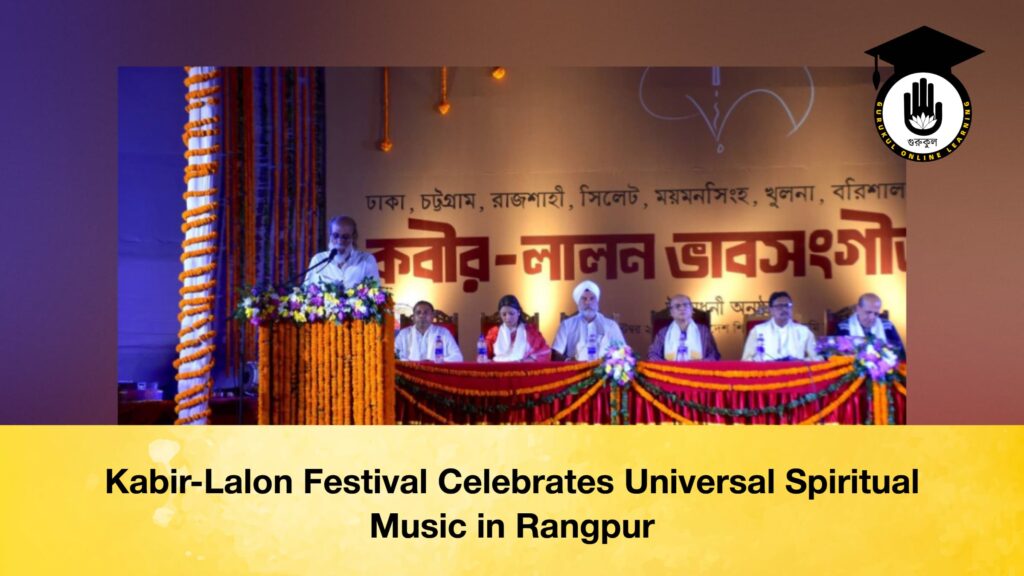
The spiritual music and humanist philosophies of Kabir and Fakir Lalon Shah have crossed the boundaries of geography and time, gaining an appeal that extends far beyond their places and periods of origin, speakers said at the sixth edition of the Kabir-Lalon Bhabsangeet Festival in Rangpur.
The festival was held on Sunday at the auditorium of Rangpur District Shilpakala Academy. Organised by Lalon Biswasangha with support from the Ministry of Cultural Affairs, the event brought together academics, cultural figures, researchers, officials and musicians to explore the shared spiritual traditions of the two influential figures.
Professor Dr Md Shawkat Ali, vice-chancellor of Begum Rokeya University, Rangpur, inaugurated the programme. In his remarks, he said the musical traditions associated with Kabir and Lalon had developed beyond the limits of a particular period or geographical region and could be regarded as a form of universal spiritual music.
He said the festival offered Bangladeshi audiences an opportunity to become acquainted with Kabir through Lalon’s music and philosophy. At the same time, presenting the two figures side by side could help audiences elsewhere gain a broader understanding of their spiritual and humanist traditions.
Rangpur Deputy Commissioner Israt Jahan attended the event as the chief guest. She said the continued public interest in Kabir and Lalon demonstrated the need for further academic research and comparative study of their lives, philosophies and spiritual traditions.
She emphasised the value of examining the two figures together, particularly as their works continue to attract interest across generations. Such comparative study, she suggested, could help deepen understanding of the ideas reflected in their music and teachings.
Rangpur Metropolitan Police Commissioner Md Mahbubur Rashid attended as a special guest. Mawlana Abdul Jalil delivered a discussion on the philosophy of Kabir and Lalon, while Abdel Mannan, chief executive of Lalon Biswasangha and a researcher of Kabir and Lalon, chaired the programme.
The festival’s second session shifted from discussion to musical performance. Under the title “From Kabir to Lalon: An Imperishable Bridge of Eternal Love”, artistes from the Kabir-Lalon Musical Mission performed 20 kalams by Kabir and Lalon.
The presentation has also been staged at earlier divisional editions of the festival, allowing audiences in different parts of the country to experience the musical traditions associated with the two spiritual thinkers.
The festival is being held across all eight divisions of Bangladesh. Its nationwide journey began in Dhaka on 11 September, with each programme combining discussions, research-based presentations and musical performances centred on the spiritual and humanist traditions of Kabir and Lalon.
Kabir, widely recognised for his devotional poetry and teachings that questioned social and religious divisions, and Lalon Shah, one of Bengal’s most influential mystic figures, are both closely associated with traditions that place human dignity, spiritual reflection and the search for truth at their centre. Their works have continued to influence music, literature and cultural thought across generations.
Following the Rangpur programme, the festival will move to Chattogram for its seventh edition. The event is scheduled for 27 October at the premises of Chattogram District Shilpakala Academy.
The concluding programme will be held on 30 October at the District Council Multipurpose Auditorium in Sreemangal, representing the Sylhet division. Through the divisional programmes, the organisers aim to bring the music and philosophies of Kabir and Lalon to audiences across the country while encouraging discussion and research on their enduring cultural legacy.